



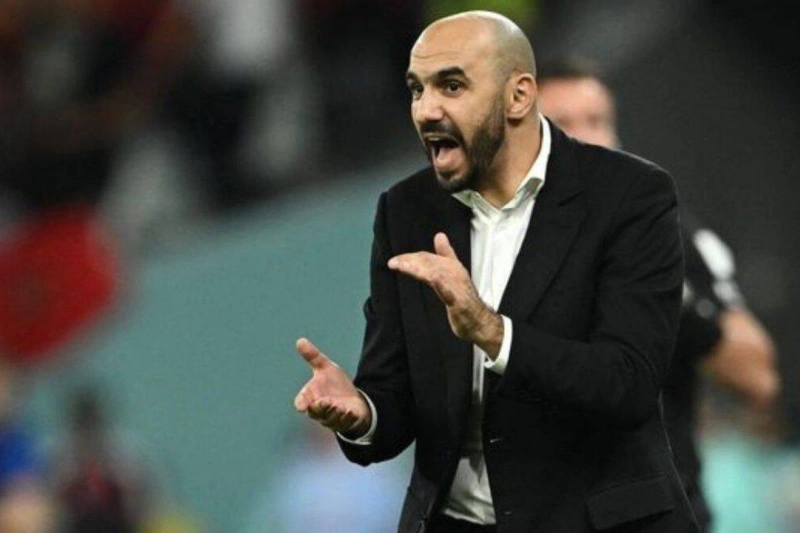

News of the Walid Regragui Morocco resignation on March 6, 2026 spread quickly through African football circles and immediately raised concern about Morocco’s preparations for the next World Cup.
Walid Regragui departs after a remarkably successful period with the Atlas Lions. During his time in charge, Morocco won 36 of the 49 matches he managed, an achievement that places him among the most effective coaches the national team has ever had.
His reputation was firmly established during the extraordinary campaign at the 2022 FIFA World Cup in Qatar, where Morocco reached the semifinals and finished fourth. No African team had ever gone that far in the tournament before.
The timing of the Walid Regragui Morocco resignation has raised immediate questions. Morocco is only months away from the 2026 FIFA World Cup, which will be hosted by the United States, Canada and Mexico.
For a team that became a symbol of African pride on the global stage, the departure of the coach who built that momentum introduces a new period of uncertainty.
Why Regragui Walked Away
The official explanation behind the Walid Regragui Morocco resignation is exhaustion, but the pressures surrounding the national team have been building for more than a year.
In the months after Morocco’s World Cup success, expectations around the team changed dramatically. Inside the country, every decision taken by the coaching staff began to attract close attention from supporters and sports commentators.
Questions also began to emerge about tactics. Morocco built its World Cup run on a compact defensive system combined with fast transitions into attack. That approach frustrated stronger opponents and produced famous victories against the Spain national football team and the Portugal national football team.
But football rarely stands still. Following the 2023 Africa Cup of Nations, several analysts suggested rival teams were beginning to read Morocco’s structure more effectively. Opponents increasingly tried to keep the ball away from Morocco’s counter attacking lanes, forcing the Atlas Lions to control possession for longer periods of the match.
That adjustment did not always suit the team’s natural rhythm, and pressure on the coaching staff continued to build.
Mohamed Ouahbi Takes Over
In response to the Walid Regragui Morocco resignation, the Royal Moroccan Football Federation moved quickly to appoint Mohamed Ouahbi as the new head coach.
Coaching transitions are not unusual in African national teams, particularly in the build-up to major tournaments. CAF’s technical development programs and analysis initiatives increasingly monitor tactical trends and coaching structures across the continent, according to the Confederation of African Football’s Technical Study Group framework.
Ouahbi arrives from Morocco’s youth development system and has worked closely with several players who are now moving into the senior national squad.
Many of these players developed in European academies across France, Spain, Belgium and the Netherlands.
The federation’s response to the Walid Regragui Morocco resignation signals a preference for continuity rather than a dramatic tactical reset.
Still, the challenge facing Ouahbi is considerable. Managing youth teams and guiding a national team at the World Cup are very different responsibilities. With the tournament approaching quickly, the new coach will have limited time to establish authority and tactical clarity.
Morocco’s Key Players
Morocco still possesses a squad filled with players competing at the highest levels of European football. Figures such as Achraf Hakimi, Sofyan Amrabat and Youssef En-Nesyri remain key pillars of the national side.
Their experience in demanding leagues across Europe has helped shape a team that is comfortable with both the physical and tactical demands of international tournaments.
What remains uncertain after the Walid Regragui Morocco resignation is whether the defensive organisation that defined Morocco’s recent success can be preserved under new leadership.
Morocco’s Own Legacy Now on the Line
The consequences of the Walid Regragui Morocco resignation are primarily Morocco’s challenge to manage.
Morocco’s remarkable campaign at the 2022 FIFA World Cup added another historic chapter to African football. But the continent’s reputation has been shaped by many teams over the years, including the achievements of the Cameroon national football team in 1990, the Senegal national football team in 2002 and the Ghana national football team in 2010.
Those moments already established that African teams can compete at the highest level of the global game.
The real question now is whether Morocco can maintain the momentum created in Qatar. With the Walid Regragui Morocco resignation, the focus shifts to how the Atlas Lions rebuild their structure and leadership before the 2026 FIFA World Cup.
In other words, the pressure belongs to Morocco itself rather than the entire continent.
2030 World Cup in The Horizon
There is also a longer strategic dimension to the discussion surrounding the Walid Regragui Morocco resignation.
Morocco will co host the 2030 FIFA World Cup alongside Spain and Portugal.
Many analysts believed the 2026 tournament would serve as the final competitive step toward that historic moment.
Instead, the Atlas Lions now enter a transitional period. How Morocco adapts after the Walid Regragui Morocco resignation may determine whether the team can sustain its position among the most respected national sides in world football.


