




A computer error at Radio Caroline’s studio in Maldon, Essex, caused the legendary British broadcaster to air a false announcement on Tuesday afternoon, 19 May, telling listeners that King Charles III had died.
The Radio Caroline false death broadcast triggered the station’s automated “Death of a Monarch” emergency protocol before staff realised what had happened and scrambled to restore normal programming.
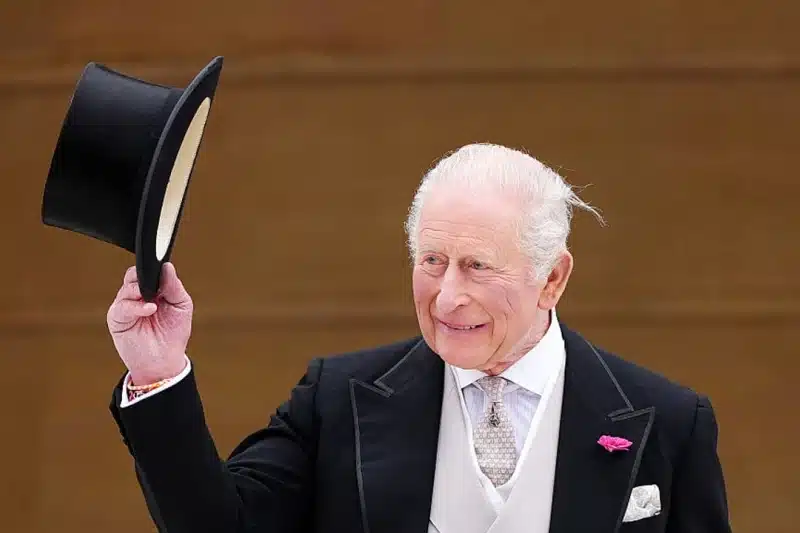
The King was alive and well at the time, visiting Northern Ireland with Queen Camilla and participating in public engagements in the town of Newcastle, County Down.
The Radio Caroline false death broadcast immediately spread across social media platforms before corrections were issued.
What the Broadcast Said
According to accounts shared publicly by the station and reported by the New Zealand Herald, the announcement began with the words: “This is Radio Caroline. We have suspended our normal programmes until further notice as a mark of formal respect following the passing of His Majesty King Charles III.”
The broadcast continued: “The news media has confirmed that His Majesty King Charles III has passed away. Consequently, as a mark of respect, Radio Caroline is suspending its normal programmes.”
The national anthem then played before the station fell silent. That silence, according to station manager Peter Moore, was what alerted staff to the error.
The Radio Caroline false death broadcast briefly convinced some listeners that an official royal announcement had been made.
“We Apologise for Any Distress Caused”
Moore posted an explanation on Facebook. “Due to a computer error at our main studio, the Death of a Monarch procedure, which all UK stations hold in readiness while hoping not to require, was accidentally activated on Tuesday afternoon (19 May), mistakenly announcing that HM the King had passed away,” he wrote.
“Radio Caroline then fell silent as would be required, which alerted us to restore programming and issue an on-air apology.”
Moore also told Newsweek that the station has since “disabled these stand-by recordings and will revert to human common sense” while investigating the root cause of the technical failure. The Radio Caroline false death broadcast, he confirmed to Newsweek, was never intended to be heard by the public.
In a separate statement, the station told listeners: “We apologise to King Charles and our listeners for any distress caused.”
Moore added a message of loyalty: “Caroline has been pleased to broadcast Her Majesty the Queen’s and now the King’s Christmas Message and we hope to do so for many years to come.”
Station executives later admitted the Radio Caroline false death broadcast should never have reached public airwaves.
Why the False Report Felt Plausible
The Radio Caroline false death broadcast caused particular alarm because of the King’s known health background.
In February 2024, Buckingham Palace announced that Charles had been diagnosed with a form of cancer, discovered during a procedure to treat an enlarged prostate. The Palace did not disclose the specific type of cancer but confirmed he had begun a schedule of regular treatments.
In December 2025, the King shared a rare video update, telling the public he was responding well and that his treatment schedule would be reduced in 2026. Buckingham Palace subsequently confirmed doctors had moved him into a “precautionary phase,” though he has not been declared in remission.
As Newsweek noted, an incorrect report of Charles’s death would feel especially alarming precisely because, given his cancer diagnosis, it would seem believable to many listeners. Public anxiety about his health, however subdued it may have become, has never fully disappeared since the 2024 diagnosis.
That background gave the Radio Caroline false death broadcast enough apparent credibility to travel rapidly across social media before the correction was made.
Every UK Broadcaster Holds This Procedure
The Radio Caroline false death broadcast also exposed how prepared UK broadcasters are for royal emergencies. Every UK radio station holds a prepared “Death of a Monarch” procedure and keeps it ready for use.
Moore’s Facebook statement made this plain, noting that the protocol is something “all UK stations hold in readiness while hoping not to require.”
Commercial radio stations use a network of blue “obit lights” connected to the Radio Alert Transmission System. When those lights flash, presenters are trained to play inoffensive music and prepare for a formal news announcement. Pre-written scripts, specially selected music, and instructions to suspend advertisements are all part of standing contingency plans.
The scale of these preparations became publicly visible in September 2022, when the death of Queen Elizabeth II activated Operation London Bridge, the codename for the comprehensive national media response to a reigning monarch’s death. BBC presenters appeared on screen in black clothing.
Rolling news coverage immediately replaced scheduled programmes across multiple channels. The Times had pre-prepared eleven days of coverage ready, and broadcasters including ITN and Sky News had long rehearsed similar scenarios.
Radio Caroline did not create an unusual system. It accidentally fired one that exists everywhere.
A Historic Station With an Unlikely Role
The fact that Radio Caroline was at the centre of this incident adds a layer of irony that helped drive the story internationally. The station’s legendary history ensured the Radio Caroline false death broadcast spread far beyond Britain before corrections were issued.
Founded on 28 March 1964 by Irish businessman Ronan O’Rahilly, Radio Caroline was launched specifically to break the BBC’s monopoly on British broadcasting. O’Rahilly broadcast from ships anchored in international waters off the Essex coast, outside the reach of British broadcasting law.
The station attracted around seven million regular daytime listeners by its first year and grew to 23 million by 1966, according to broadcaster and historian Ray Clark, who spoke to ABC News during the station’s 60th anniversary in 2024.
The BBC created Radio 1 on 30 September 1967 as a direct response to pirate radio’s popularity, hiring many of the offshore DJs to staff the new station. Radio Caroline continued offshore broadcasting until 1991, when its ship, the Ross Revenge, ran aground off the Kent coast. The station later moved to digital platforms and is today licensed and legal, broadcasting from a studio in Maldon, Essex.
A station born as a deliberate challenge to British broadcasting authority accidentally announcing the death of the reigning monarch is a collision of histories that few could have scripted.
Automation, Not Human Error
What makes the Radio Caroline false death broadcast significant beyond the embarrassment is where the fault actually lay.
Moore consistently described a “computer error,” not a lapse in human judgement. The emergency sequence was triggered automatically before any presenter or producer made a decision. Media experts described the Radio Caroline false death broadcast as a warning about automated newsroom systems.
Modern radio stations rely heavily on automated playout software, pre-scheduled broadcast macros, and digitally stored emergency sequences. Those systems are designed to activate instantly and without requiring human intervention. In the case of a genuine royal death, that speed matters. But the same architecture means a misfire can air sensitive content before anyone in the building knows it has happened.
Newsweek reported that in this particular incident the error passed largely unnoticed by a wide audience, but noted it highlights how easily a consequential mistake can occur. Media industry observers are now discussing the incident as a practical warning about the risks of fully automated emergency systems in legacy broadcasting environments.
Reaction Online
Clips from the Radio Caroline false death broadcast circulated rapidly across X, Facebook, and TikTok.
Listeners who commented on Radio Caroline’s social media post described initial shock before realising the station had made an error, according to Radio New Zealand.
Online reaction split broadly into three directions. Some listeners reported genuine alarm given the King’s health history. Others turned the incident into social media humour, drawing comparisons with famous accidental celebrity death reports from previous decades. A third group raised pointed questions about why automated systems capable of making national-level announcements are not protected by stronger safeguards.
The King Continued His Schedule
At no point did Buckingham Palace issue a formal condemnation of the broadcast. While the Radio Caroline false death broadcast circulated online, Charles and Queen Camilla joined a performance with an Irish folk group in Northern Ireland, as reported by Euronews.
That continued public visibility from the Palace helped limit the spread of genuine confusion. The King’s presence at public engagements served as the most effective correction the Palace could have made without issuing a statement.
Even after corrections were issued, the Radio Caroline false death broadcast continued trending internationally.
The Broader Lesson
A single accidental broadcast from a licensed digital radio station in Essex became international news within hours on 20 and 21 May 2026.
The Radio Caroline false death broadcast did not last long on air and caused no lasting panic. But it illustrated, with unusual clarity, how quickly misinformation spreads when it involves a monarch, how deeply embedded emergency broadcast systems are in British media, and how automated processes can produce real-world consequences faster than any human being can intervene.
For now, Radio Caroline has switched off its stand-by recordings. The investigation into what went wrong continues. The Radio Caroline false death broadcast may ultimately become a case study in modern broadcast automation failures.
Sources: Radio Caroline statement via Facebook (Peter Moore); Newsweek (Peter Moore interview); New Zealand Herald; South China Morning Post; Euronews; Radio New Zealand; The Irish Times; ABC News (Radio Caroline 60th anniversary); Buckingham Palace statements (February 2024, December 2025); NewscastStudio (Operation London Bridge, 2022)


