



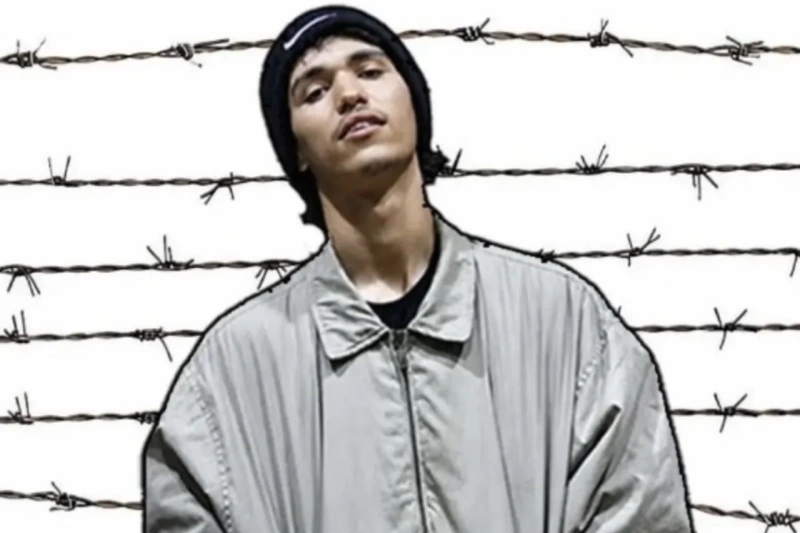

A drawing can be an act of political expression. In Morocco, caricatures of King Mohammed VI have cost 22-year-old artist Yasser Mounbir four years in prison.
A Casablanca court sentenced the graffiti artist on Friday, 30 October, after finding him guilty of insulting the king and public officials over drawings he published online. The Moroccan cartoonist was also fined 40,000 dirhams, approximately €3,600. His lawyers have announced an appeal.
The Moroccan cartoonist sentence has brought renewed attention to Morocco’s treatment of political satire and the legal boundaries placed on artistic expression when it challenges or ridicules the monarchy.
Mounbir, who has about 12,000 followers on Instagram, is known for his graffiti work and murals. The drawings at the centre of the case depicted King Mohammed VI in disguise and as an animal, according to RFI. The authorities considered them offensive.
The Moroccan cartoonist was arrested on 15 June, weeks before the trial that would end with a four-year prison sentence. Early accounts of the arrest referred to an altercation with a police officer, a version disputed by his relatives, Maroc Hebdo reported. He has remained in custody at Oukacha prison in Casablanca since then.
According to Maroc Hebdo, the proceedings extended across eighteen hearings. A national strike by lawyers left Mounbir without legal representation for part of the proceedings. His requests for provisional release were repeatedly rejected, including a final application on 21 October.
His defence team presented arguments until about 1am on 28 October, the weekly reported. The lawyers challenged both the investigation and whether the drawings met the legal requirements for the offences with which he was charged.
The legal provisions behind the sentence are central to the controversy. Article 179 of Morocco’s penal code provides prison terms of six months to two years for defamation, insult or offences against the person of the king. The penalty can be doubled when the offence is committed electronically. This provision allows for a potential four-year sentence in cases involving online publication, although Mounbir was also convicted of insulting public officials. The precise contribution of each offence to the final sentence should not be assumed.
The case also raises questions about Morocco’s obligations under international freedom-of-expression standards. The country is a party to the International Covenant on Civil and Political Rights, whose Article 19 protects the right to express and communicate ideas, including through artistic forms.
In its General Comment No. 34, the UN Human Rights Committee states that the fact that expression is considered insulting to a public figure is not, by itself, sufficient reason to impose penalties. It specifically recognises that even heads of state and government are legitimate subjects of criticism and political opposition. The committee has also expressed concern about laws that criminalise disrespect for authority or defamation of the head of state.
These standards do not make every form of expression immune from legitimate legal restrictions. They do, however, place particular importance on protecting political debate and require restrictions to meet tests of necessity and proportionality. The sentence against the Moroccan cartoonist therefore raises a wider question about whether imprisonment is a proportionate response to political caricature.
“Criticising power is not a crime,” said Hakim Sikouk, head of the Rabat branch of the Moroccan Association for Human Rights, as quoted by Maroc Hebdo. The association has called for Mounbir’s release. Several hundred people also signed a petition demanding his freedom during the summer.
His lawyers, Farouk Mehdaoui and Sara Soujar, described the sentence as disproportionate and a serious blow to creative freedom, RFI reported. Their argument touches on a wider question about the place of satire in public life: whether an artistic work should attract criminal punishment simply because it mocks, shocks or offends those in positions of power.
Political caricature has long been used to question authority, expose contradictions and challenge public figures. When such expression carries the risk of imprisonment, the consequences can extend beyond the individual artist. Other cartoonists, illustrators, writers and commentators may become more cautious about addressing subjects involving those in power. The criminalisation of satire can therefore affect the wider space available for political expression, even beyond the person facing prosecution.
Morocco has faced similar controversies before. In 2009, cartoonist Khalid Gueddar and newspaper editor Taoufik Bouachrine received four-year suspended prison sentences and substantial financial penalties over a cartoon involving a member of the royal family. Human Rights Watch documented the case, which also led to the newspaper being kept off the stands and its offices sealed for a period.
The case of Ali Lmrabet, editor of the satirical publications Demain and Doumane, offers another comparison. In May 2003, he was sentenced to four years in prison for offences including insulting the king and undermining the monarchy. An appeal court reduced the sentence to three years, and King Mohammed VI pardoned him in January 2004, after he had spent more than seven months in detention.
More recently, Saïd Boukioud received a five-year prison sentence in 2023 over Facebook posts critical of Morocco’s normalisation of relations with Israel. His sentence was reduced to three years on appeal, Maroc Hebdo reported. These cases illustrate how criminal proceedings involving expression about the monarchy and other politically sensitive subjects have continued across different forms of media.
The prosecution of Gueddar involved a newspaper cartoon, while Lmrabet’s case centred on satirical journalism. Mounbir’s work circulated through Instagram. The platforms have changed, but the prosecution of the Moroccan cartoonist shows that the legal questions surrounding criticism, ridicule and political expression remain unresolved.
The distinction matters because political satire does not operate like ordinary reporting. A caricature uses exaggeration, distortion and humour to communicate an idea. Its purpose may be to provoke, ridicule or challenge the authority of its subject. Treating offence as sufficient grounds for imprisonment risks turning the personal reaction of those in power into a limit on artistic expression.
The appeal court in Casablanca has not yet set a date. Until then, the Moroccan cartoonist remains at Oukacha prison, where he has been held since his arrest in June.
The case leaves a question extending beyond Mounbir himself: how much room does political satire have when ridiculing the most powerful institution in a country can result in years behind bars? A drawing takes seconds to publish. Mounbir has spent more than four months in custody for his work and now faces a four-year prison sentence.


