




AfricanQuarters.co / Maiduguri / 16 May 2026
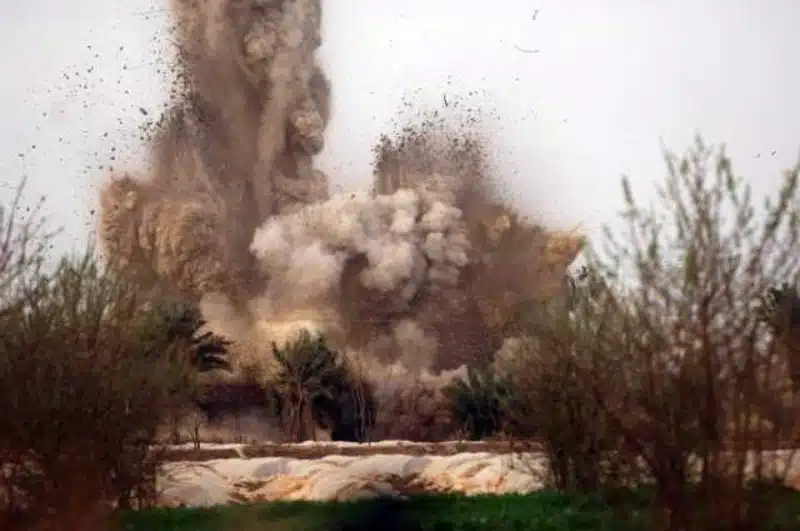
Six suspected militants died on Friday morning after an explosion ripped through what regional intelligence operatives described as an improvised explosive device (IED) assembly site linked to a senior ISWAP bomb maker network operating in Marte Local Government Area of Borno State, northeastern Nigeria.
The blast occurred around 7:00 AM local time. According to regional security sources, the militants were assembling explosives inside the facility when the device detonated prematurely.
The incident came within hours of President Donald Trump announcing, via Truth Social, that United States and Nigerian forces had killed Abu-Bilal al-Minuki, described as the global second-in-command of ISIS, in a joint operation on Nigerian soil.
The ISWAP Bomb Maker at the Centre of the Story
The most significant loss in Friday’s blast, according to regional intelligence operatives, was Abu Umar, identified as one of ISWAP’s most experienced explosives technicians and the group’s leading ISWAP bomb maker along the Lake Chad axis.
Security sources say Abu Umar specialised in assembling vehicle-borne devices and roadside IEDs. He was also reportedly linked to recent explosive attacks on military convoys and supply routes in Borno State, and had been training younger operatives in advanced bomb construction.
His death is expected to set back ISWAP’s ability to manufacture and deploy sophisticated devices at scale, at least in the short term.
It is important to note that the Nigerian military had not issued any public statement on Abu Umar or the Marte explosion at the time of publication. The details in this report are drawn from regional intelligence operatives and security sources who were not authorised to speak on record.
Why Marte Matters
Marte is not a random location. The town sits at a junction of critical access routes linking northern Borno to the Lake Chad islands, a zone ISWAP has long used for weapons movement, cross-border mobility between Nigeria, Niger, Chad and Cameroon, and fighter recruitment.
As recently as May 2025, ISWAP launched what analysts described as its most sophisticated assault in recent memory through Marte, dislodging Nigerian military forces using drones and high-mobility tactics before seizing the town and exploiting its proximity to Lake Chad smuggling corridors.
The International Crisis Group documented ISWAP raids on army bases in the Marte and Kala Balge areas in May 2025 that killed ten soldiers.
In March 2026, ISWAP fighters struck military positions across Borno State in a single coordinated wave, hitting Konduga, Mainok, Jakana and Marte within hours of each other. The group had publicly framed this offensive as its “burning of the camps” campaign, a stated strategy of grinding down Nigerian military formations through sustained, simultaneous pressure.
Maintaining infrastructure for an experienced ISWAP bomb maker network in Marte gives the group direct supply lines to some of its most active attack corridors.
What the Loss of a Senior ISWAP Bomb Maker Means
Security analysts say losing trained explosives engineers hurts insurgent groups more deeply than losing rank-and-file fighters. Expertise of the kind Abu Umar reportedly possessed, including knowledge of pressure-triggered devices and remote-detonation systems capable of evading military detection, takes years to develop.
Defence analyst and former army bomb technician Dr. Idris Khalid told TruthNigeria that ISWAP has spent years refining its IED techniques, with devices typically pressure-activated and deliberately designed around known civilian and military travel patterns.
Every experienced ISWAP bomb maker who dies in the field represents a gap that cannot be filled quickly. Replacing someone of Abu Umar’s reported seniority requires not just technical knowledge but the operational trust and network connections to move materials, train recruits and evade surveillance simultaneously.
The Bigger Context: ISIS Global No. 2 Killed the Same Day
Friday’s Marte blast followed directly on news of a far higher-profile loss for the wider ISIS network.
Trump wrote on Truth Social that “brave American forces and the Armed Forces of Nigeria flawlessly executed a meticulously planned and very complex mission to eliminate the most active terrorist in the world from the battlefield,” announcing the killing of Abu-Bilal al-Minuki, whom he named as the second-in-command of ISIS globally.
According to the Counter Extremism Project, al-Minuki served as a senior commander within ISWAP and oversaw operations for the Lake Chad division under ISIS’s General Directorate of Provinces, the administrative body that provides operational guidance and financing to the group’s affiliates worldwide.
The US State Department had designated al-Minuki a Specially Designated Global Terrorist in June 2023, citing his role in coordinating international funding and operational support for ISIS-affiliated cells across Africa and beyond.
Trump thanked the Nigerian government for its partnership in the operation but did not disclose the precise location of the strike. The US had already deployed hundreds of troops to Nigeria to provide technical support and intelligence sharing, and carried out an airstrike against ISWAP fighters in Sokoto State on Christmas Day 2025.
Two Blows, Two Levels
What makes Friday, 16 May 2026 worth noting is the combination. The killing of al-Minuki removed a figure who, according to the Counter Extremism Project, controlled logistics, planning and financing across ISIS’s entire African theatre. The death of an experienced ISWAP bomb maker of Abu Umar’s seniority, on the same day, removed someone who translated those resources into actual weapons on the ground.
Together, the two losses strike ISWAP at the strategic and operational levels within hours of each other.
Regional analysts caution, however, that ISWAP has shown consistent resilience after leadership losses. The group sustains its operations through ransom payments, taxation of local populations, extortion and cross-border smuggling, funding models that do not depend on any single individual.
Governor Babagana Umara Zulum of Borno State has previously warned Nigeria’s defence minister and military chiefs that ISWAP is entrenching itself in the Lake Chad islands, Sambisa Forest and the Mandara mountains along the Cameroon border, exploiting military setbacks to consolidate territory.
The IED Campaign Has Escalated in 2026
The broader context for Friday’s explosion is a sharp escalation in IED use across Borno State this year.
ISWAP claimed responsibility via Telegram for an IED attack near Rann in Kala-Balge LGA in late April 2026 that killed at least 26 people, including women and children, when a truck struck a buried device. The initial death toll of 17 rose as more bodies were recovered from surrounding bush over subsequent days.
Human Rights Watch documented a resurgence of suicide bombings in the region in 2024 and into 2025, noting that ISWAP increasingly favours targeted attacks on security agencies and military installations rather than mass civilian casualties, a strategic shift from the original Boko Haram playbook.
TheCable’s documentation of the insurgency shows ISWAP intensified its operations through 2025 and 2026 under a stated campaign designed to systematically weaken Nigerian military formations across Borno State.
No Final Victory Yet
For Nigerian security forces, Friday’s events offer real but incomplete progress. An ISWAP bomb maker with years of irreplaceable expertise is gone. A man described by the United States government as ISIS’s second-in-command globally is gone. The Marte bomb-making facility has been destroyed.
But the insurgency is not.
ISWAP maintains decentralised cells, cross-border recruitment pipelines, and the financial infrastructure to rebuild after tactical losses. The group’s May 2025 assault on Marte itself demonstrated it can seize and hold strategic terrain even against a reinforced military presence. That structure also allows the group to rapidly identify replacement personnel whenever an ISWAP bomb maker or field commander is lost.
What Friday’s twin setbacks may force, analysts say, is a period of tactical recalibration. Reduced movement along high-risk corridors. A temporary shift toward smaller-scale attacks. A scramble to identify and promote the next ISWAP bomb maker capable of running a facility like the one that no longer exists in Marte.
That search is now under way.
Reporting draws on regional intelligence operatives, security sources in northeastern Nigeria, statements by the US President on Truth Social, reporting by Reuters, Al Jazeera, HumAngle, TruthNigeria, TheCable, the International Crisis Group and the Counter Extremism Project. The Nigerian military had not issued a public statement on the explosion that killed the senior ISWAP bomb maker at the time of publication.


