



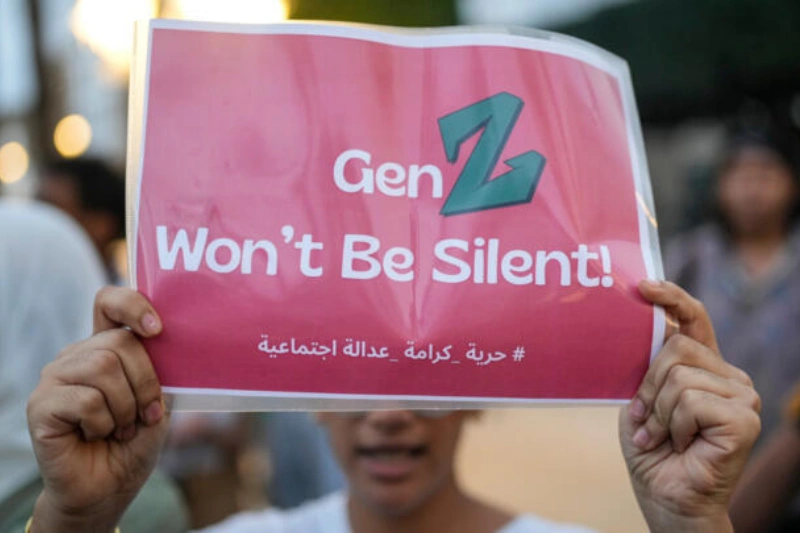

That silence says more than any chant did a year ago.
The GenZ 212 movement pulled hundreds of thousands of Moroccans onto the streets in the autumn of 2025. It has largely gone offline since. Its energy has shifted from Discord servers to voter rolls. Nobody yet knows if that shift will hold.
The GenZ 212 movement began small. Four anonymous users launched a Discord server on 18 September 2025. Fewer than 1,000 people joined at first.
Within three weeks the server had swelled past 250,000 members. It became the digital engine behind the largest youth protests Morocco had seen since the Arab Spring.
The trigger was specific and devastating. Eight women died during caesarean sections at the Hassan II public hospital in Agadir. Anger over that failure fused with years of frustration over underfunded schools, joblessness and government spending on football stadiums ahead of the 2030 World Cup. “Hospitals before stadiums” became the rallying cry.
For three weeks, from 27 September to 18 October, demonstrations spread from Rabat to Casablanca, Marrakesh and smaller towns rarely touched by national politics. The state response was forceful.
Three protesters were killed. Hundreds more were injured. The Moroccan Association of Human Rights reported that well over 2,000 people were arrested, with nearly 600 jailed or facing trial.
The government’s counter move was money. Days after the worst of the unrest, the royal cabinet pledged close to fifteen billion dollars for health and education in the 2026 budget, a sixteen per cent rise. It promised 27,000 new jobs across both sectors.
What the GenZ 212 movement actually wanted, though, was the resignation of Prime Minister Aziz Akhannouch. That demand was never met.
This is where the real story begins, past the headlines about protest and crackdown.
A movement that shook a government in three weeks could not, in the end, remove a single minister.
King Mohammed VI acknowledged social grievances in his October speech. He named no names. He sacked nobody. The GenZ 212 movement won budget lines. It did not win accountability.
A year on, the gap between concession and consequence is being tested at the ballot box. Wednesday’s election is the first national vote since the GenZ 212 movement erupted and offers the clearest measure yet of whether protest energy can translate into political participation.
Voters elect all 395 seats in the House of Representatives on 23 September, the first national vote since the protests began. It is being framed, fairly or not, as Morocco’s answer to a generation that once flooded its streets.
The numbers suggest the answer may be silence again, just of a different kind. Data reported by Atalayar showed that registered voters aged 18 to 24, the age bracket that built the GenZ 212 movement, have fallen from eight per cent to four per cent of the electorate.
The 25 to 44 bracket has slipped from nineteen per cent to fifteen per cent. The Justice and Charity Group, an influential Islamist movement, announced its own boycott of the vote on 9 September. That added an organised absence to what was already a drift away from the polls.
That contrast is telling. A generation loud enough to fill Discord servers with a quarter of a million members in three weeks is now the demographic least likely to show up and vote. Anger, it turns out, travels faster online than it does to a polling station. Recent reporting has found that only a small share of younger Moroccans have registered to vote despite making up a far larger share of the population.
There has also been a quieter cost to the GenZ 212 movement. Arrests linked to it did not stop when the protests ended.
Between 1 and 15 February 2026, activists in Casablanca, Marrakesh and Tiznit were detained or prosecuted, some over social media posts made months earlier. One organiser, Zineb El Kharroubi, the Civicus Monitor recorded, was arrested at Marrakesh Menara Airport on her return from France. The message to anyone thinking of marching again was not subtle.
“The arrests created a climate of fear among young activists,” Civicus noted in its monitoring of post-protest detentions.
Whether the GenZ 212 movement resurfaces after the election depends on Wednesday’s result. If Akhannouch’s coalition, the National Rally of Independents, holds its 102 seats or close to it, the calculation that budget concessions can substitute for political change will look vindicated.
If youth turnout defies the registration numbers and punishes the ruling coalition, Morocco’s political class may finally have to answer the question protesters asked outside empty hospital wards a year ago. Whose priorities actually come first.
For many young Moroccans, the election will be the first real test of whether the GenZ 212 movement can evolve from a protest network into a lasting political force.
For now, Morocco is choosing between two forms of protest. One filled the streets and got arrested for it. The other, quieter than the GenZ 212 movement ever was, simply might not turn up at all.


