



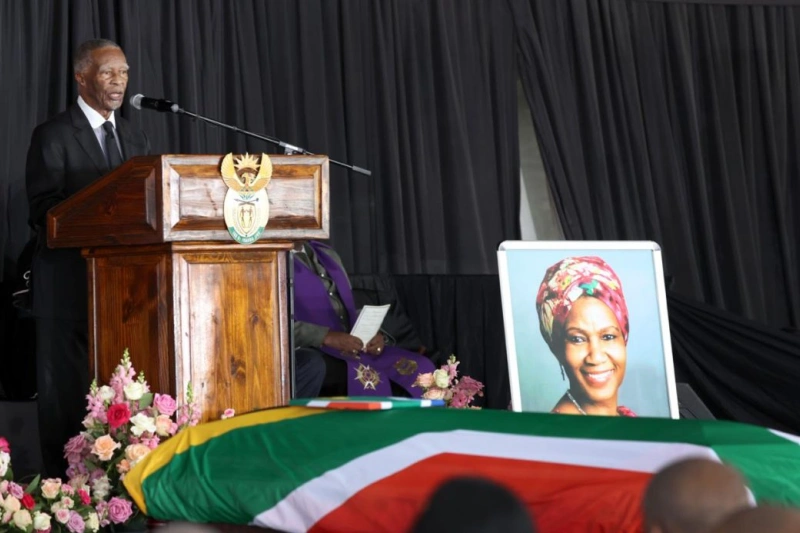

Thabo Mbeki came to bury his former deputy and ended up putting a question to his own party.
He was speaking at the state funeral of Phumzile Mlambo-Ngcuka in eXesi, Eastern Cape, on Saturday. The former president turned his tribute into a hard look at the ANC’s electoral decline.
President Cyril Ramaphosa then rose to deliver the eulogy. He told mourners he would not take the argument on there.
The exchange brought two men who have led the ANC into an unusually public disagreement. It came a day after the party’s secretary-general told Mbeki to stop criticising the leadership in public.
Mlambo-Ngcuka died on 20 November, aged 71, after complications from a medical procedure. She was South Africa’s first woman deputy president, a post Mbeki gave her in 2005.
That history shaped what he said. The 2004 general election was the last national contest in which she had been politically involved, and the ANC won almost 70% of the vote.
Mbeki walked mourners through the party’s declining support in four numbers. By his count, support fell to 57% in 2019, 40% in 2024 and 30% in 2026. Inside Politics reported that he said Mlambo-Ngcuka would have wept to see the masses desert the party.
“What have we done wrong?” he asked, voicing the question he believed she would have put to herself.
He said the party still owed her an honest answer for its shrinking support. He also offered a cause. Inside Politics reported that he told the service the forces that fought the ANC for decades never gave up after 1994. Their aim, he said, stayed the same.
Ramaphosa did not engage Mbeki’s argument directly. He agreed that Mbeki had raised important issues about the party’s losses but said they belonged inside the ANC. The discussion, he said, should begin with where the party’s problems started and be “as truthful as we possibly can”.
He did not say which period he had in mind. That is where the numbers get uncomfortable for both men.
Electoral Commission figures trace the ANC’s electoral decline step by step. The party peaked at 69.69% in 2004 under Mbeki. It slipped to 65.90% in 2009, months after the party recalled him as president. It fell to 62.15% in 2014 with Jacob Zuma in office. In 2019, Ramaphosa’s first general election as leader, it dropped to 57.50%, and then to 40.18% in 2024.
Neither man owns a clean record in that sequence. The ANC’s electoral decline began before Ramaphosa. The steepest fall came on his watch.
One caution on Mbeki’s last figure. It comes from municipal polls, not a national contest. The ANC won 30.76% in the 4 November local elections, down from 45.59% in 2021, on a turnout of about 52%.
Even so, a like-for-like fall of almost 15 percentage points is a heavy blow. It also shows how far the slide has reached down to town and city halls. Daily Maverick reported that 140 of the 213 councils ended up hung, against 70 in 2021.
This was not Mbeki’s first intervention on the ANC’s electoral decline since the election. On 9 November, he told Mbuyiseni Ndlozi’s African Renaissance Podcast that in democracies, leaders hit by a disaster of this kind “take responsibility.
He was reacting to a Sunday Times report that Ramaphosa had offered to resign. Ramaphosa dismissed it and asked who came up with such a rumour. Mbeki added that he sits on the national executive himself, and that the top seven should look hard at their own responsibility.
Fikile Mbalula answered on Friday, after a special meeting of the national executive. Mbeki should bring his proposals to that body, he said, because an ANC stalwart cannot “attack the ANC in public”.
The party, he added, must examine the ANC’s electoral decline honestly, through its own structures.
So both sides say the party’s poor performance must be examined. The dispute is over where, by whom and from what starting point.
Mbeki wants the leadership to own the failure and has suggested that the top seven should consider stepping down. Ramaphosa wants a reckoning that begins with the origins of the problem, a phrase that can point in more than one direction.
The clock matters too. Mbalula himself warned against turning the debate into a contest over positions ahead of the ANC’s 2027 elective conference. Yet with every public exchange, that is what it risks becoming.
Even on the day of the clash, the two men found common ground. Both said the ANC and the country need more leaders like Mlambo-Ngcuka.
She was laid to rest at home in eXesi on Saturday. The question about the ANC’s electoral decline asked in her name is still waiting for an answer.


