




Ghana’s mineral export restrictions come with firm deadlines, but their legal foundations and practical implications are less settled.
The date attracting the most attention is 2028. It covers one category of gold: output from artisanal and small-scale mines. Under the 2027 budget, at least 70 per cent of this gold must be refined locally by December 2027. By December 2028, the target rises to 100 per cent, when exports of raw small-scale mining gold are due to stop.
The wider mineral export restrictions follow a different timetable. Ghana intends to process at least half of its manganese and bauxite production locally by the end of 2028. By the end of 2030, all of both minerals must be processed domestically, with raw exports prohibited.
These mineral export restrictions therefore come in two waves. The 2028 deadline is not a blanket ban on all raw mineral exports.
Lands Minister Emmanuel Armah-Kofi Buah made the government’s ambition clear at a Trades Union Congress event in Accra, as Graphic Online reported. Ghana, he said, wants to “refine, process and manufacture our minerals at home.” The government has committed $1.5 billion to processing facilities covering gold, manganese, bauxite and lithium.
President John Mahama has also directed his message at investors. Speaking at the Mining in Motion conference on 19 October, he said: “Investors must understand the processing obligations associated with access to our resources.”
But there is an important distinction between an announced policy and an enforceable legal obligation.
Ghana already has legislation regulating gold purchases, refining and exports. The Ghana Gold Board Act, 2025, gives GoldBod authority over the gold trade, and the board has directed that gold doré purchased under approved offtake arrangements must be refined locally before export, effective 1 September 2026.
The wider mineral export restrictions, however, require further legal and regulatory work. The Minerals and Mining Bill, laid before Parliament on 26 May, would empower the minister to prohibit raw mineral exports through a separate legislative instrument. The proposed framework does not itself establish all the deadlines announced by the government. Those targets will need appropriate implementing measures.
The political calendar adds another uncertainty. Mahama’s current term ends in January 2029, and the constitution prevents him from seeking another consecutive term. Ghanaians will elect his successor in 2028, the same year the gold export deadline takes effect. The proposed 2030 restrictions on manganese and bauxite will therefore fall to a successor’s administration to implement.
That is the central tension. The government has announced ambitious and dated commitments, but the legal instruments, infrastructure and investment arrangements needed to deliver them are still developing.
For investors, mineral export restrictions raise questions about the future operating environment and the cost of meeting new processing requirements. Large gold producers already convert ore into doré at mine sites, so the proposed restriction on raw small-scale gold exports has different implications for them. Manganese and bauxite producers face a more substantial adjustment because much of what Ghana currently exports leaves the country as ore.
Mining contracts are another source of concern. Stability agreements protect specified fiscal and regulatory terms for periods of up to 15 years. Government officials have indicated that existing agreements will not simply be renewed under the old arrangements. The proposed mining legislation also raises questions about how those protections will be handled in future agreements.
The Ghana Chamber of Mines supports a review but has expressed reservations about abolishing stability protections outright. Mining companies argue that large upfront investments require predictable rules over long periods.
The mineral export restrictions do not automatically cancel existing signed agreements. The more immediate pressure is likely to arise when leases and associated agreements come up for renewal.
The Damang mine reverted to the state after Gold Fields’ lease expired in April 2025. The Tarkwa lease is due for renewal in 2027, and Minerals Commission chief executive Isaac Andrews Tandoh has indicated that renewal will not be business as usual. How the government handles these cases will offer investors an early indication of its approach.
Lithium could provide another test. Ghana’s first ratified lithium mining lease, for the Ewoyaa project, is designed around the production of spodumene concentrate. That is already a processed mineral product, but it is not the same as the battery-grade chemicals the government ultimately wants to manufacture locally.
The government has yet to provide sufficient public clarity on whether spodumene concentrate will satisfy its definition of local processing. The distinction matters because companies need to know what level of domestic value addition their licences and export approvals will require. The proposed mineral export restrictions leave this question open.
For artisanal and small-scale miners, however, the immediate challenge is less about legal interpretation than refining capacity and cost. The mineral export restrictions could have their most direct effect on this group because its gold will have to pass through domestic refining arrangements before export.
Small-scale gold production reached a record 104 tonnes in 2025, overtaking output from large-scale mines for the first time. GoldBod chief executive Sammy Gyamfi has put the sector’s foreign exchange earnings at approximately $10.8 billion.
GoldBod has been the sole legal exporter of small-scale mining gold since it began full operations in May 2025. Its local refining arrangements are therefore central to the government’s plans.
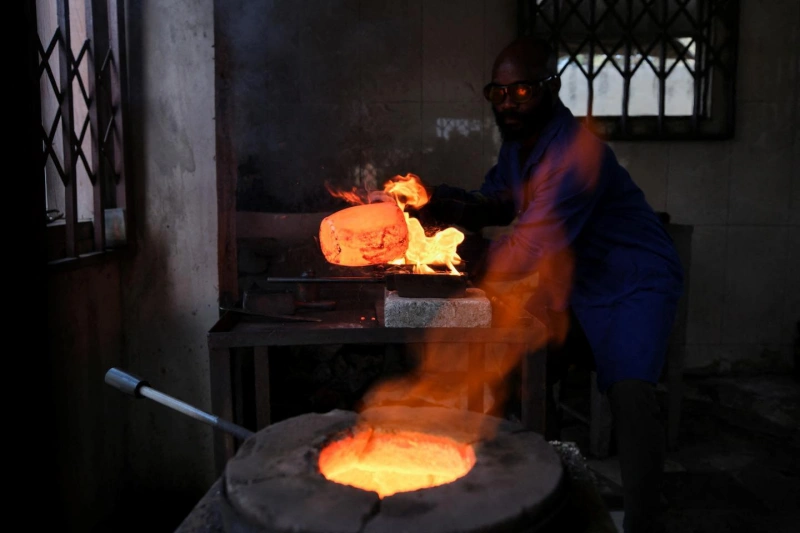
The board has signed agreements with Gold Coast Refinery and Royal Ghana Gold Refinery. Lands Minister Buah said each facility could refine up to one tonne of gold weekly. On that stated capacity, their combined potential throughput would be approximately 104 tonnes annually.
That is roughly equivalent to the entire small-scale gold output recorded in 2025. But rated capacity is not the same as actual production. Refining schedules, equipment availability, logistics, financing and the quality of the gold supplied all affect how much the facilities can process. GoldBod’s own public statements have also distinguished between the refineries’ potential capacity and the volumes actually being processed.
There are signs of progress. GoldBod reported that 5.4 tonnes of the 5.7 tonnes of small-scale gold it purchased in October 2026 were refined locally, representing 94.6 per cent. The figure suggests that the existing arrangements are already handling substantial volumes, although sustaining that performance as production grows will require reliable capacity and wider market access.
Steve Manteaw, co-chair of the Ghana Extractive Industries Transparency Initiative, has described the target as achievable but questioned the absence of a clear implementation roadmap. His concern is not simply whether Ghana can refine its gold, but how the government intends to expand capacity and organise the transition.
Cost is another pressure point. The 2027 budget proposes a three per cent discount on small-scale gold purchases. Although local refining adds value, the costs must be absorbed somewhere in the supply chain. Depending on how purchasing arrangements are structured, miners, aggregators or their commercial partners could bear part of the burden.
The Association of Small-Scale Miners has acknowledged that refining comes with additional costs. Its communications director, Abdul Razak Alhassan, has urged the public to consider the jobs and economic value that domestic refining could generate.
That argument has merit, but the distribution of those benefits matters. A policy that creates refinery jobs and increases export earnings while squeezing the margins of small-scale miners could generate resistance, particularly if miners have little influence over refining charges and purchasing prices.
For miners, the question is straightforward: who pays for the difference between the country’s existing refining arrangements and the capacity required to meet the government’s targets? The mineral export restrictions will be judged not only by how much gold Ghana processes locally, but also by whether small-scale producers can remain commercially viable.
Ghana’s mineral export restrictions are ultimately a test of industrial planning, not just export control. The government must provide the legal certainty, investment, infrastructure and transparent pricing arrangements needed to make local processing commercially viable.
A deadline can be announced in a day. A refinery takes years to build, equip and operate efficiently. Ghana’s miners and investors will be watching to see whether the capacity arrives before the restrictions do.


