



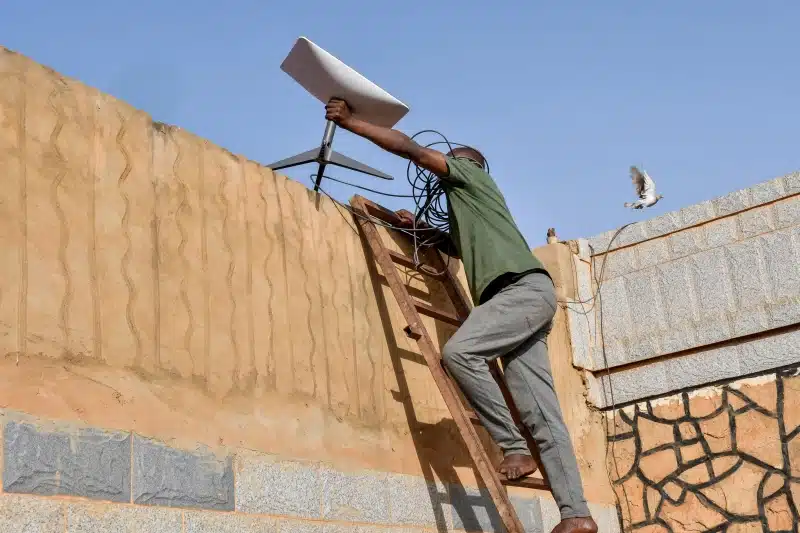

Senegal’s Supreme Court has ordered a temporary suspension of the Starlink Senegal licence.
The move unsettles a satellite internet rollout that had only gone live seven months earlier.
The ruling was delivered on Monday, 7 September. It followed a legal challenge from Sonatel, the country’s dominant telecoms operator.
Sonatel argues that the terms under which the Starlink Senegal licence was granted could damage its economic interests. It says the arrangement also undermines fair competition and weakens its rights of defence in the dispute.
According to the Senegalese Press Agency, APS, the disagreement centres on ministerial order number 038974. It was signed on 6 November 2025 by the then communication minister, Alioune Sall.
That order authorised Starlink Senegal SUARL, a subsidiary of Elon Musk’s SpaceX, to run a fixed satellite internet access service. The licence runs for five years and is renewable.
Sonatel first raised its objections through a formal complaint to the telecommunications ministry on 10 March 2026. It escalated the matter to the Supreme Court only after that complaint stalled.
The operator holds what it describes as a first-rank individual licence. It says it has paid heavily for that status, including around 100 billion CFA francs in dues and a further 34.5 billion CFA francs for its 5G spectrum.
Sonatel contends that obligations covering nationwide coverage, universal service, and continuity of service were not matched by comparable conditions attached to the Starlink Senegal licence.
The court’s decision is provisional rather than final. It does not cancel the Starlink Senegal licence outright, nor does it settle whether the original authorisation was lawful.
The ruling simply freezes the licence’s legal effects. Judges must still examine Sonatel’s underlying challenge in full, a process that could run for months.
Starlink began commercial service in Senegal in February 2026, shortly after Musk confirmed the rollout on X. The government, Space in Africa reports, had separately negotiated preferential terms for 5,000 Starlink kits.
Officials told the National Assembly the arrangement was expected to save the state around 64 billion CFA francs, roughly 114.7 million US dollars. Part of the plan tied to the Starlink Senegal licence involved free internet access for about one million Senegalese during the first half of 2026.
That promise is now in doubt. Space in Africa’s reporting, citing DataReportal figures, notes that close to 40 percent of Senegal’s population remained offline at the end of 2025, despite mobile connections outnumbering residents.
Communities in remote villages face losing access while the case proceeds. Starlink had often been the only realistic option for connectivity in those areas, supporting remote work, e-learning, telemedicine, and digital commerce.
The Starlink Senegal licence dispute also arrives against a backdrop of earlier friction with regulators. Authorities took action against informal sales of Starlink equipment as far back as 2023, before the company held any authorisation.
After the service launched, the telecoms regulator warned in March 2026 about unauthorised community wifi hotspots reselling Starlink connections. It cautioned that offenders could face up to five years in prison and fines reaching 60 million CFA francs.
Further arrests followed in Kaolack in August 2026, reportedly after a complaint from Sonatel itself.
For now, both sides are left waiting. Sonatel has secured a temporary win, but the fight over the Starlink Senegal licence is far from settled.
The Supreme Court’s eventual ruling on the merits will decide whether satellite internet keeps its place in Senegal’s telecoms market.


