



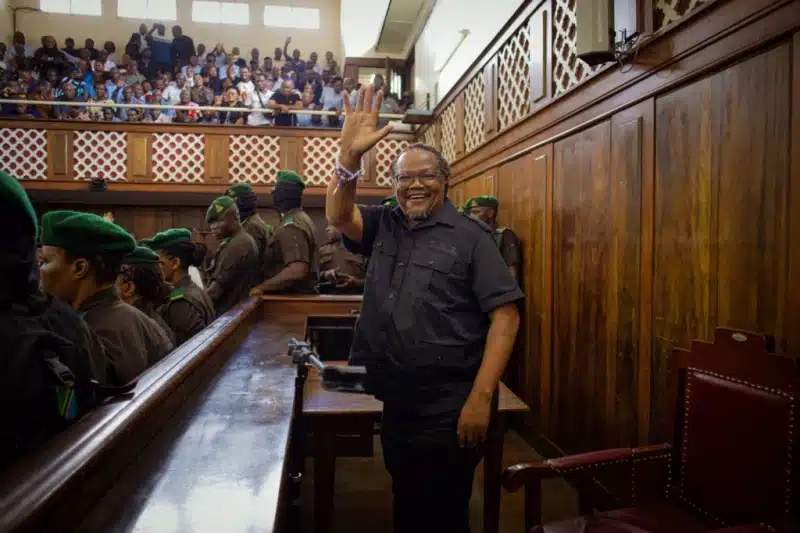

Tundu Lissu conviction came after 577 days in custody facing a possible death sentence.
On Friday, a Tanzanian court acquitted the Chadema chairman of treason. Then it jailed him for four years for incitement, an offence not on the original charge sheet.
The High Court in Dar es Salaam acquitted the Chadema chairman of treason on 6 November. Its three judges said prosecutors had not proved he intended to intimidate the government, according to The Chanzo’s courtroom report.
Then they reached for another law.
Justice Dunstan Ndunguru told the court that Section 319 of the Criminal Procedure Act lets judges convict on a lesser offence. That holds even when it was not charged separately. Using that power, he found Lissu guilty of incitement under Section 390 of the Penal Code, The Citizen reported.
The court’s defence of the Tundu Lissu conviction starts with that statute. The judges also described incitement as a “cognate” offence, meaning it was sufficiently related to the original charge to be considered under that procedure. They said the trial evidence had centred on his words, so he had notice and a chance to answer.
Lissu rejects that. In The Chanzo’s account, he told the judges “I was not charged with incitement” before insisting he was completely innocent.
To see why the Tundu Lissu conviction matters, follow the timeline.
Lissu spoke at a Chadema meeting in Dar es Salaam on 3 April 2025, during the party’s “No Reforms, No Election” campaign. Amnesty International says police arrested him on 9 April after a rally in Mbinga. He was charged with treason the next day.
Treason carries the death penalty. It is also not bailable. So he stayed in prison.
The Chanzo reports that prosecutors called 17 witnesses, while Lissu defended himself, testified and called four others. In his closing argument in September, he maintained that a treason case could end only in conviction or acquittal.
The verdict gave him a third outcome.
The American Bar Association Center for Human Rights says the Tundu Lissu conviction raises serious questions. Did he have adequate notice? Did he get a meaningful chance to prepare a defence? Mr Massawe, a lawyer quoted by The Citizen, makes a similar point and adds an oddity on bail. Lissu waited 577 days in remand on a non-bailable charge, he notes, before being convicted of a bailable one.
The sentence raised its own questions. Section 390 sets no penalty of its own. Section 35 of the Penal Code allows up to five years, a fine or both, The Chanzo explains.
Ndunguru accepted that a fine is usually the first option. He chose prison, citing Article 30(1) of the Constitution, which protects other people’s rights. The Chanzo notes that the court did not say how Lissu’s 577 days will count against the four years.
The election hangs over all of it. State Attorney Nassoro Katuga asked for a deterrent sentence and pointed to retired Chief Justice Mohamed Chande Othman’s presentation on the October 2025 violence. Lissu objected. Chande had not testified, he said, and the killings came months after he was jailed.
He had indeed been in custody since April, some six months before polling day. The Chande presentation reported 518 deaths, a figure it said was not final. Chadema puts the toll nearer 2,000, which the United Nations has said it cannot verify.
The Tundu Lissu conviction is not a finding that he caused those deaths. The Chanzo notes that the court announced no such finding.
There is a tension inside the Tundu Lissu conviction itself. The panel said provocative speeches seeking political change do not necessarily amount to a crime. Yet it held that his words crossed the line into encouraging the obstruction of an election by non-peaceful means.
Amnesty International regional director Tigere Chagutah said Lissu “should never have been arrested, let alone prosecuted and convicted.” The group wants the Tundu Lissu conviction quashed and his release.
Chadema spokesperson Brenda Rupia says Lissu will appeal. His lawyer, Rugemeleza Nshala, says the defence will also apply for bail. Any appeal against the Tundu Lissu conviction would go to the Court of Appeal.
The Tundu Lissu conviction also landed in the middle of a family bereavement. Lissu’s elder brother, Alute Mughwai Lissu, died on 1 November. Lissu pleaded with the court: “Please, let me go and lay Mzee Alute to rest.” The Chanzo says the burial is set for 10 November in Mahambe village, Singida, and the court announced no bail.
A court can lawfully swap one charge for another. Can it do so fairly, after 577 days and a defence built for a different case? That is the question the Tundu Lissu conviction now hands to the judges above it.


