



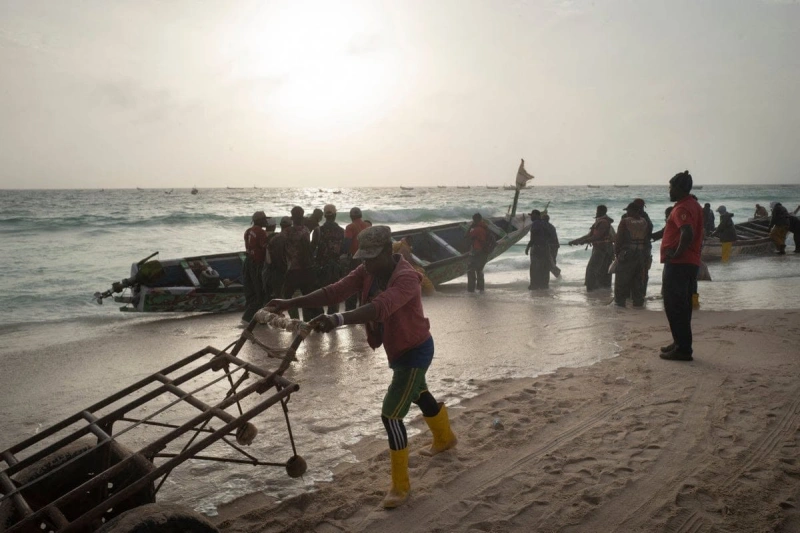

The sea returned the first four bodies on Friday. By Sunday, it had returned 34.
The state news agency APS reported on Sunday, citing an official source, that 34 people had died and one had been rescued. Searches are continuing off the Louga region, about 180 kilometres north of Dakar.
The toll from the Kébémer shipwreck rose in stages. On Friday, the mayor of Thiéppe, Mouhamed Dia, told APS that a boat had run aground at Tébène 2 and that four people were dead. Three more bodies were found on Saturday morning. By Saturday evening, according to an Interior Ministry statement published on Sunday, rescuers had found 21 bodies and one survivor. Then came 34.
Mr Dia also told APS that several people on board survived the grounding and fled through a stand of filao trees. The ministry’s tally, however, identifies only one survivor. It has not explained whether those who fled through the trees were subsequently located or included in its count.
That leaves the Kébémer shipwreck with gaps in its most basic facts. Saliou Diouf, founder of the migrant support group Boza Fii, told AFP that the wreck happened on Friday and that the bodies recovered on Saturday were Senegalese. He added that “we do not know exactly whether there are other nationalities” while the search goes on.
AFP reported, citing a national daily, that most of the victims are believed to come from the communes of Léona and Thiéppe. If that holds, two neighbouring communes face a very long week of funerals.
Now set that against the same Friday. According to AFP, gendarmes intercepted a boat off Dakar carrying 142 people, among them women, two infants and two minors. The operation ran alongside security for the Youth Olympic Games. The International Olympic Committee calls them the first Olympic sporting event held on African soil. About 2,650 young athletes are competing in Senegal this fortnight. Up the coast, the Kébémer shipwreck was unfolding.
The Interior Ministry said Minister Mouhamadou Makhtar Cissé felt “deep sadness”. It added that the government would keep fighting smuggling networks through closer cooperation with neighbouring countries. Mr Cissé is due at the scene on Monday. President Bassirou Diomaye Faye, in remarks carried by Senegalese media, tied that fight to opportunity at home. His words: “No departure should have the sea as its only horizon.”
A pledge like that is easy to make and hard to measure. After the Kébémer shipwreck, the test is concrete. Published accounts of the ministry’s statement do not say where the boat set off from, where it was headed or who organised the trip.
The rights group ADHA had already raised the alarm. In a communiqué signed on 28 October by its president, Adama Mbengue, it argued that young Senegalese need credible prospects at home. That came days after nearly 1,000 West Africans reached the Canary Islands on 22 and 23 October. The Kébémer shipwreck gives that warning a human cost.
The wider route is lethal. The Spanish rights group Walking Borders counted at least 635 deaths on the Atlantic route in the first five months of 2026, roughly 21 for every 100 people who reached the Canary Islands.
Thirty-four is what the sea has returned so far. Until someone can say how many boarded, the Kébémer shipwreck has a floor, not a final figure.


