



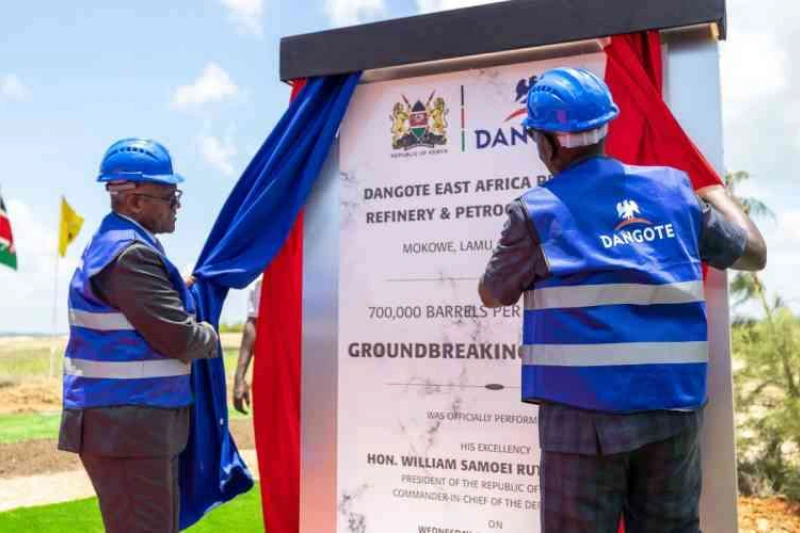

Aliko Dangote gave himself 40 months. President William Ruto made sure the whole region heard it.
At the groundbreaking of the Lamu oil refinery at Mokowe on Wednesday, Ruto turned to the Nigerian billionaire and issued a warning. “Kenyans are very good at keeping data,” he said.
Dangote’s Lagos refinery gives that warning some weight.
Dangote has promised to return in 40 months to commission the Lamu oil refinery. Counting from 30 September, that points to early 2030.
Citizen Digital reported that Dangote told the crowd Lekki had shown what was possible and that Lamu “must prove that it can be repeated.
The Lamu oil refinery is designed to process 700,000 barrels of crude a day. Kenya’s government expects about 60,000 jobs. Uganda’s Yoweri Museveni and Ethiopia’s Abiy Ahmed were among the leaders at the ceremony.
Lekki is why Ruto’s remark carries weight.
Dangote announced the Lagos refinery in 2013 as a smaller plant due in 2016. By 2018 he was hoping to start production in early 2020. Petrol output began in September 2024.
Lekki did get built. Ruto toured it on 25 September and called what he saw extraordinary.
So the question in Lamu is narrower than it looks. Can Dangote build this one on schedule?
The Lamu oil refinery is being sold as Lekki’s sequel. Kenya wants the sequel to run to time.
The pace has been quick. Talks began in Nairobi in April, alongside fertiliser discussions. Dangote told Citizen TV on Tuesday that he first eyed Tanga in Tanzania because of the planned Ugandan crude pipeline. He moved to Lamu after finding enough water, sea depth and land.
The Kenya Ports Authority confirmed that the first vessel carrying construction equipment had docked at Lamu Port on 26 September. Two days later, residents went to court.
Even the cost of the Lamu oil refinery remains disputed. Kenya’s government uses KSh2.2 trillion, while Dangote has spoken of $16 billion. Billionaires.Africa reported that he has also cited $20 billion, and that the gap turns on whether port infrastructure is counted.
Roughly 70 per cent of the money, about KSh1.45 trillion, is borrowed, with the rest raised as equity. The Africa Finance Corporation is a co-developer.
Ruto has said Kenya will take a stake in the Lamu oil refinery through the National Infrastructure Fund. Ordinary Kenyans will be able to buy shares later through the Nairobi Securities Exchange. In Kilifi on 29 September, Ruto urged anyone with spare money to buy in and told them they would thank him later.
Not everyone is convinced. Ndindi Nyoro, who leads the People’s Party of Kenya, demanded on Saturday that the government publish the names of everyone who will own a share.
The refinery is meant to supply Kenya, Uganda, South Sudan, Rwanda, Burundi and the Democratic Republic of Congo. Together, they import almost all their fuel.
Billionaires.Africa reported that the Lamu oil refinery needs regional output above 600,000 barrels a day to run at full capacity. Projections are 350,000 from South Sudan, 250,000 from Uganda and 120,000 from Kenya.
On paper, that adds up to 720,000 barrels. On the ground, Kenya’s commercial oil production is only expected to begin towards the end of this year. Projections are not barrels.
Dangote has said the Lamu oil refinery will give East African producers priority, with extra volumes bought abroad, including from the United Arab Emirates. Ruto told Dangote that Kenya is working on a route to carry Turkana crude to Lamu.
The ceremony went ahead on land that some residents say was taken from them. The Lamu oil refinery site covers more than 7,000 acres.
On Monday, 133 residents of Chandavai sued the government, the LAPSSET Corridor Development Authority, Lamu County and Dangote Industries. In their filing, the residents say they were pushed off ancestral land without compensation. They also allege that officers cleared one disputed parcel on 10 September and told them it would host the ceremony.
Justice Jane Onyango of the Malindi Environment and Land Court declined to certify the application as urgent. She refused to stop the groundbreaking of the Lamu oil refinery but issued a status quo order running to 14 October.
Dangote Group said the ruling would not halt the launch but might affect activities at the site. Dangote himself said he was ready if anyone went to court.
Ruto told Lamu residents that their concerns would be handled fairly and lawfully. Dangote promised a training school in Lamu for 1,000 local people.
Ruto told the ceremony that “a refinery is a promise kept.”
The Lamu oil refinery now has a date. It also has a disputed price, a pending lawsuit and an audience that keeps score.
Forty months is a long time to keep a promise. Someone in Kenya is already counting.


