



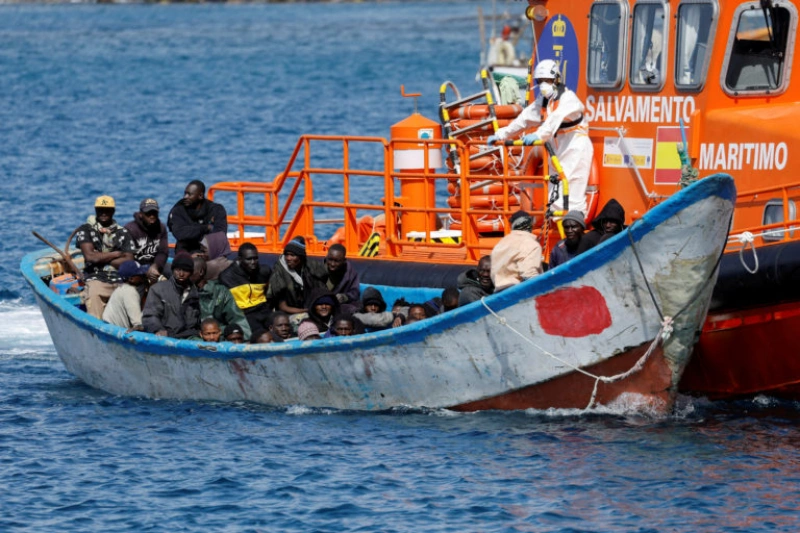

The two boats had been at sea for about a week when Mauritania’s coastguard found them off Nouakchott on Sunday, highlighting the continuing dangers along the Mauritania migration route.
There were 260 people on board, including 61 women and 17 children. Most were Senegalese or Gambian, with four Guineans among them.
Here is the detail that matters. Neither boat had set off from Mauritania. They were only passing through its waters, a reminder of how the Mauritania migration route has evolved in 2026.
Two years ago, the picture was reversed. Spain’s national security department counted about 25,000 departures from Mauritania in 2024, more than any other country and roughly as many as Morocco and Algeria combined.
None of this was new. Nouadhibou, the port city near the Western Sahara border, has been a launch point since 2006, when the so-called cayuco crisis brought about 31,700 people to the Canary Islands. The Mauritania migration route was old. What changed was the scale.
Spanish figures show more than 12,000 people reached the islands in the first three months of 2024, against about 2,000 a year earlier. By December the record stood at 46,843, according to Spain’s Interior Ministry.
Brussels moved fast. On 7 March 2024, the European Union and Mauritania signed a partnership declaration on irregular migration in Nouakchott. Mauritania was to receive €210 million to reduce the number of migrants crossing its territory, the Institute for Security Studies reported. Overnight, the Mauritania migration route became a European priority.
On paper, it worked. Spanish authorities recorded a 62 per cent fall in Canary Islands arrivals in 2025. This year is starker. Between 1 January and 15 September, 5,592 people reached the archipelago, down from 12,453 a year earlier, according to Spain’s Interior Ministry.
Then comes the catch. The Balearic Islands, reached from Algeria, now record more arrivals than the Canaries on the ministry’s mid-September count. Professor Margalida Capellà, quoted by InfoMigrants, says that route is shorter and lacks the surveillance now found off West Africa. The crossing from Algeria can take about 15 hours. A boat from Banjul can take a week, or far longer.
Departures have also drifted south. The International Organization for Migration says the coast of The Gambia has emerged as the main departure point on the Atlantic route. Boats that use the Mauritania migration route today often start in The Gambia or Senegal and only pass through Mauritanian waters.
Longer crossings mean longer exposure. UNHCR reported 144 people dead or missing after a boat from The Gambia drifted for about 25 days before it was found on 18 July. Doctors Without Borders called it “one of the deadliest landings” its teams had seen in Mauritania this year.
The NGO Caminando Fronteras counted 3,090 deaths on the route in all of 2025, and more than 1,300 by early June this year. A falling arrival count does not mean fewer people are leaving. It may only mean fewer are reaching Spain through the Mauritania migration route.
So what did €210 million buy? The data suggest fewer arrivals in Spain. Yet the evidence also indicates that the Mauritania migration route has not disappeared. Instead, departures have shifted south and journeys have become longer and more dangerous.
Inside the country, the human cost is harder to measure. In early 2025, a spike in mass expulsions to Mali and Senegal triggered political tensions with both neighbours, according to Human Rights Watch. Its report, based on 223 interviews, accused Mauritanian forces of abuses that included collective expulsions and mistreatment in detention. It said the EU and Spain share responsibility through their funding and equipment.
Mauritania’s government rejected allegations of torture and systematic violations. It pointed to a ban on collective expulsions and new procedures adopted in May 2025.
A Malian aid worker in the border town of Nioro du Sahel put the bitterness plainly to the rights group in 2022: “Africans are doing the work for the EU, and they know it.
The country carries another burden as well. While managing the Mauritania migration route, it is also hosting hundreds of thousands of refugees fleeing conflict in neighbouring Mali. UNHCR registered 290,000 Malian refugees in the south-eastern region of Hodh Ech-Chargui in July, Amnesty International reports. Nouakchott is policing a coastline for Europe while sheltering people fleeing a war next door. Migration management is only one of the pressures on the state.
The next test may come with the seasons. Canary Islands president Fernando Clavijo blames tougher policing around Ceuta for a recent rise in arrivals, while Madrid points to the fall across the year. Both can be right at once.
Europe paid Mauritania to close a route. Yet the Mauritania migration route found a longer way round. Spain counts the boats that reach its shores. Mauritania is left counting everyone else.


