



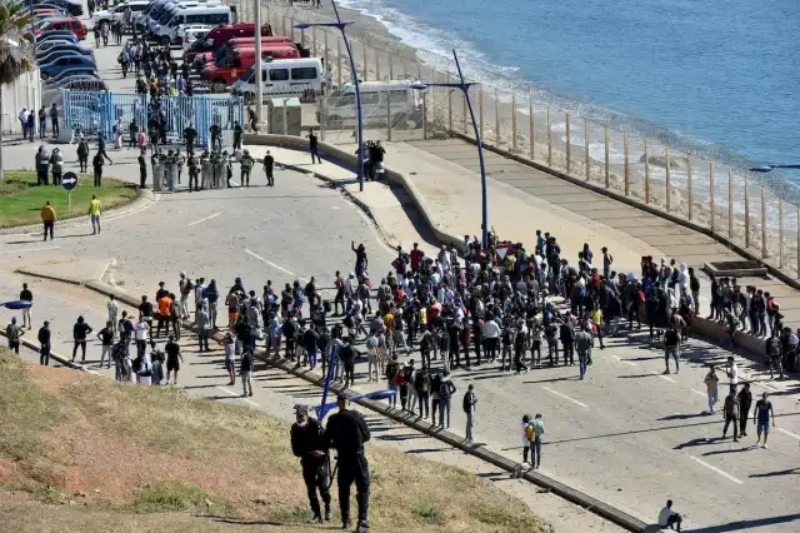

Spain is grappling with a deepening Ceuta migration crisis after more than 1,500 migrants swam into the North African enclave from Morocco within one week, leaving reception centres overwhelmed and local leaders pleading with Madrid for urgent help.
Juan Jesus Vivas, president of the autonomous city, told journalists on Wednesday that recent arrivals had pushed Ceuta into what he called total humanitarian and social emergency. He said the reception centre, built to hold 512 people, now has hundreds sleeping outside its gates because there is simply no room left inside.
According to figures cited by Vivas, more than 200 migrants have been entering Ceuta each day in recent weeks, most of them swimming from the Moroccan coast near Castillejos to reach Spanish territory, a pace that has come to define the current Ceuta migration crisis. Spain’s Civil Guard, the Maritime Rescue Service and the Red Cross have all been deployed with boats to pull swimmers from the water before ferrying them ashore.
The Ceuta migration crisis has also turned deadly. Spanish authorities recovered four bodies from the waters around the enclave over a single weekend, bringing the confirmed death toll along Ceuta’s coastline this year to at least 27, with several more people feared missing. Officials told the news agency EFE that two of the bodies had likely been in the water for about a week, leaving them too decomposed for visual identification, so the Civil Guard collected fingerprints and forensic samples in the hope that relatives could later confirm their identities through DNA testing.
Vivas noted that around 60 bodies had been spotted at sea near Ceuta over the past year, underlining how dangerous the short but treacherous crossing from Morocco has become. Most of those attempting the swim are reported to be Moroccan nationals in their late teens and twenties, along with a smaller number of Algerians and many unaccompanied minors.
Morocco has continued to cooperate with Spain on border management even as the Ceuta migration crisis intensifies. Moroccan naval units intercepted roughly 300 people at sea in recent days, while Spain’s Civil Guard rescued around 100 more, according to figures reported by Hespress. Spain’s interior ministry said in a statement that several government departments were coordinating to respond with speed and efficiency, and confirmed that Rabat was working faithfully with Madrid to prevent further crossings.
Interior Minister Fernando Grande-Marlaska is due to travel to Ceuta to assess the situation firsthand and meet local officials, the ministry added, describing the visit as part of an effort to guarantee both border security and the humanitarian assistance needed to keep migrants safe at sea. However, the Spanish government has ruled out declaring a national emergency over the Ceuta migration crisis, arguing that civil protection law only permits such a declaration for natural or technological risks such as floods, earthquakes or wildfires, not migratory pressure.
Guardia Civil sources told the Spanish agency EFE that the surge in crossings appears linked to a Supreme Court ruling issued earlier this month, which found that migrants intercepted at sea while trying to reach Ceuta cannot be summarily returned to Morocco without due process, unlike those who cross the land border fence. The ruling effectively halted the so-called pushback practice that Spain had relied on for years, pending fresh instructions from the central government.
Spanish Interior Ministry data show that 2,826 irregular arrivals had reached Ceuta between January and mid July this year, compared with 1,133 over the same period in 2025, a rise of about 149 per cent. Some accounts place the figure closer to 2,582 for the first half of the year alone when measured through late June, reflecting how quickly the scale of the Ceuta migration crisis has grown since the sea route overtook land crossings as the dominant path into the enclave from March onward.
Local officials say the numbers behind the Ceuta migration crisis tell only part of the story, since many crossings go unrecorded until migrants are either rescued, detained or found dead along the coastline.
Ceuta’s government has requested that Madrid assume unified command of the response and formally activate national emergency protocols, a request the interior ministry has rejected on legal grounds while insisting that the state continues to exercise its full authority over security in the territory. The crisis has also stirred political tension within Spain, with some opposition figures blaming the government’s broader migration policy for what they describe as a pull effect drawing more people towards the coast.
Humanitarian workers in Ceuta say the coming days will be critical for containing the Ceuta migration crisis, with warm summer weather traditionally driving a seasonal rise in sea crossings across the western Mediterranean. Aid groups have called for additional resources to process arrivals safely and to identify growing number of bodies recovered from the strait, many of which remain unclaimed.


