



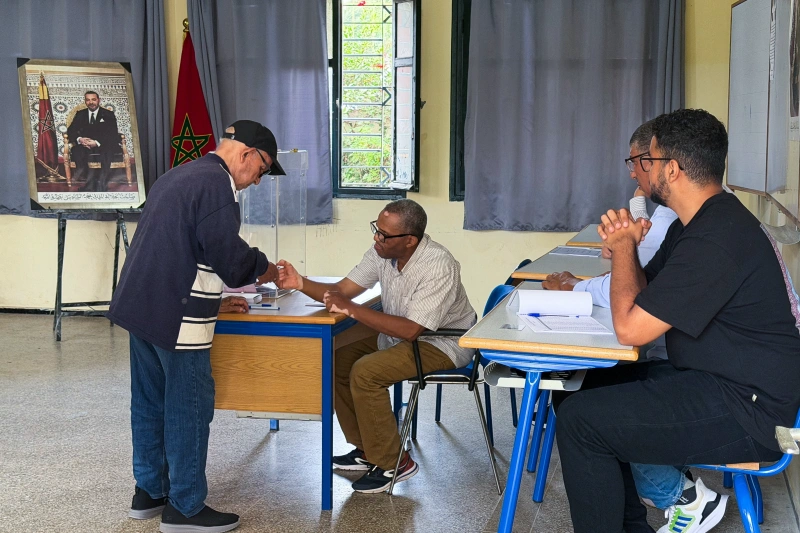

Morocco has a new parliament. Barely a third of registered voters bothered to help choose it.
The Morocco election results published in the early hours of Thursday tell two stories at once. One is about a winner. The other is about a country that stayed home.
The Authenticity and Modernity Party, known by its French acronym PAM, has come out on top. Provisional Morocco election results from the Interior Ministry give the party 97 of the 395 seats in the House of Representatives.
That is enough to lead coalition talks. It is nowhere near the 198 seats needed to govern alone, putting the Morocco election results into context from the outset.
The National Rally of Independents, the party that headed the outgoing government, slipped to second place with 66 seats. Istiqlal followed with 65.
Both were PAM’s partners in the coalition that has run Morocco since 2021. That partnership now looks finished. PAM figures have already ruled out working with RNI again, after months of the two parties blaming each other for unfinished promises.
Here is where the Morocco election results get more interesting than a simple scoreboard. Turnout came in at 38.02 percent, the lowest recorded in nearly two decades.
That is well down on the 50.35 percent who voted in 2021. Of roughly 16 million registered voters, most chose not to cast a ballot at all.
That gap matters. A party can win the most seats and still fail to capture public attention.
PAM’s 97 seats represent a plurality of a shrinking electorate, not a groundswell of enthusiasm. Read that way, the Morocco election results describe a mandate that is real on paper and thinner in practice.
Turnout has been sliding in Morocco for years. It stood at 37 percent in 2007. It recovered to 45.5 percent in 2011, after the Arab Spring protests pushed through constitutional reforms.
By 2021 it had climbed to 50.35 percent. Wednesday’s vote broke that recovery. Participation slid back below where it stood almost twenty years ago.
The Morocco election results reveal another striking contrast. The Justice and Development Party tells a different story. The Islamist movement governed Morocco for a decade before collapsing to just 13 seats in 2021. It has now surged back to 54 seats.
Its comeback is widely credited to the return of former prime minister Abdelilah Benkirane as the party’s public face. Moroccan voters, it turns out, can still swing hard even when most of the country is not voting at all.
Leftist parties picked up a smaller but notable share. The Socialist Union of Popular Forces took 26 seats. The Party of Progress and Socialism took 19. The Federation of the Democratic Left took eight, according to the provisional count reported by Al Jazeera.
PAM built its campaign around a $37 billion economic platform. It promised a million new jobs, higher wages and expanded healthcare spending.
Two figures led that campaign in public. Marrakech mayor and national planning minister Fatima-Zahra Mansouri was one. Budget minister Fouzi Lekjaa was the other.
If PAM secures the premiership and the king names Mansouri to head the government, she would become Morocco’s first woman prime minister. That would be a first that carries weight far beyond any seat count.
None of that changes what the king still controls. Under Morocco’s constitution, Mohammed VI appoints the head of government from the party that finishes first.
He keeps defence, foreign affairs and religious authority under direct royal control regardless of who wins. Coalition talks decide the rest. With no party close to a majority, and the Morocco election results this fragmented, those talks could run for weeks.
The Morocco election results also land at a delicate moment. The country is racing to finish infrastructure tied to co-hosting the 2030 World Cup, while households complain about living costs, unemployment and inequality.
The vote follows a summer migration crisis. Large numbers of young Moroccans tried to reach the Spanish enclave of Ceuta.
It is a sign of the frustration simmering among the country’s youngest citizens. Many of them stayed away from the polls this week too.
No PAM leader had issued a public victory statement by the time results were confirmed on Thursday. Neither RNI nor Istiqlal had commented on the reshuffled order either.
That silence, more than any seat total, is the real story hiding inside these Morocco election results. A country just picked a parliament. Most of it was not watching.


