



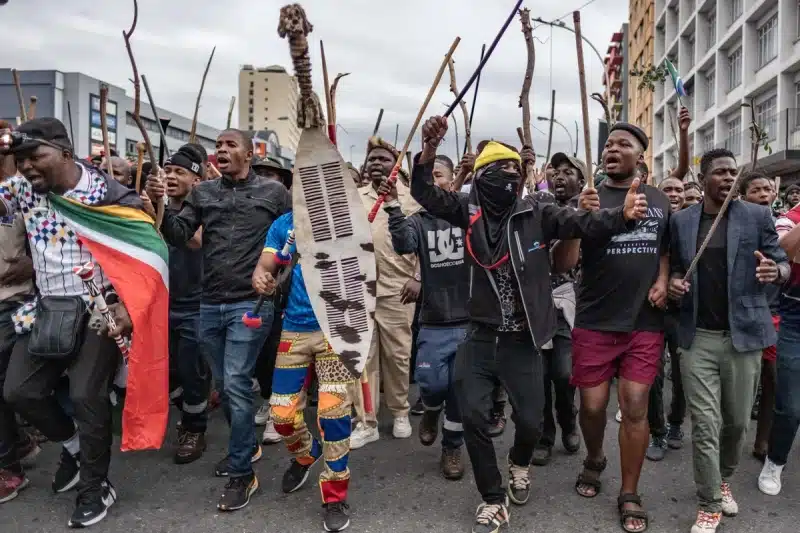

South Africa’s anti-immigration movement, March and March, has set a September 30 deadline for undocumented foreign nationals to leave the country. The group has threatened a much larger demonstration if the government fails to act before the September 30 deadline passes.
The deadline was first announced on 17 August. Movement leader Jacinta Ngobese-Zuma made the announcement outside the Durban International Convention Centre, where regional leaders had gathered for the 46th SADC Summit. She addressed the crowd under the banner “It’s time to fetch your people”. The slogan was a direct challenge to President Cyril Ramaphosa’s recent comments on the treatment of migrants.
Ramaphosa had spoken days earlier at a SADC public lecture at the University of KwaZulu-Natal. He said South Africans should feel ashamed of the mistreatment faced by nationals from other African countries. “We cannot preach integration at summits and practise exclusion in our streets,” he said. Ngobese-Zuma dismissed the remarks as insufficient. She insisted the government still had no clear plan for dealing with undocumented migration.
March and March describes the September 30 deadline mobilisation as the second wave of its June 30 National Day of Action. Tens of thousands marched across South African cities that day. The group is now calling on African heads of state to prepare for what it has called “the mother of all protests.
The June 30 mobilisation had a heavy toll. Xenophobic unrest linked to those protests claimed four lives. An estimated 178,000 foreign nationals are reported to have left South Africa in the weeks that followed. Policing, deportation and repatriation operations tied to the June demonstrations cost the state around R600 million, according to figures shared with parliament.
Home Affairs Minister Leon Schreiber told lawmakers his department had spent more than R175 million on deportations over the past two financial years. South Africa is also seeking $18.5 million in reimbursement from Malawi, Nigeria and Ethiopia. The money would cover the cost of repatriating their citizens.
Police say they are taking the run-up to the September 30 deadline seriously. Deputy National Commissioner Tebello Mosikili confirmed officers would remain visible during the planned demonstrations. No special budget has been set aside beyond normal policing operations, he said. Weekly marches, held every Thursday, have continued in Durban since the movement first gained traction.
Tension has already spilled into violence ahead of the September 30 deadline. On 3 September, around 100 March and March members clashed with foreign nationals in Umbilo, Durban. The foreign nationals had been camping outside the Home Affairs office on Che Guevara Road. What began as a so-called “clean-up” operation turned into a confrontation involving thrown stones and sticks. Police had to intervene and separate the two groups.
Refugees and asylum seekers, including children, continue to sleep rough near the Umbilo office. They are waiting to be moved to a reception centre. Ghanaian refugee Princess Adjei said the wait had become unbearable. “We can’t keep sleeping on the streets forever as well,” she said.
March and March spokesperson Sphelele Shinga said the movement expects as many as 1.5 million people to join the next demonstration once the September 30 deadline lapses. He said communities across the country were mobilising again to demand action from the government.
The standoff has consequences beyond South Africa’s borders. Nigeria and Ghana have already taken steps to evacuate or repatriate some of their citizens. Other African governments are watching closely too, given how many of their nationals live and work in South Africa.
With the September 30 deadline now just weeks away, pressure is mounting on Pretoria to show it can manage the humanitarian fallout. It also faces the political risk of a movement that has shown no sign of slowing down.


