



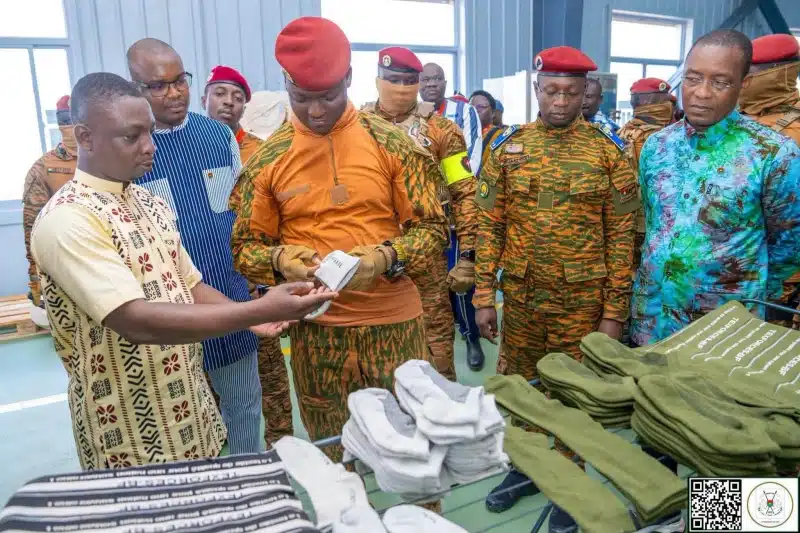

Burkina Faso has switched on a new industrial complex built to turn homegrown cotton into finished clothing without shipping the fibre abroad first. The complex, TEXFORCES-BF, was inaugurated on Wednesday 9 September 2026 at Logofourousso, near Bobo-Dioulasso, the country’s second-largest city.
Captain Ibrahim Traoré, Burkina Faso’s leader, presided over the opening. State authorities have presented the project as a major step towards industrial sovereignty and local transformation of Burkinabe cotton rather than simply the launch of another factory.
TEXFORCES-BF sits on a 30-hectare site and brings together most stages of textile production under one roof. Spinning, weaving and knitting, dyeing, finishing and garment manufacturing are all integrated into the same complex. That matters for a country that grows large volumes of cotton but has historically exported much of it as raw fibre before importing finished textile products at a far higher cost.
The stated goal is straightforward. More of the cotton grown in Burkina Faso should leave the country as a finished shirt, uniform or garment rather than as a bale destined for mills overseas. Officials describe this as reclaiming value, jobs and industrial know-how that have long been captured elsewhere in the global textile chain.
The scale of TEXFORCES-BF is considerable. According to figures released during the inauguration, the complex can produce up to 20 million metres of woven fabric annually, between five and six million knitted units, up to 20 million metres of finished and dyed fabric, as well as millions of uniforms, T-shirts and other garments each year. Authorities say the longer-term ambition is to transform up to 50,000 tonnes of cotton annually while expanding production for national, regional and international markets.
Burkina Faso is one of West Africa’s larger cotton producers, alongside neighbours such as Mali and Côte d’Ivoire. For decades, raw cotton exports have dominated the sector, while local spinning and weaving capacity remained limited. TEXFORCES-BF is designed to narrow that gap through a fully integrated production chain located on a single site.
Uniforms for the country’s security forces sit at the centre of the plan, though the ambition extends beyond military requirements. TEXFORCES-BF is also expected to manufacture clothing for civilian consumers, giving the project both strategic and commercial significance. Authorities say the complex will supply defence and security forces while serving broader domestic demand for textile products.
The timing is not accidental. Burkina Faso’s military government has spent recent years promoting self-reliance across sectors ranging from agriculture and energy to industrial production. TEXFORCES-BF fits squarely within that agenda. A cotton-growing nation making its own cloth and its own clothes is a direct answer to years of dependence on imported uniforms and garments.
The project has moved from blueprint to inauguration in just over two years. Construction was launched in April 2024, with an initial emphasis on producing uniforms for security personnel and community defence volunteers. The completed TEXFORCES-BF complex now represents a broader effort to build an integrated national textile industry around locally produced cotton.
Bobo-Dioulasso already has strong links to Burkina Faso’s cotton economy, making Logofourousso a logical location for the investment. Authorities expect the project to generate demand across the wider textile value chain, from cotton production and transport to manufacturing, logistics and technical services. Official figures indicate the complex could create hundreds of direct jobs initially and support thousands more livelihoods across the broader cotton ecosystem.
For now, the inauguration marks a significant statement of intent rather than a final outcome. Full output, reliable cotton supplies and ambitions to compete beyond Burkina Faso’s borders will take time to prove. Burkina Faso wants to wear what it grows, and TEXFORCES-BF is the clearest attempt yet to make that happen within its own borders.
For more click


