



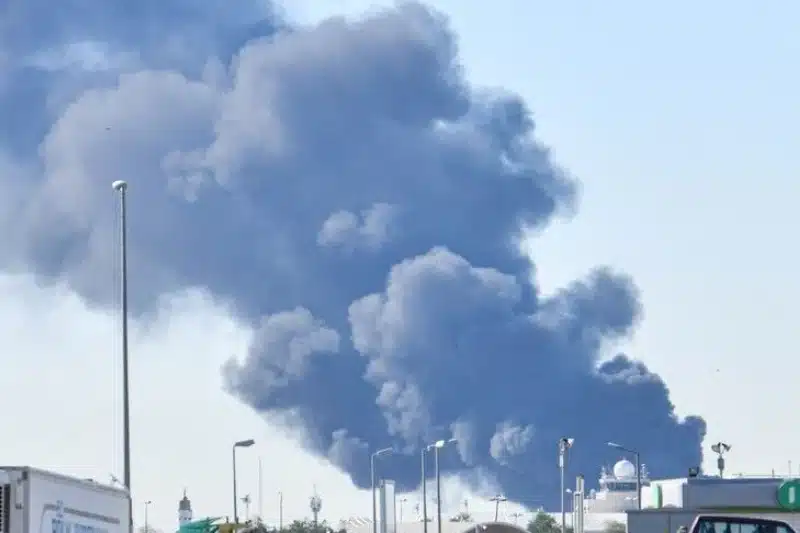

A drone struck an untreated naphtha storage tank at the Zawiya oil refinery in western Libya early on Saturday. The attack tore two holes in the tank and triggered a fuel leak. The Zawiya Oil Refining Company confirmed the incident in a statement.
The company said the drone hit the tank wall at about 3.45am local time. Naphtha spilled out immediately after impact. Engineering staff moved fast to contain the spill and shut off the leak. No fire broke out and nobody was hurt. The Libya Observer, citing the same statement, reported that the affected tank was numbered 1 to 7. It said the drone appeared to explode on contact.
The Zawiya oil refinery sits about 40 kilometres west of Tripoli on Libya’s Mediterranean coast. It is one of the country’s largest functioning plants. Its output capacity runs close to 120,000 barrels a day. That scale makes the Zawiya oil refinery central to domestic fuel supply. Any disruption at the Zawiya oil refinery tends to ripple through transport and energy markets across the region.
The operator raised alarm over military hardware near the plant. It warned that such equipment endangers lives, property and the surrounding environment. It urged all armed factions to keep fighting and weapons away from the refinery. It stressed the sensitivity of operations at the site and the risks facing civilian staff.
The strike follows days of fighting between rival armed groups in Zawiya and the neighbouring town of Surman. Surman lies roughly 60 kilometres from Tripoli. Clashes erupted on Tuesday between the Anti Security Threats Apparatus, led by Mohammed Bahroun, and fighters from the 103rd Infantry Battalion under Othman al Lahab.
A third militia commanded by Mohannad Suwaisi was also drawn into the fighting, according to Asharq Al Awsat. Local leader Salem Bahr told the Turkey based Libya Al Ahrar television channel that the violence killed three civilians and wounded several others. He appealed for calm, saying everyone who wins in the fighting ultimately loses.
The unrest also triggered a mass breakout at Surman prison. The Tripoli based Judicial Police Authority confirmed the escape in a statement. It said an investigation was underway and a committee had been formed to identify the fugitives. The authority did not disclose how many inmates had fled.
Amid the fighting, the Zawiya Oil Refining Company declared a day off for staff in unsafe areas. It told employees to avoid roads leading into the conflict zone. Workers at the Zawiya oil refinery were advised to stay clear of the coastal road while clashes continued nearby. Relative calm has since returned to both towns. Local officials said the shift followed the deployment of a neutral force.
Security sources cited by Asharq Al Awsat noted a wider shift in tactics. Forces aligned with the Tripoli based Government of National Unity have previously used drones in western Libya against suspected smuggling networks. Their use by smaller local militias in an internal dispute marks a fresh escalation. That shift raises new risks for civilians near strategic sites such as the Zawiya oil refinery. The plant sits within reach of the contested coastal road.
Zawiya has endured repeated rounds of armed confrontation in recent years. Several of those clashes left casualties and damaged critical infrastructure, including facilities close to the Zawiya oil refinery. Libya remains split between two competing administrations. The internationally recognised Government of National Unity is headed by Abdul Hamid Dbeibeh and based in Tripoli.
A rival government appointed by the House of Representatives is led by Osama Hammad from Benghazi. The country has struggled to reunify its institutions since the 2011 uprising that toppled Muammar Gaddafi. The United Nations Support Mission in Libya continues to press rival factions toward a political settlement that could pave the way for long delayed elections.
Output at the Zawiya oil refinery appears to have continued despite the strike. The company gave no indication of a halt in operations. But the incident adds to a growing list of security threats facing a facility that supplies a significant share of Libya’s domestic fuel needs.
Analysts tracking the country’s fragmented security landscape say the episode shows how contests between armed groups keep spilling into infrastructure that ordinary Libyans depend on for power and fuel.


