




The United Nations has voiced fresh alarm over the rising use of drone strikes in Sudan, after an attack on a customary court in North Darfur left dozens of civilians dead.
The UN humanitarian coordination office, OCHA, said on Monday that drone strikes in Sudan continue to endanger civilians and disrupt aid operations, even as fighting between the Sudanese Armed Forces and the Rapid Support Forces grinds through its fourth year.
The warning followed a strike on Sunday afternoon in the village of Ghara al-Zawiya, near Kabkabiya in North Darfur state. Emergency Lawyers, a Sudanese rights group that monitors violence against civilians, said drones struck the village’s traditional court while local leaders were hearing community disputes under a tree.
At least 35 people were killed and dozens more wounded, the group said. A local administration aligned with the Rapid Support Forces put the toll higher, at 37 dead and 50 injured. Among the victims were four tribal leaders and two Rapid Support Forces commanders, according to a witness cited by the AFP news agency.
Darfur24, a local news outlet, quoted a resident who said two drones flew over the village before firing more than four missiles at the court building. The Sudanese army has not commented on claims that its forces carried out the strike, though Emergency Lawyers said the drones belonged to the military.
Emergency Lawyers condemned the attack as a grave violation of international humanitarian law and called for an independent and transparent investigation to identify those responsible. It said drone strikes in Sudan are increasingly being used to target civilian gatherings, worsening an already dire humanitarian situation across Darfur.
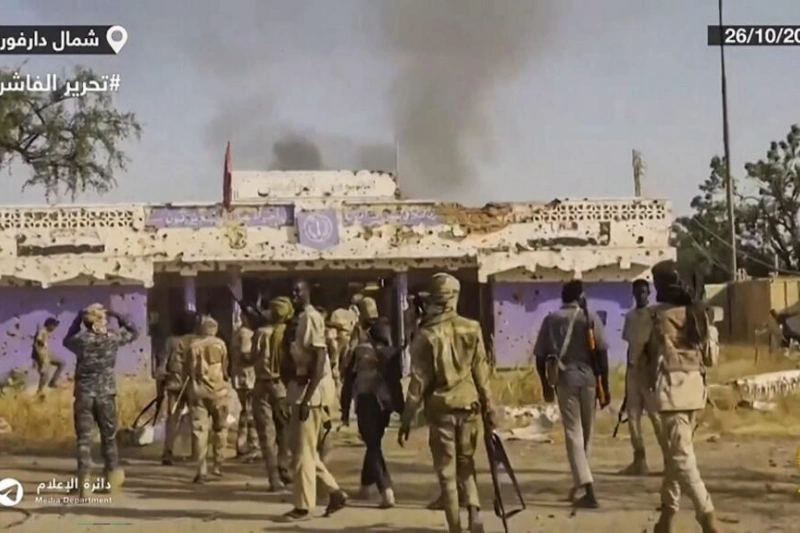
Ghara al-Zawiya lies roughly 150 kilometres west of El-Fasher, the army’s last stronghold in Darfur before the Rapid Support Forces captured the city in October 2025. UN investigators have said violence linked to the siege and capture of El-Fasher bore the hallmarks of genocide.
OCHA said renewed drone strikes in Sudan have also struck El Obeid, the capital of North Kordofan state, putting civilians, critical infrastructure and aid operations at risk. UN Emergency Relief Coordinator Tom Fletcher said humanitarians are scaling up efforts to reach families affected by the fighting in North Kordofan and will seize every opportunity to expand lifesaving aid in and around the city.
Fletcher called on both warring parties to de-escalate, protect civilians and guarantee humanitarian access. OCHA also urged donors to boost funding for the Sudan response, noting that only about 1.2 billion dollars of the 2.9 billion dollars required this year has been received so far.
The United Nations says drone strikes in Sudan have become one of the deadliest features of the war, with more than 1,000 civilians killed by drones in the first five months of this year alone. The conflict, which erupted in April 2023 between army chief Abdel Fattah al-Burhan and Rapid Support Forces commander Mohamed Hamdan Dagalo, has killed tens of thousands of people and displaced about 14 million. Analysts say the growing reliance on drone strikes in Sudan reflects how both sides have shifted tactics after costly ground battles for cities such as El-Fasher.
Diplomatic efforts to end the war remain stalled despite renewed engagement. The UN, African Union, regional bloc IGAD, the League of Arab States and the European Union, collectively known as the Quintet, held fresh consultations with Sudanese political leaders in recent days, building on exploratory talks held in Addis Ababa in June.
UN Deputy Spokesperson Farhan Haq said the discussions focused on proposals for advancing a Sudanese-led political process, including confidence-building measures. No breakthrough on a ceasefire has been announced.
The Secretary-General’s Personal Envoy for Sudan, Pekka Haavisto, has continued shuttle diplomacy with both sides. He spoke by phone with Sudan’s Foreign Minister, Muhieddine Salem, at the weekend to discuss recent developments and prepare for an upcoming visit to Khartoum. Haavisto also continues to engage RSF leader Hemedti on practical steps toward de-escalation.
Since the war began, ceasefire attempts brokered separately by the United States, Saudi Arabia, IGAD and the African Union have repeatedly collapsed, with both sides accused of pursuing outright military victory instead of a negotiated settlement. Diplomats say any lasting truce will need to address drone strikes in Sudan directly, given how central the weapons have become to both sides’ strategies.
For now, rights groups warn that drone strikes in Sudan show no sign of slowing, and that civilians in Darfur and Kordofan remain exposed to attacks on markets, water points, hospitals and now courts, as the war’s fourth year begins.


