



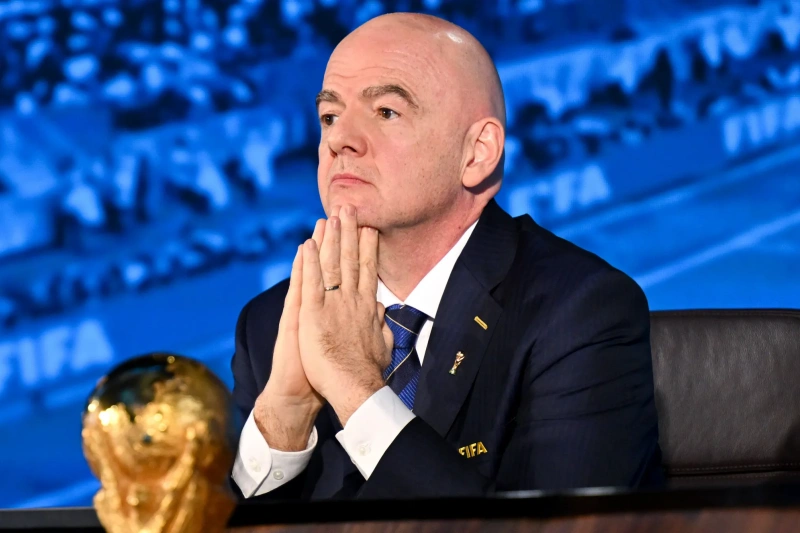

Gianni Infantino has abandoned the World Cup private equity plan that had thrown global football into turmoil since it was first unveiled last Tuesday. The FIFA president confirmed late on Friday that the scheme, which would have handed private investors a stake in football’s biggest tournament, would no longer proceed.
The World Cup private equity plan, known internally as FIFA Forward Enterprise, sought to raise up to $4.2 billion by selling roughly a fifth of a new commercial subsidiary valued at $20 billion. That subsidiary would have run FIFA’s flagship events, including the World Cup and the Club World Cup, with a group of outside investors said to include Josh Kushner, brother of Jared Kushner, taking a lead role.
Infantino, in a statement released by FIFA, said the proposal had created divisions of a nature that were no longer in the interest of the objective set out at the start. He added that FIFA’s purpose had always been to unite the game rather than split it, and confirmed the World Cup private equity plan would not proceed in its current form.
The retreat came after a torrid week for Infantino, during which UEFA voted to boycott FIFA competitions, including September’s Women’s Under-20 World Cup in Poland, unless the scheme was withdrawn. CONCACAF and the Asian Football Confederation lodged similar objections, and reports suggested close to 100 of FIFA’s 211 member federations had pushed back against the World Cup private equity plan by the time it collapsed.
Two senior figures inside FIFA broke ranks on Friday, hours before Infantino’s climbdown. Carlos Cordeiro, a former Goldman Sachs banker who served as Infantino’s senior adviser and represented FIFA on the White House task force for the tournament, resigned in protest, saying he could not stand by while FIFA considered selling a stake in the World Cup. A second official said staff had been misled about the scope of the project.
For African football, the collapse of the World Cup private equity plan closes a chapter that had only just opened. The Confederation of African Football, chaired by Patrice Motsepe, told its member associations on Wednesday to study FIFA’s proposal ahead of an executive committee meeting, while stopping short of taking a formal position either way. CAF said it remained committed to working with FIFA and other confederations to widen funding for the game across the continent, a goal the now-abandoned scheme had tried to address through a promised one-off payment of $20 million to each federation.
That payment, along with a pledge to lift FIFA’s funding allocation for the 2027 to 2030 cycle, had made the World Cup private equity plan attractive on paper to cash-strapped federations in Africa, where grassroots development and youth programmes are frequently starved of resources. Its collapse leaves that funding gap unresolved, even as Infantino signalled a willingness to find another route to the same goal.
Infantino used his statement to reach out to the confederations that had opposed him, saying his intention was to bring all interested parties back together in the coming days and weeks in the spirit of shared interest in the game. He said the aim remained growing football everywhere, particularly in countries that need support the most, a line widely read as a nod to Africa and other developing football regions.
The episode has nonetheless raised fresh questions about Infantino’s standing inside FIFA less than four months before the deadline for nominations in the next presidential race, due to be decided in Rabat, Morocco, where the organisation keeps its African headquarters. He has led FIFA since 2016 and was re-elected unopposed in 2019 and 2023, but the scale and speed of the revolt against the World Cup private equity plan marked one of the sharpest challenges yet to his authority.
FIFA has not said whether a revised version of the commercial subsidiary will be brought back for discussion, nor has it set a new timeline for consultation with member federations. For now, the World Cup private equity plan is off the table, and African football administrators will be watching closely to see what, if anything, replaces it.


