



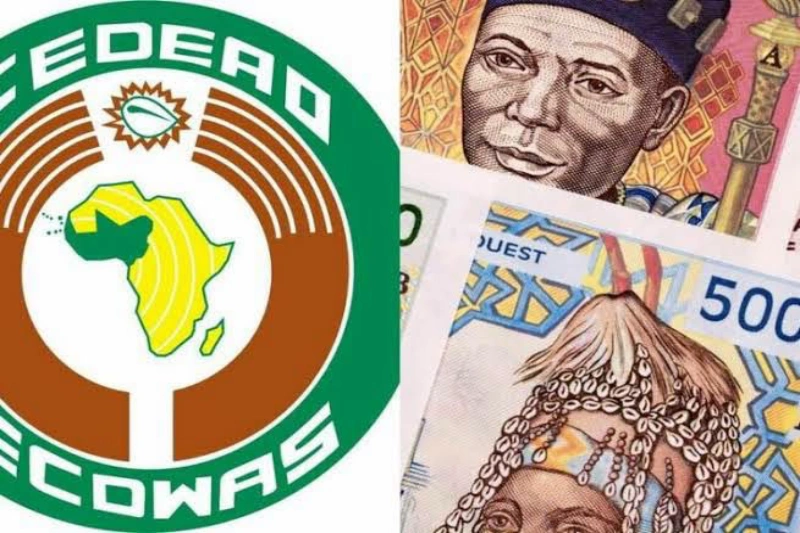

West African leaders have recommitted to launching the ECO single currency in 2027, describing it as central to deeper economic integration across the region.
The pledge came at the close of the 69th Ordinary Session of the ECOWAS Authority of Heads of State and Government, held in Lungi, Sierra Leone, on Sunday, 19 July. Sierra Leonean President Julius Maada Bio chaired the summit, which brought together heads of state and senior officials from across the bloc.
In a final communiqué issued on Tuesday, the Authority stated that it remains firmly committed to launching the ECO single currency in 2027 as a tool for deepening regional integration and driving inclusive growth. The bloc did not set a fixed calendar date beyond the year itself.
Under the arrangement, the ECO single currency will initially be adopted only by member states that meet agreed macroeconomic convergence criteria. Countries yet to qualify will receive technical and financial support to help them join the monetary union at a later stage, according to the communiqué.
The convergence benchmarks include a single-digit inflation rate, a budget deficit capped at around 3 to 4 percent of gross domestic product, and public debt kept below 70 percent of GDP, figures drawn from the West African Monetary Institute‘s long-standing criteria. Central bank financing of budget deficits must also stay within 10 percent of the previous year’s tax revenue, while foreign reserves must cover at least three months of imports.
Few ECOWAS countries currently meet all these thresholds simultaneously, a gap that has repeatedly delayed the ECO single currency project since it was first proposed for a 2020 launch. The rollout was pushed back largely because of the coronavirus pandemic and persistent difficulty meeting fiscal targets across the bloc’s fifteen member states.
The Authority struck a more optimistic tone on the region’s near-term outlook. It projected that ECOWAS economies would improve in 2026, pointing to declining inflation, lower public debt-to-GDP ratios and a widening current account surplus, even as fiscal deficits remain a concern for several states.
On intellectual property, the bloc confirmed that the name “ECO” has now been registered with the African Intellectual Property Organisation. The ECOWAS Commission has been directed to pursue further trademark protection with other regional and international bodies, a move intended to safeguard the currency’s identity ahead of its eventual rollout.
The summit also produced leadership changes at the top of the bloc. Senegalese President Bassirou Diomaye Faye was elected the new Chairman of the ECOWAS Authority for a one-year term, while General Birame Diop of Senegal was appointed President of the ECOWAS Commission for the 2026 to 2030 term.
The ECO single currency initiative dates back more than two decades and was originally conceived to run alongside, and eventually replace, national currencies within the West African Monetary Zone before extending across the wider ECOWAS bloc. Analysts have long noted that Nigeria alone accounts for roughly two thirds of the bloc’s combined GDP, a disparity that continues to complicate efforts to align fiscal policy across such economically uneven member states.
Whether the 2027 target holds will depend largely on how many member states can close the gap on inflation, debt and deficit targets over the next eighteen months, a challenge that has undone previous deadlines for the ECO single currency in 2020, 2022 and 2025.


