



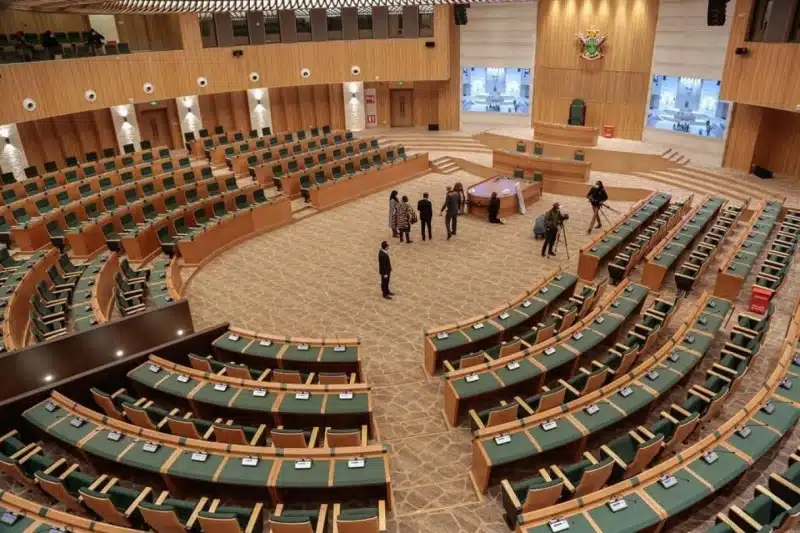

Zimbabwe’s parliament has passed a bill that would scrap direct presidential elections, handing a fresh victory to President Emmerson Mnangagwa while deepening fears among critics that the country is sliding toward one-party rule.
The Zimbabwe presidential election bill, known as Constitutional Amendment Bill No. 3, passed the National Assembly on Thursday after 216 lawmakers voted in favour and 42 against. The margin cleared the two-thirds threshold required for constitutional changes.
Thirty-five opposition legislators voted alongside ZANU-PF to help the Zimbabwe presidential election bill secure the majority it needed. The ruling party itself contributed 181 votes.
The bill now heads to the Senate, where ZANU-PF’s commanding majority makes passage widely expected.
What the bill proposes
The Zimbabwe presidential election bill proposes scrapping the direct popular vote for the presidency and replacing it with election by a joint sitting of parliament. It also extends presidential, parliamentary and local authority terms from five to seven years, enlarges the Senate with ten presidential appointees, and abolishes both the Gender Commission and the National Peace and Reconciliation Commission.
If enacted, the Zimbabwe presidential election bill would prolong Mnangagwa’s tenure until 2030, two years beyond the current constitutional deadline requiring him to leave office in 2028.
Cabinet approved the bill in February 2026, and Justice Minister Ziyambi Ziyambi introduced it to parliament the following month, framing it as a fix for structural gaps in how the country is run.
Ziyambi, who sponsored the bill, rejected accusations that it undermined Zimbabwe’s constitutional order. Speaking in parliament on 3 June, he said the Zimbabwe presidential election bill was “not an abandonment of our constitutional order in any way, shape or form but a continuation of it.” He argued the changes were the product of practical reflection on provisions of the 2013 constitution that needed refinement.
Citizens unconvinced
For many Zimbabweans, the government’s framing has not been persuasive.
Barnabas Gura, a 38-year-old from Harare’s Glen View suburb, told Al Jazeera the Zimbabwe presidential election bill handed an absurd amount of power to a tiny group of politicians. “Only 210 members of parliament vote on behalf of a population of 15 million. It is preposterous,” he said.
Gura added that Mnangagwa had already had eight years to deliver on promises made during the 2018 elections. “More time will not make any difference,” he said.
Rights groups raise alarm
Pride Mkono, a social justice activist and human rights defender, told Al Jazeera the Zimbabwe presidential election bill would deepen ZANU-PF’s dominance. “We will effectively enter a one-party state, but one dominated by a cartel of individuals,” he said.
Obert Masaraure, president of the Amalgamated Rural Teachers’ Union of Zimbabwe, said the Zimbabwe presidential election bill would strip citizens of the ability to hold leaders to account. “Power will be usurped from the people, and the executive acting in concert with the elites will freely loot national resources, exploit workers, destroy the environment and dehumanise our people without any restraint,” he told Al Jazeera.
A consultation process marred by violence
Ziyambi told parliament that a 90-day public consultation process had been completed and was widely supported. Opponents, however, say the hearings were marred by intimidation and violence, with anti-amendment activists assaulted by suspected state agents or arrested.
In Chiredzi, suspected ZANU-PF youths assaulted activist Gilbert Mutebuki after preventing him from speaking against the Zimbabwe presidential election bill at a public hearing in late March.
Parliament received more than 300,000 submissions during the 90-day consultation period, and many opposed both the term extension and the removal of direct presidential elections. A parliamentary committee report nonetheless claimed that 99.4 per cent of submissions supported the proposed changes.
Rawlings Magede, senior programme lead at Heal Zimbabwe Trust, disputed that figure. “It is not true that most people are in support of the bill. Those supporting it are only a few who think that by supporting the bill, they will get some rewards,” he told Al Jazeera.
Questions of inducement
Wicknell Chivayo, a businessman and ally of Mnangagwa, offered legislators $3.6 million in April if they passed the Zimbabwe presidential election bill before withdrawing the offer following public criticism. During the National Assembly debate, Chivayo gave vehicles and cash to two MPs after they spoke in support of the bill.
Tatenda Chikumbu, a Harare resident, said the episode destroyed whatever trust he had left in lawmakers. “If they can be bribed and vote for the bill, how can I trust them to vote for the president once the amendment is done?” he asked Al Jazeera.
Legal challenges mount
War veterans filed a constitutional challenge in Zimbabwe’s Constitutional Court on 13 May 2026, arguing the Zimbabwe presidential election bill cannot lawfully proceed without a referendum and that the process violates section 328 of the constitution. The Law Society of Zimbabwe has also submitted that passing the term-extension clauses without a referendum would breach the constitution.
Human rights activist Youngerson Matete separately approached the High Court seeking to stop enactment of the Zimbabwe presidential election bill without a referendum. Many Zimbabweans, however, have lost confidence in the judiciary, which critics accuse of lacking independence. The Constitutional Court has already begun dismissing some of the challenges on technicalities.
Mkono said legal action alone was unlikely to be enough. “Social movements must be launched and all concerned Zimbabweans come together to fight this politically,” he told Al Jazeera. “That is the only viable option.”
The Zimbabwe presidential election bill has its roots in a campaign that began in 2024 around the slogan “2030, he will still be the leader,” and reflects what analysts describe as a broader pattern of executive consolidation under the administration that has styled itself as Zimbabwe’s Second Republic.


