



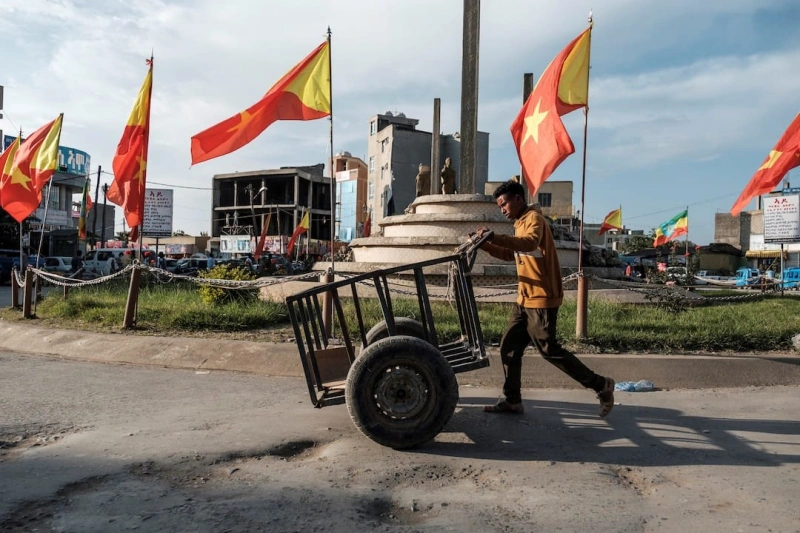

The man who led Tigray through one of this century’s bloodiest wars is back in charge. His return may have just triggered the Tigray peace deal collapse that the world had spent three years trying to prevent.
On 5 May 2026, the Tigray People’s Liberation Front convened what it called the sixth regular session of the Tigray State Council in Mekelle, the regional capital. The session had been suspended for three and a half years. When it ended, Debretsion Gebremichael had been sworn in as regional president and the Tigray peace deal collapse that many had feared was no longer a warning. It was a fact.
The council elected Debretsion by majority vote, with one vote against and three abstentions, before he took the oath of office. It also elected Kiros Hagos as speaker and Mihret Berkene as deputy speaker reports Addis Standard.
The move sent an immediate shockwave through Addis Ababa, the diplomatic community, and the camps of nearly one million Tigrayans still displaced from their homes.
The Peace Deal That Never Held
To understand why this moment is so explosive, it helps to understand what was supposed to happen.
The Pretoria Agreement, signed on 2 November 2022, ended two years of civil war that researchers say killed hundreds of thousands of people through direct violence, the collapse of healthcare, and famine. The agreement created an interim administration, established through dialogue between the TPLF and Ethiopia’s federal government, to govern Tigray until new elections could be organised.
That interim administration was led by Lt. Gen. Tadesse Worede. For nearly three years, it was the recognised governing body in the region. But the relationship between Tadesse and the TPLF was always uneasy, and by early 2026, it had completely broken down.
Last month, Prime Minister Abiy Ahmed announced the extension of Lt. Gen. Tadesse Worede’s tenure as chief administrator of the Tigray Interim Administration for an additional one-year term beginning on April 9, 2026. Federal authorities stated that extending the interim administration would provide additional time to consolidate the peace agreement.
The TPLF saw it differently. The TPLF accused the federal government of violating the Pretoria Agreement by extending the term of the interim administration’s president without consulting it. It also accused Addis Ababa of withholding funds for civil servants’ salaries and of provoking armed conflict in the region.
These grievances hardened into a decision. The Tigray peace deal collapse, in the TPLF’s framing, had already happened at the hands of the federal government.
A Rival Government in Mekelle
Tigray now has two men claiming authority over it from the same city.
Tadesse Worede has said he intends to remain in his post, creating two rival authorities. A day before the council session, he warned that the TPLF’s actions could spark renewed conflict.
Tadesse has framed the TPLF’s move in stark terms. According to reporting by Kulu Media, he told the people of Tigray that “the people of Tigray cannot afford another round of failure,” arguing that bypassing the interim structure violates the peace process and risks plunging the region back into conflict.
Meanwhile, old-guard figures in Tigray, including Debretsion Gebremichael, are said to be building ties with Eritrea and Sudan amid their standoff with the federal government. That detail matters enormously. Eritrea fought alongside the Ethiopian federal army during the 2020 to 2022 war, and its forces have never fully withdrawn from parts of Tigray. The idea that Asmara is now courting the TPLF’s leadership represents a dangerous realignment in the Horn of Africa.
Reports indicated that the Eritrean government is particularly interested in the election of Debretsion as president of the region. Addis Ababa has accused Eritrea of violating its sovereignty, while Eritrea, which still has troops in Tigray, has also made overtures to the TPLF.
Explosion Near the Presidential Offices
The political crisis has already touched the streets of Mekelle.
On Monday, the day before the council session, there was an explosion near the interim administration’s offices in the regional capital. The BBC’s Tigrinya language service quoted the police as saying a hand grenade had caused the explosion but that there were no casualties. It was not clear who may have been responsible.
Borkena reported that, following the council session, roads leading to the presidential offices in Mekelle were closed, and that there were reports of SU-27 fighter jets manoeuvring over Mekelle’s skies.
The federal government, as of Wednesday morning, had still not issued any statement.
The Warning From Scholars
Those who study the TPLF closely are not mincing their words.
Kjetil Tronvoll, a professor of peace and conflict studies at Oslo New University College and a scholar of the TPLF, told Reuters: “The decision by TPLF is clearly a major escalation. If mitigating efforts and a process of de-escalation are not introduced quickly, this may trigger the outbreak of new armed conflict.”
The Pretoria Agreement, Tronvoll noted, had already been under significant strain. Armed skirmishes have been breaking out since January between TPLF forces and the federal army and government-aligned fighters.
The Tigray peace deal collapse, in other words, did not happen overnight. It has been unravelling for months — in the hills as much as in the council chambers.
The Election Complication Behind Tigray Peace Deal Collapse
The timing could scarcely be worse.
Ethiopia is scheduled to hold national elections in June 2026. Tigray’s political crisis adds another layer of danger to a vote already taking place under fraught conditions. With the June 2026 national polls approaching, no mechanism for a Tigray-specific regional vote has been established.
The TPLF cannot legally contest the national election either. The National Election Board of Ethiopia had previously revoked the TPLF’s legal registration, and the party’s move to govern unilaterally appears to be an attempt to secure power ahead of national elections which the party is currently barred from entering.
Ethiopians in the diaspora are organising global protests in May against the upcoming June elections, arguing that conflicts and instability in several regions do not allow elections in the affected areas.
A Genocide Watch country report, cited by the Europe External Programme with Africa, warned that Ethiopia is sliding toward renewed mass atrocity risks amid rising tensions with Eritrea, ongoing violence in the Amhara and Oromo regions and with continued denial of the genocide and atrocities committed in Tigray.
A Humanitarian Crisis That Cannot Wait
Even before the Tigray peace deal collapse accelerated this week, the region was already living through a slow catastrophe.
The 2020 to 2022 war left the region’s health system in ruins. Hundreds of schools remain closed. In 2024, child malnutrition stood at 21% in some areas, far above the World Health Organisation’s threshold of 15% at which a situation is classified as an emergency.
The collapse of US foreign aid made everything worse. A consortium of aid agencies in Tigray had to stop distributions to the over one million people it had been responsible for feeding with US-provided grain. The closure of USAID not only ended food deliveries; it also forced the World Food Programme to close its office in Shire, which is host to one of the largest IDP populations in Ethiopia.
People are dying in the camps. In December 2025, Addis Standard documented that more than 1,700 internally displaced persons sheltering at the Hitsats IDP centre were facing a worsening hunger crisis, with repeated fatalities and growing numbers of people in critical condition due to severe food shortages and limited access to medical care.
By March 2026, the scale of death had become official. Gebrehiwot Gebregzabher, head of the Disaster Risk Management Commission, told Addis Standard that fuel allocations to the region had collapsed, saying: “We are unable to distribute even the limited resources we have because of fuel shortages,” adding that the fuel allocation to Tigray had dropped to 1.2 million litres from a previous level of 15 million litres.
In Kola Temben, a UN-led fact-finding mission found Global Acute Malnutrition rates of 62% in children under five, and over 70% in pregnant and lactating women.
If a military blockade returns to Tigray alongside the political crisis, these numbers will get significantly worse.
Europe and Britain Call for De-escalation
The international response has been measured, but urgent.
The European Union and Britain have called for de-escalation over the past week. The EU has separately allocated emergency humanitarian funding for Ethiopia and issued a formal statement calling for immediate de-escalation and urging all parties to avoid actions that jeopardise the Pretoria Agreement.
The United States was reportedly working to persuade TPLF leaders against taking actions that jeopardise the Pretoria Agreement. Despite those efforts, the council session went ahead regardless.
Neither Abiy Ahmed’s spokesperson Billene Seyoum nor TPLF representatives responded to requests for comment from Reuters.
What Next After Tigray Peace Deal Collapse
The window for a negotiated solution is narrow and closing.
Debretsion Gebremichael is now back in the position he held when the war began. Tadesse Worede refuses to leave. The federal government has yet to respond formally. And Eritrea, still with boots on Tigrayan soil, appears to be watching events in Mekelle with something approaching approval.
The Tigray peace deal collapse is no longer a hypothetical scenario that analysts warn about. It is the situation on the ground, as of today.
What comes next depends almost entirely on whether Addis Ababa chooses dialogue or force. Given that national elections are six weeks away, Prime Minister Abiy Ahmed faces a decision with consequences far beyond Tigray’s borders for the Horn of Africa, for the millions of Ethiopians already living on the edge of famine, and for a peace agreement that took a devastating war to produce.
The grenade outside the presidential offices in Mekelle may have harmed no one. But across the region, the Tigray peace deal collapse is now burning toward an unpredictable outcome.
Reported by AfricanQuarters. Additional source reporting from Reuters, Addis Standard, Ethiopia Observer, Al Jazeera, and PBS NewsHour.


