




A coordinated wave of attacks has struck multiple cities, penetrated Mali’s most fortified military zone, and triggered the most serious security crisis since the 2020 coup.
AfricanQuarters | Bamako Bureau
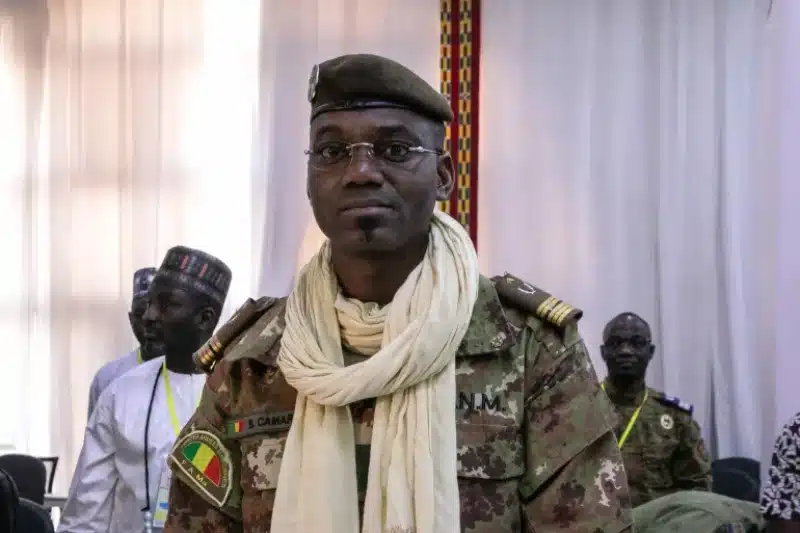
In the early hours before dawn, explosions tore through the residence of Mali’s Defence Minister Sadio Camara in Kati, a garrison town that has long been the nerve centre of the country’s military command. By the time the gunfire settled, the Mali security crisis had entered a new and dangerous phase.
Local sources and security-linked accounts described an initial blast followed by sustained gunfire. Camara, one of the most powerful figures in the current administration and a central architect of its security strategy, was reported killed. Early government statements had downplayed the incident, citing limited casualties. By the following day, family-linked sources indicated he had not survived.
Why Kati matters
Kati is not simply a town on the outskirts of Bamako. Situated roughly 15 kilometres from the capital, it is the operational backbone of Mali’s military command structure and one of the country’s most fortified zones.
A successful strike there signals that this Mali security crisis has reached beyond remote northern strongholds. It has now landed at the heart of the state itself.
A coordinated offensive in Mali security crisis
The assault on Kati was not an isolated incident. It was part of a broader, synchronised wave of violence that spread across multiple regions simultaneously, in a pattern analysts say has not been seen in Mali for years.
FLASHPOINTS IN THE CURRENT OFFENSIVE
- Kati – Camara’s residence struck; situation tense but stabilising
- Bamako – heightened security presence; curfew imposed
- Gao – reports of heavy fighting and attacks on military assets
- Sévaré – clashes near the airport and strategic installations
- Kidal – reportedly under separatist control; independent verification limited
The jihadist network Jama’at Nusrat al-Islam wal-Muslimin has been linked to the offensive, alongside separatist factions including the Azawad Liberation Front. Analysts note that the timing across locations suggests operational overlap between these groups, though the precise degree of coordination remains unclear.
Mali military leader moved to safety
As the Mali security crisis escalated, junta leader Assimi Goïta was reportedly moved to a secure location at the height of the Kati assault, a move that underscores how seriously the threat was assessed by those around him.
Additional unconfirmed reports suggest that senior military figure Oumar Diarra may also have been wounded during the unfolding violence. If accurate, the cumulative impact on Mali’s military leadership would represent a significant blow to command continuity at a moment when the country needs it most.
Russia’s security model tested
Camara was the figure most closely associated with Mali’s strategic pivot towards Russian-backed security partnerships, including the deployment of Africa Corps forces across the country’s conflict zones.
The experiences of the last two days, including reported losses in northern strongholds and attacks targeting air assets, have raised uncomfortable questions about whether that model can deliver what it promised. The Mali security crisis, as it now stands, suggests that external military support has not translated into durable territorial control, particularly in the historically volatile north.
Civilians caught in the crossfire
Beyond the military dimension, ordinary Malians are absorbing the cost of this Mali security crisis in the most direct way. Residents in affected areas have described a climate of fear, with explosions and gunfire continuing over extended periods.
Movement restrictions, including a curfew in Bamako, have disrupted daily life across the capital. Access to reliable information has remained limited, adding to the psychological toll on populations living near key military installations.
International alarm grows
The scale of the Mali security crisis has drawn urgent international attention. United Nations Secretary-General António Guterres condemned the violence and warned of the risk of further territorial fragmentation within Mali.
The United States embassy in Bamako issued a shelter-in-place advisory for American citizens in the capital. Regional governments within the Alliance of Sahel States are watching with concern, given their own ongoing struggles with insurgency.
A turning point, not just an escalation
Security analysts are careful to frame the current Mali security crisis as more than a tactical flare-up. The combination of a high-profile killing, a breach of the most protected military zone in the country, and simultaneous pressure across multiple regions points to a deliberate strategic shift by the groups involved.
Whether Mali’s government can stabilise the situation in this Mali security crisis in the coming days will determine whether this moment is remembered as a setback that was contained, or the point at which the balance of power in the country began to shift in ways that could not be reversed.
For now, the Mali security crisis has moved from the periphery to the centre, and the state’s capacity to respond is under greater strain than at any point since the 2020 coup.


