



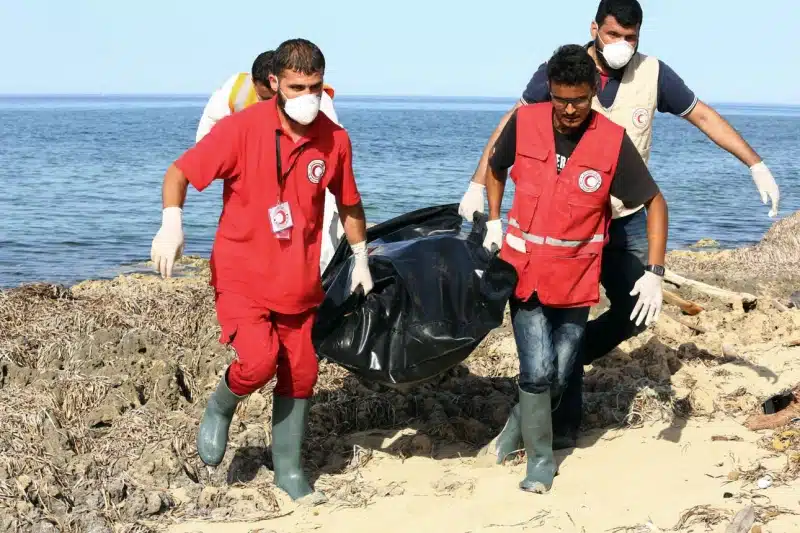

Calmer seas have brought more boats and more Mediterranean migrant deaths. The latest recoveries near Libya’s capital are a warning of what is to come.
AfricanQuarters.co – Libya / Central Mediterranean
The recovery, confirmed at approximately 15:45 Central Africa Time, is one of the largest single-location finds along the Libyan coast this season. Investigators believe the victims were part of one or more shipwrecks in the preceding 48 to 72 hours, the bodies carried inshore by coastal currents before they reached open waters.
The deadliest spring paradox
Every year, as winter subsides and seas quieten, smuggling networks along Libya’s western coast dramatically scale up their operations. It is a pattern so well established that aid organisations have given it a name: the spring calm paradox. The weather improves. More people attempt the crossing. Fewer survive it.
Departures are concentrated at two key hubs: Tajoura, east of Tripoli, and Zuwara, close to the Tunisian border. From these points, migrants board overcrowded, poorly maintained vessels and attempt the perilous crossing towards Italy through the Central Mediterranean route, one of the most dangerous migration corridors anywhere in the world.
Even under calm conditions, spring thermal winds, engine failures and vessel instability frequently cause boats to capsize within miles of the Libyan shore. The pattern observed in this latest incident, with bodies recovering close to the departure coast, suggests the vessel or vessels involved never reached deep international waters.
Fewer crossings, far more deaths
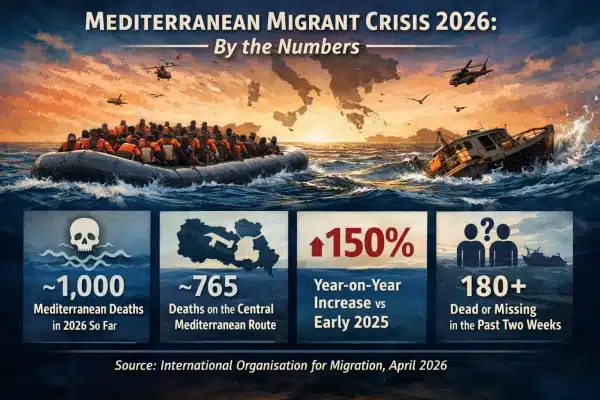
What makes the scale of Mediterranean migrant deaths in 2026 particularly alarming is the direction of overall arrivals. According to data from the International Organisation for Migration, the number of people reaching European shores has actually declined compared with previous years. Yet the proportion dying in the attempt has risen sharply. The mortality rate on the Central Mediterranean route is up 150 per cent compared with the same period in 2025.
In plain terms: fewer people are making the journey, but far fewer of them are surviving it.
“Over 180 people have been reported dead or missing on the Central Mediterranean route in the past two weeks alone,” the International Organisation for Migration has recorded this month.
A coastline already scarred by loss
Body recoveries along the Libyan coast are not unusual. They occur in clusters, often across several locations simultaneously, which points to multiple overlapping shipwrecks rather than a single incident. The Libyan Red Crescent and local authorities regularly carry out recoveries at sites including Qasr Al-Akhyar and Sabratha, coastal zones that have become grimly familiar markers of the wider crisis.
The absence of a coordinated maritime rescue system across Libya means many distress calls go unanswered. Rescue operations, when they do materialise, are frequently fragmented and delayed. Even minor mechanical failures on overcrowded vessels become fatal events before help can arrive.
Libya’s broken governance is part of the problem
The United Nations Support Mission in Libya raised fresh alarms in 2026 over the discovery of mass graves in the country’s east, systematic abuse within detention centres and the near-total impunity with which smuggling networks operate across politically fragmented territory. Libya’s divided governance structure makes any coherent migration management or search-and-rescue strategy effectively impossible to implement.
Migrants who do not drown face a separate ordeal. Human rights organisations have documented the conditions inside Libya’s detention and trafficking networks at length, describing abuse that begins long before anyone sets foot on a boat.
Key Departure Hubs
Tajoura (east of Tripoli) and Zuwara (near the Tunisian border) are the principal launch points for Central Mediterranean crossings from western Libya. Both areas operate with limited oversight under Libya’s fragmented governance arrangements.
Why “calm” is the most dangerous word in this crisis
The surge in Mediterranean migrant deaths in 2026 reflects a deadly equation that worsens precisely when conditions appear most favourable. Calm seas increase departure volume. Limited search-and-rescue capacity reduces the likelihood of timely intervention. A boat that might have been rescued in rougher conditions, when a distress call is more likely to prompt a faster response, goes down undetected.
The result is a counterintuitive and lethal reality: the sea is calmer, but Mediterranean migrant deaths are rising at an accelerating pace.
A warning, not just a tragedy
Seventeen bodies recovered along a single stretch of coastline is not merely a tragedy to report. Aid workers and migration analysts who track the Central Mediterranean route regard incidents of this kind as early-warning signals of what a full spring season typically brings: increased departures from western Libya, rising reports of missing vessels, additional body recoveries and limited international response to any of it.
The conditions that produced this week’s deaths remain entirely unchanged. The smuggling networks are operating. The boats are being prepared. And the sea, for now, is calm.


