



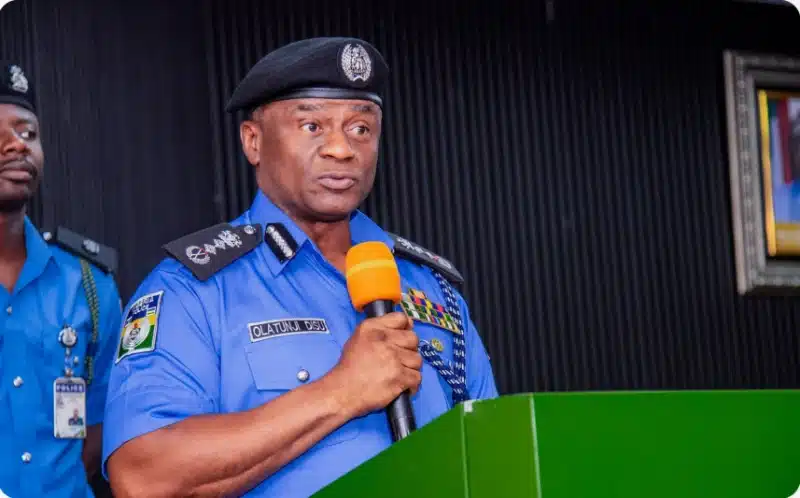

When Olatunji Disu took charge as Nigeria’s Inspector-General of Police in early 2026, few expected him to move so quickly. Within weeks, he had ordered one of the most sweeping Nigeria police redeployment exercises in recent memory, reshuffling senior officers across the country in what his office described as a reform drive.
The reaction has been anything but quiet.
What is actually happening
Between March and April 2026, IGP Disu authorised a large-scale restructuring involving Assistant Inspectors-General and Commissioners of Police. The Nigeria police redeployment exercise has touched some of the most sensitive positions in the force, from volatile frontline states to the corridors of VIP protection.
Officers once assigned to powerful political figures have been moved to high-risk postings in Kwara, Plateau, and Benue. Some Nigerians have cheered the move as long overdue. Many in the political elite have not.
A broken chain of seniority
Part of what makes this controversy cut so deep is that Disu’s own appointment broke convention. His elevation to IGP bypassed several more senior officers, unsettling the traditional hierarchy before the Nigeria police redeployment exercise had even begun.
For those passed over, the postings that followed felt like a continuation of the same pattern. Within the upper ranks, friction has turned into open unease.
Political pressure from above
The reform rhetoric coming from government has been consistent. The Minister of Police Affairs, Ibrahim Gaidam, has framed the broader effort as a push towards “professionalism, discipline, transparency, and the rule of law,” with the goal of building a “modern, accountable and citizen-focused institution.”
IGP Disu himself has pledged that “together, we will build trust and a safer Nigeria.”
But security analysts and civil society observers say the public statements are not backed by enough transparency. The absence of any detailed public justification for specific postings in the current Nigeria police redeployment exercise has fuelled speculation that the moves may not be purely administrative.
“What appears as routine redeployment may, in reality, be the early contours of a broader struggle over who controls Nigeria’s security machinery.”
A constitutional standoff
Adding to the unease is a running battle between the IGP’s office and the Police Service Commission. The two bodies have clashed over who holds authority on postings and retirements, producing conflicting directives that have left many officers uncertain about where they actually stand.
This institutional friction, analysts say, exposes unresolved constitutional ambiguities in how police oversight works in Nigeria. The Nigeria police redeployment controversy has become a proxy for a much bigger question: who, ultimately, controls the force?
Fears of political timing
Nigeria heads to the polls in 2027, and the timing of the current Nigeria police redeployment wave has not been lost on critics. Officers handling sensitive operations have been reassigned. Established seniority norms have been set aside. Security details protecting influential political figures have been pulled. Taken together, observers say the picture suggests a deliberate realignment of loyalties within the force, not a routine efficiency exercise.
The security backdrop makes that reading more troubling. Banditry and kidnapping remain serious problems across multiple states, and any sudden change in command structure carries real risk. New commanders take time to find their footing. Operational gaps open before they close. In Plateau and Benue, where violence has already cost lives this year, that window of vulnerability is not an abstraction.
The shadow of EndSARS
There is also a political memory to reckon with. If the current Nigeria police redeployment exercise is widely perceived as biased or destabilising, analysts warn it could trigger civil society backlash echoing the scale of the 2020 EndSARS protests.
That movement began as a reaction to police brutality and quickly became something much larger. The lesson of EndSARS is that public trust in the police, once lost, is extraordinarily difficult to regain.
What’s next in the Nigeria police redeployment saga
The police leadership insists the changes are driven by a single goal: “strengthening operational efficiency, enhancing leadership capacity and improving service delivery nationwide.”
But the credibility of that position depends on transparency, and transparency has been notably absent from this round of postings.
For many Nigerians watching closely, the ongoing Nigeria police redeployment saga is no longer simply about who sits in which command chair. It is about whether the country’s security apparatus can be trusted to remain independent from the political pressures that will only intensify as 2027 draws closer.
That question does not yet have an answer. But the way it is resolved will shape the institution, and the country, for years to come.


