



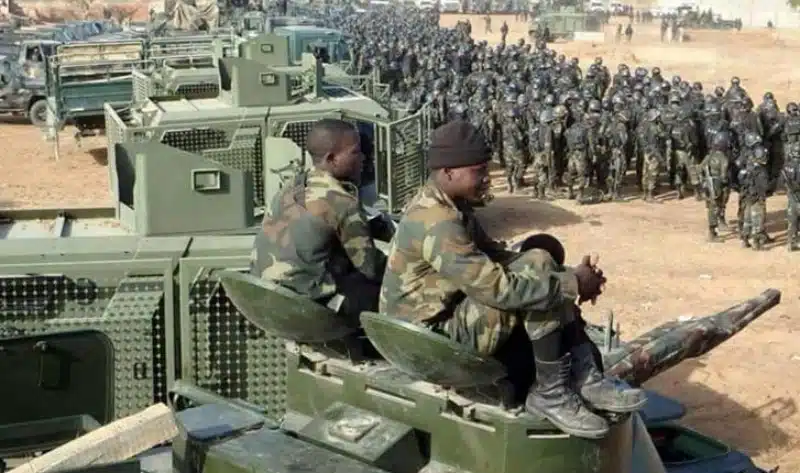

The Nigerian military says it has repelled a large-scale attack by suspected fighters of Islamic State West Africa Provinceon a military position in Mallam Fatori, a border town in Borno State, in what officials described as a Mallam Fatori attack that was repelled after several hours of fighting.
According to statements from Operation Hadin Kai, the incident occurred in the early hours of 18 March 2026 when insurgents advanced on the 68 Battalion from multiple directions.
Military officials say troops of the 68 Battalion came under pressure as fighters advanced on the position. The attack targeted a fortified base often described as a “super camp”, part of a broader defensive strategy adopted in recent years.
Residents in nearby settlements, speaking through local contacts, reported hearing sustained gunfire overnight, suggesting the engagement lasted several hours before the Mallam Fatori attack was repelled.
How Mallam Fatori Attack Unfolded
Early details from the area suggest the fighters did not approach from a single direction. Security sources familiar with the Mallam Fatori axis said the movement appeared to come from the Duguri side, with pressure applied at different points around the base.
That approach is different from the shorter raids more commonly reported in the area, where attackers strike quickly and withdraw. In this case, the pattern of movement suggested an attempt to probe the perimeter and find weak spots.
There were also reports from the field that drones were seen overhead during the Mallam Fatori attack. It is not yet clear how many were deployed or what type they were, but some sources believe they may have been used for surveillance and possibly to drop small explosive devices.
While the Nigerian military has not released detailed technical confirmation, analysts familiar with the conflict say such tactics are becoming more common among armed groups operating around the Lake Chad basin.
Troops on the ground were able to maintain their positions, according to official accounts, before air support was deployed.
The Nigerian Air Force later carried out targeted strikes in areas identified as insurgent gathering points, after which the attackers began to withdraw.
Casualties and Leadership Losses
Military statements indicate that around 80 insurgents were killed during the exchange linked to the Mallam Fatori attack.
In addition, three individuals described as senior ISWAP figures were reportedly among the dead:
-
Ibn Al-Goni (also known as Abba-Kaka)
-
Malam Musa
-
Abu Maryam
Their exact ranks and operational roles have not been independently verified. However, multiple security sources tracking insurgent activity in northern Borno say the names correspond to individuals previously linked to cross-border operations and local coordination.
Experts note that losses at this level can disrupt planning cycles within armed groups, particularly where commanders act as links between dispersed cells.
The Role of Air Support
The military credited air support with helping to stabilise the situation after the initial phase of the fighting.
Over the past two years, Nigerian operations in the northeast have increasingly relied on closer coordination between ground troops and air units. Defence analysts say this shift has improved response times, especially in remote locations such as Mallam Fatori, where reinforcement by land can be difficult.
In this case, air strikes appear to have targeted retreating fighters and assembly points beyond the immediate perimeter of the base.
Why Mallam Fatori Remains a Flashpoint
Mallam Fatori has been one of the more contested locations in the northeast for several years, largely because of where it sits on the map.
The town is close to Nigeria’s border with Niger, and people familiar with the area say the surrounding routes have long been used to move goods, fuel and, at times, armed groups across the Lake Chad region.
Holding the town gives the military a vantage point over those movements, especially along the border corridor. It also supports operations deeper into northern Borno State, where access can be difficult without a forward position like Mallam Fatori.
The town has also taken on added importance in recent years due to efforts by the Borno State Government to return displaced residents. Governor Babagana Zulum has repeatedly visited the area as part of a broader resettlement programme aimed at restoring civilian life under military protection.
For security planners, holding the town after the Mallam Fatori attack was repelled is therefore not only a military objective but also part of a longer-term stabilisation effort.
Wider Context and What Comes Next
The mention of drones in this attack, even without full technical details, points to a shift that security watchers in the Lake Chad region have been quietly noting for some time. Armed groups are making more use of small, commercially available technology, whether for surveillance or to support attacks on fixed positions.
It is still unclear how consistent or widespread that capability is in northeastern Nigeria, but incidents like this suggest it is no longer isolated.
At the same time, the broader pattern of the conflict has not changed overnight. Military operations under Operation Hadin Kai have recorded gains in some areas, particularly around key bases and supply routes. But fighters linked to Islamic State West Africa Province have also shown they can regroup and test those positions again, sometimes within weeks.
In recent days, there have been several reports of clashes across parts of Borno State, including incidents that resulted in military casualties. That context makes the defence of Mallam Fatori significant for those on the ground, even if it does not, on its own, signal a broader shift in the conflict.
What can be said with some confidence is that the Mallam Fatori attack was eventually repelled in the early hours of 18 March, after a military position was targeted and air support deployed.
Other details are less clear. The casualty figures released so far have not been independently verified, and there is still limited information about the identities of those reported killed or the exact type of equipment used during the assault.
For now, much of the picture relies on military briefings and local security reporting from the area. As with many incidents in the Lake Chad basin, a fuller account may only emerge over time.


