



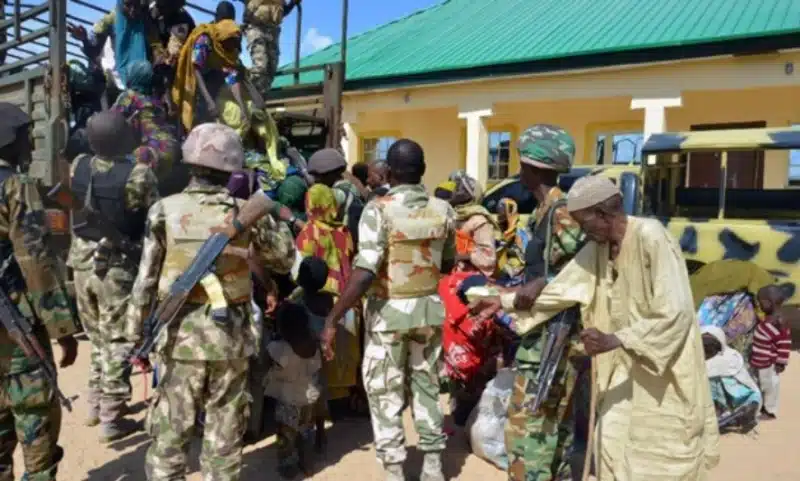

A wave of militant attacks across Borno State has pushed the Northeast Nigeria security crisis into a dangerous new phase after gunmen raided the town of Ngoshe and abducted hundreds of residents.
Local officials say more than 300 people, mostly women and children, were taken during the assault on 6 March, while Nigerian troops were simultaneously engaged in clashes with insurgents in several nearby locations.
Security officials say the latest violence highlights growing pressure on Nigerian forces as militant factions continue to adapt their tactics across the wider Lake Chad Basin.
Recent Attacks
In the past several days, Borno State has experienced one of the most significant bursts of insurgent activity in months, with the town of Ngoshe emerging as the centre of the crisis.
Local officials and security sources report that militants carried out a large scale raid on 6 March, abducting more than 300 people, most of them women and children.
The attack triggered panic across surrounding communities and forced hundreds of residents to flee toward safer towns.
During the same period, Nigerian military units engaged militants in several locations across the state, including:
-
Konduga
-
Marte
-
Jakana
Military authorities confirmed that several soldiers, including a senior officer, were killed during clashes while attempting to repel the assaults.
Local officials believe the surge in attacks may have been retaliatory following a Nigerian military operation earlier in the week that reportedly eliminated three senior Boko Haram commanders.
Understanding the Northeast Nigeria Security Crisis
Security experts increasingly describe the Nigerian military as confronting a highly adaptive insurgency that blends traditional guerrilla warfare with newer technologies and rapid mobility tactics.
Weaponised Drones
Militant factions linked to Boko Haram and the Islamic State West Africa Province (ISWAP) are believed to be using modified commercial drones for battlefield reconnaissance and limited aerial attacks.
While the drones are relatively simple, analysts say they allow militants to:
-
track troop movements
-
identify vulnerable military bases
-
launch improvised aerial strikes
The tactic reflects a broader trend across insurgent conflicts in Africa and the Middle East, where low cost drone warfare is becoming increasingly common.
The Motorbike Blitz
Another hallmark of the current insurgency is the use of large motorbike convoys.
In many recent attacks, fighters have arrived in large groups on motorcycles, moving quickly through rural tracks and surrounding villages or isolated military posts.
Witnesses say the attackers often leave the area just as quickly, disappearing into nearby forests or bushland before security reinforcements reach the scene.
Internal Rivalries Among Militants
The insurgency is also shaped by a continuing rivalry between:
-
Boko Haram’s Jama’atu Ahlis Sunna Lidda’awati wal-Jihad (JAS) faction
-
Islamic State West Africa Province (ISWAP)
Security monitoring groups estimate that more than 200 militants have been killed in clashes between the rival factions in recent months.
Although these internal conflicts weaken the groups militarily, they can also lead to increased attacks on civilians as factions compete for recruits, territory and resources.
Regional Implications: The Lake Chad Basin
The conflict has long spilled beyond Nigeria’s borders. Militant groups operate across the Lake Chad Basin, affecting communities in Nigeria, Chad, Niger and Cameroon and forming part of the wider Lake Chad Basin insurgency.
Security operations in the region are coordinated through the Multinational Joint Task Force (MNJTF), a coalition created to allow the four countries to pursue insurgent fighters across their shared borders.
However, security analysts say progress has been limited in clearing the Tumbuns, marshy islands in Lake Chad that serve as long standing militant strongholds.
The Multinational Joint Task Force mandate is due to expire later this year, a development officials say could affect how regional operations are coordinated going forward.
Signs of Geographic Expansion
Security agencies are also monitoring reports that suggest insurgent activity may be appearing outside the group’s traditional strongholds in northeastern Nigeria.
Some recent reports point to suspected Boko Haram linked attacks or recruitment networks in parts of North Central Nigeria, including Kwara State.
Authorities have not confirmed a sustained militant presence in the area, but officials say the reports are being investigated.
Growing Humanitarian Emergency
The violence is unfolding at a time when humanitarian agencies are already warning of growing food shortages across northern Nigeria.
The World Food Programme (WFP) warns that funding for emergency food assistance in the country could be exhausted by March 2026.
Key indicators include:
-
35 million people projected to face severe food insecurity this year
-
150 nutrition clinics already closed in Borno and Yobe states
-
Hundreds of thousands of children at risk of acute malnutrition
Humanitarian organisations warn that continued insecurity could make aid delivery increasingly difficult, especially in rural communities already isolated by conflict.
Security Snapshot: Early 2026
| Metric | Status / Trend | Key Drivers |
|---|---|---|
| Primary Actors | ISWAP, Boko Haram factions, emerging armed groups | Increasing use of drones and night vision equipment |
| Civilian Impact | Rising | Large scale kidnappings and village raids |
| Military Pressure | Increasing | Attacks on bases and ambushes of patrols |
| Geographic Scope | Expanding | Possible movement into North Central Nigeria |
| Humanitarian Situation | Critical | Food insecurity and aid funding shortages |
Outlook
The attacks reported in early March show that militant groups remain active across parts of northeast Nigeria, despite years of military operations aimed at weakening them.
Officials say the Northeast Nigeria security crisis continues to pose serious security challenges in the region as Nigerian forces and their regional partners attempt to contain the insurgency.
Analysts warn that unless military pressure, regional coordination and humanitarian support improve simultaneously, the conflict risks entering another prolonged and destabilising phase for northeast Nigeria and the wider Lake Chad region.


