




ABUJA, Nigeria – Security forces have saturated the streets of Nigeria’s capital following a critical US Embassy Abuja security alert triggered by the global fallout of the assassination of Iranian Supreme Leader Ali Khamenei.
The alert, issued late Tuesday, warned of a “high potential” for violent demonstrations in the Federal Capital Territory (FCT). As the Middle East slides toward a broader regional war following the February 28, 2026, airstrikes, the shockwaves are being felt acutely in Abuja, where pro-Iranian groups and Western diplomatic missions are now on a high-stakes collision course.
Visa Appointments Halted as Tensions Peak
The most immediate impact of the US Embassy Abuja security alert has been the total suspension of routine consular operations. Embassy officials confirmed that all visa interviews scheduled for Wednesday, March 4, and Thursday, March 5, 2026, have been abruptly cancelled.
Applicants who were scheduled for these dates are reportedly being notified via email and SMS. The Mission has clarified that these appointments will be rescheduled automatically once the security posture returns to “Level 1.” In an urgent advisory, the mission implemented a “shelter-in-place” recommendation for American personnel, warning that protests could materialize with “little to no warning” at traditional flashpoints like the Eagle Square or the Wuse II diplomatic enclave.
While the gates are closed for standard visas, the embassy remains open for Emergency American Citizen Services, and the United States Consulate General Lagos continues to operate under heightened surveillance, albeit with restricted public access.
The “IMN Factor”: Protests Sweep Nigerian Cities
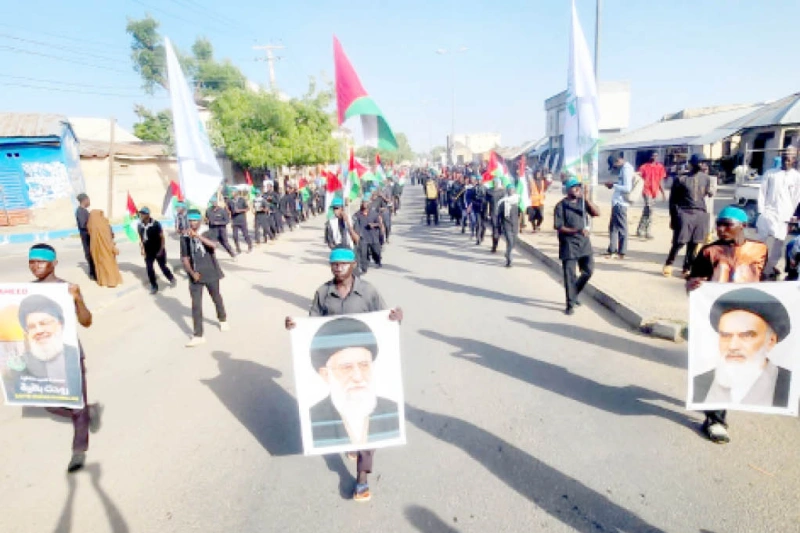
Nigeria’s internal security response is being driven by the rapid mobilization of the Islamic Movement in Nigeria (IMN). The Shiite group, which maintains deep ideological and spiritual ties to Tehran, has already begun staging “solidarity processions” across the federation.
Reports confirmed by AfricanQuarters indicate that demonstrators carrying portraits of the late Khamenei and chanting anti-Western slogans have emerged in several states:
-
Kaduna and Sokoto: Traditional strongholds of the movement where security forces have already used tear gas to disperse crowds.
-
Lagos: Scattered “flash protests” reported near the Ojota and Ikeja axis.
-
Niger State: A massive procession was sighted along the Suleja-Abuja corridor, moving toward the capital’s borders.
The primary concern for the Nigeria Police Force (NPF) and the Department of State Services (DSS) is a “convergence event,” where these groups attempt to bypass checkpoints to storm the Three Arms Zone—the nerve center of Nigerian power housing the Presidential Villa and National Assembly.
Armoured Units Encircle the Capital
By daybreak on Wednesday, the physical manifestation of the US Embassy Abuja security alert was visible across the city’s main arteries. Armoured Personnel Carriers (APCs) and elite Mobile Police units have established “choke points” to filter traffic entering the city.
Heavy deployments are currently concentrated at:
-
The Mararaba–Nyanya Expressway: To intercept protesters entering from Nasarawa State.
-
Wuse II and Maitama: Perimeter security has been tripled around foreign missions and the residences of senior diplomats.
-
The Airport Road: Security details are conducting “stop-and-search” operations to ensure the city’s main international gateway remains secure for diplomatic transit.
Global Context: Operation “True Promise 4”
The volatility in Abuja is a mirror of the chaos in the Persian Gulf. Following the death of Khamenei, Iran’s Islamic Revolutionary Guard Corps (IRGC) launched “Operation True Promise 4.” Retaliatory missile strikes have already hit US military facilities in Qatar, the UAE, and Bahrain.
With unconfirmed intelligence reports suggesting drone threats targeting Western interests globally, the Abuja mission’s decision to “go dark” on public services is part of a standardized defensive posture by the US State Department for missions located in high-sentiment regions. Security analysts suggest that Nigeria is viewed as a “high-risk theater” because of the historical friction between the state and the IMN, which has previously led to lethal clashes in the capital.
Advisory for Abuja Residents and Travelers
Security officials are urging FCT residents to exercise extreme caution and maintain a low profile. Common gathering points for activists, such as Wuse II and the Central Business District, should be avoided entirely until at least the end of the week.
“The situation is incredibly fluid,” a senior security source told AfricanQuarters. “The US Embassy Abuja security alertis a necessary precaution based on shared intelligence, but our primary mandate is to ensure that international grief does not translate into local carnage. We are operating on a zero-tolerance policy for unauthorized processions within the city center.”
Key Safety Recommendations:
-
Carry Identification: Ensure you have valid government-issued ID at all times.
-
Avoid Crowds: If you see a gathering forming, move in the opposite direction immediately.
-
Check Flight Status: If traveling via Nnamdi Azikiwe International Airport, allow an extra 3 hours for security checkpoints.
-
Monitor Official Channels: Follow the @USEmbassyAbuja and @PoliceNG social media handles for real-time updates.
For now, the capital remains in a state of “watched calm,” as the world waits to see if the funeral rites for Khamenei in Tehran will trigger a further escalation of violence on the streets of Abuja.


