



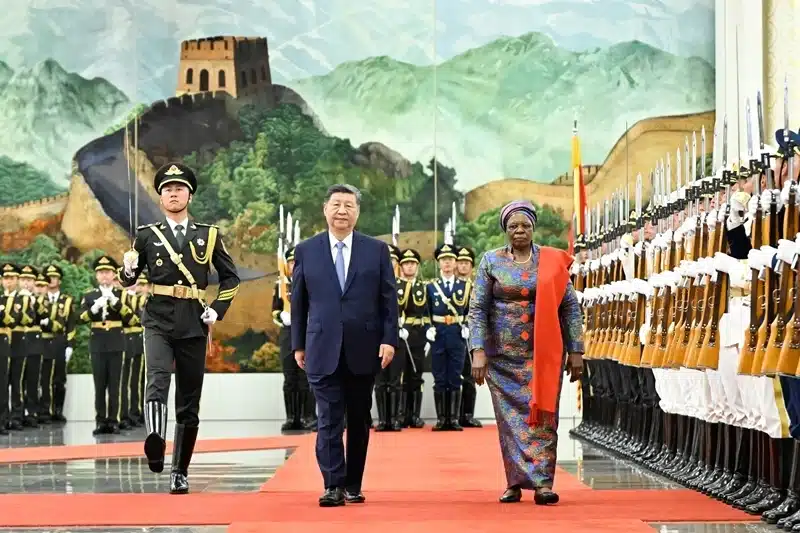

The Namibia China partnership now spans infrastructure, mining, energy, agriculture and green minerals. A joint statement from the two governments said the two sides jointly announced the elevation of bilateral relations to a China-Namibia community with a shared future for the new era. Namibia and China first established diplomatic ties in 1990 and upgraded to a comprehensive strategic partnership in 2018, a foundation both leaders referenced as they widened the relationship further.
Central to the new Namibia China partnership is a firm commitment to processing minerals inside Namibia rather than exporting them raw. The official joint statement recorded that the two sides recognised the strategic importance of critical minerals to global economic transformation and agreed to strengthen cooperation in sustainable development, local processing, beneficiation and value addition of Namibia’s mineral resources, including uranium, lithium, rare earth elements, and other strategic minerals.
Reuters reported that Xinhua’s own readout of the meeting stressed the same point, noting that both sides recognised the strategic value of critical minerals and agreed to strengthen cooperation in the development of key minerals such as uranium, lithium and rare earths.
Beneficiation is not a token line in the text. Reporting on the visit noted that the statement emphasised the role of promoting local processing, a theme raised recently by a number of African commodity producers, alongside technological transfer and local skills development. For a Namibia China partnership that has historically leaned on raw uranium sales, this marks a deliberate shift toward keeping more value, and more jobs, on Namibian soil.
Uranium remains the backbone of that trade relationship for now. Namibia sends roughly a quarter of its total exports to China, and of the $1.3 billion worth of Namibian goods China bought last year, uranium accounted for 85 percent, according to a recent IMF report cited in the coverage. Chinese capital already runs deep in the country’s resource sector too, with Chinese firms having invested $4.2 billion in Namibia, data from the American Enterprise Institute think tank shows, nearly all of it channelled into the country’s metals sector.
Beyond minerals, the Namibia China partnership touches oil and gas, agriculture, education and science and technology. Xinhua’s readout of the Beijing talks quoted China pledging to deepen cooperation with Namibia in infrastructure construction, energy, minerals, agriculture, education, youth, and science and technology. Namibia is also positioning itself as a rising oil producer, since Shell and TotalEnergies have already discovered an estimated 2.6 billion barrels of crude offshore Namibia, with production expected to begin before the end of this decade, a development that could push the country into Africa’s top four oil producers by 2030.
Nandi-Ndaitwah, who took office in 2025 and made China her first state visit outside Africa, told her hosts that Namibia holds an unwavering commitment to this longstanding friendship between Namibia and China, noting her delegation included dozens of business people. Xi, in turn, told her that choosing Beijing first showed the importance she attaches to this significant relationship, for which he expressed his appreciation.
The visit fits into Nandi-Ndaitwah’s broader economic agenda. She used her inauguration speech to call for a green revolution built on monetising the country’s agricultural sector and water resources, while the IMF has pointed to agriculture, fisheries, oil and gas, and green hydrogen as the sectors most likely to create jobs as Namibia works through high unemployment and inequality.
For Windhoek, the Namibia China partnership offers capital and technology at a moment when the country is trying to convert mineral wealth into industrial capacity rather than simply shipping ore abroad. The Namibia China partnership could also accelerate domestic manufacturing and skills development. Whether local processing commitments translate into refineries and jobs on the ground will now depend on how quickly both governments move from joint statements to actual construction.


