



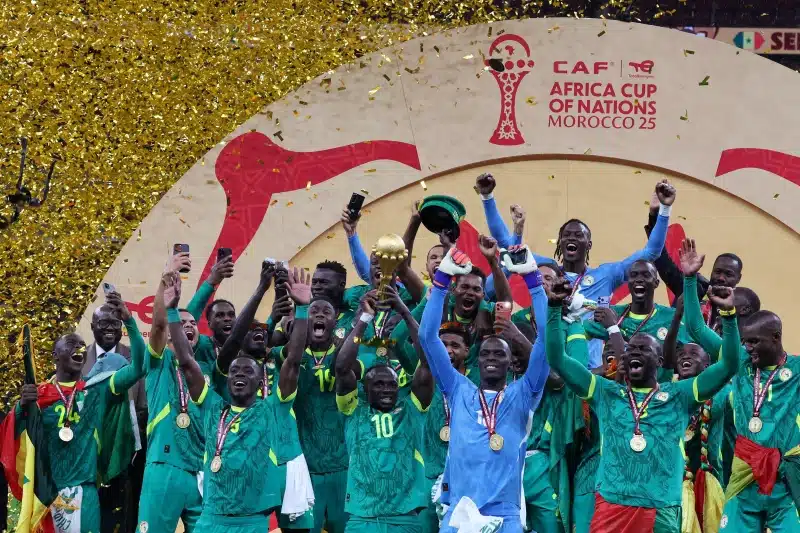

Senegal lifted the trophy in January. They lost it in March. On Tuesday, they got it back.
The Court of Arbitration for Sport has handed the Senegal AFCON title back to the Teranga Lions, ending a ten-month fight over one of the most contentious finals in African football.
CAS said the Senegalese Football Federation’s appeal was upheld unanimously. The 1-0 extra-time win in Rabat stands. CAF’s decision to award Morocco a 3-0 victory has been set aside.
It is a dramatic reversal for a match that had plenty of drama already.
The final was goalless deep into stoppage time on 18 January. Senegal had just seen a goal disallowed when referee Jean-Jacques Ndala went to the VAR screen and awarded Morocco a penalty for a foul by El Hadji Malick Diouf on Brahim Diaz.
Senegal coach Pape Thiaw told his players to leave the pitch. They did.
For roughly a quarter of an hour, the biggest match in African football had no Senegal players on it. Sadio Mane went into the dressing room and helped bring his team-mates back out.
Then came the twist. Diaz attempted a Panenka penalty, but Edouard Mendy saved it. In extra time, Pape Gueye scored the winner, giving Senegal their first goal in an AFCON final.
Morocco, the hosts, were chasing a first continental crown in 50 years. They had lost on the pitch. They went after the Senegal AFCON title in the boardroom instead.
CAF’s disciplinary board initially left the result intact on 28 January. It banned Thiaw for five matches, fined him $100,000 and imposed fines on both federations. The 1-0 score stood.
Morocco appealed. On 17 March, CAF’s appeal board reversed that position. It ruled that Senegal had left the field without permission, applied Articles 82 and 84 of the tournament regulations, and awarded Morocco a 3-0 victory and the trophy.
Senegal’s federation called the decision “unfair, unprecedented and unacceptable”. It registered an appeal at CAS on 25 March.
Three arbitrators, Gérald Simon, Luigi Fumagalli and Ulrich Haas, heard the case in Lausanne on 8 October. The parties did not agree to an expedited process, so the case followed the standard CAS timetable. On Tuesday, the court said the full grounds had been issued to the parties. The wait over the Senegal AFCON title stretched into late November.
The whole case over the Senegal AFCON title hinged on one whistle.
CAS said the referee’s decision to resume the match fell within his authority. When Ndala blew his whistle, both teams were back on the pitch and had expressed their willingness to continue.
The panel applied the “field of play” doctrine, under which refereeing decisions during a match are generally not reviewed unless there is evidence of arbitrariness or bad faith. Articles 82 and 84, it said, apply when a team’s conduct leads the referee to abandon a match permanently. That did not happen in Rabat, so the articles did not apply.
CAS concluded that Ndala had not made an error of law in restarting the game. That is the legal basis for restoring the Senegal AFCON title.
The distinction matters. The panel did not endorse Senegal’s walk-off or rule that it was acceptable. It said CAF used the wrong rule to overturn the result. CAS said the full grounds had been issued to the parties, although the award’s full wording is what will carry legal force.
That matters beyond Dakar. Thiaw’s ban and fine came from separate disciplinary proceedings, and they do not automatically fall away because the Senegal AFCON title has been restored.
Hours before the verdict, Reuters reported that Morocco’s federation had raised an alleged phone call between Senegal federation president Abdoulaye Fall and one of the arbitrators. Reuters said it could not independently verify whether the call took place or establish what was discussed.
Senegal’s federation denied that any call had taken place. CAS had earlier told AFP it had received no correspondence from the Moroccan federation about an incident as of Tuesday morning. The competing accounts remain allegations, not findings in the CAS ruling.
CAF president Patrice Motsepe had said the confederation would respect and implement whatever CAS decided. Morocco captain Achraf Hakimi had also said before the ruling that his country would accept it.
Morocco could still challenge the award at the Swiss Federal Tribunal, but the grounds are limited. It would not amount to a rehearing of the football match.
After CAF’s March decision, Motsepe said the final showed that work was needed to address “suspicion and a lack of trust”.
This verdict does not repair that trust. It does settle who owns the Senegal AFCON title, after months of uncertainty over Senegal’s status as champions.
A whistle on a Rabat night decided the match. It took ten months and a Swiss court to settle the dispute over the Senegal AFCON title.


