



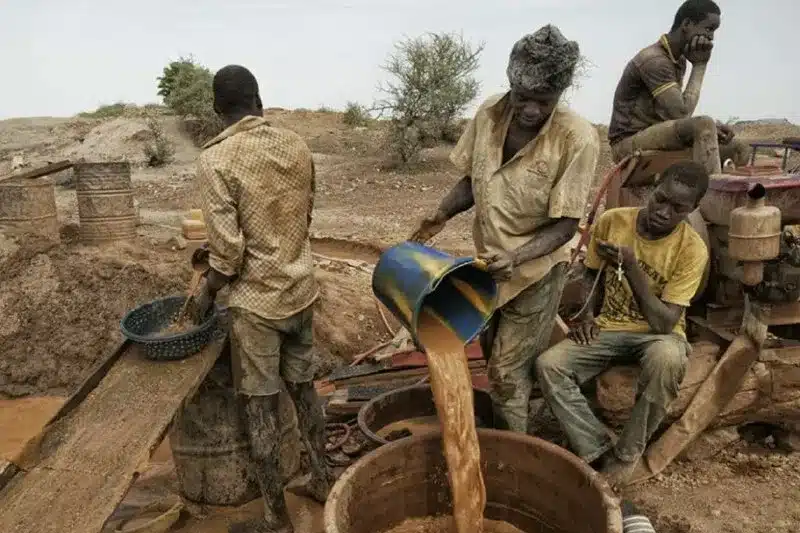

Ten people died in Siguiri on Wednesday, nine days after Guinea’s artisanal mining ban took effect. The same day, a court in Conakry opened the trial of more than 1,200 people accused of illegal gold mining. They had been arrested in Siguiri, the district where the shooting took place.
The government’s account is short. The Ministry of Territorial Administration said late on Thursday, in a statement reported by Reuters, that defence and security forces were checking compliance with the artisanal mining ban when protesters blocked public roads with barricades. Gunfire followed. The ministry counts ten dead and 13 injured. Five of the dead were foreign nationals, but it did not name their countries. It describes the figures as provisional.
Who fired first? The statement, as reported, does not say. Nor does it explain how the dead are split between civilians and security personnel. The government says prosecutors have been asked to establish responsibility.
Officials give an environmental reason for the artisanal mining ban. They blame unregulated digging for polluted farmland and rivers and for stripped vegetation. Foreign Minister Morissanda Kouyaté said, in remarks reported by AFP, that ‘environmental protection cannot be sacrificed in the name of African brotherhood’.
The numbers explain the force. Guinea’s mines ministry says artisanal miners supplied about 50 of the 70 tonnes of gold the country exported in 2025. The artisanal mining ban therefore targets the biggest source of Guinean gold, even though it applies only to the north-east.
Follow the dates. In June, President Mamadi Doumbouya banned raw gold exports and ordered all gold refined at home. Guinea has since launched its first gold refinery. A refinery needs a steady, traceable supply, and the state has long struggled to oversee the miners who provide most of it. Although the government presents the crackdown as an environmental measure, its timing also fits a broader push to control where Guinea’s gold goes and who profits from it.
Kouyaté has said the prohibition is not new, pointing to joint orders signed in 2015. What has changed is the willingness to enforce it. The crackdown has been extensive.
AFP reported that a joint statement from the defence and security ministries, dated 7 November, put the number of arrests at 1,263. They came from Guinea, Burkina Faso, Mali, Togo, Niger, Ivory Coast and Ghana. At the Conakry trial, lawyer Abou Camara argues the accused are being made to answer for others. ‘We must not use my clients as scapegoats,’ he said.
A number of local officials have also been struck off over claims they allowed illegal mining. Their lawyer, Sidiki Berete, says no money changed hands.
The enforcement campaign has pushed the fallout across Guinea’s borders. AFP reported that Malian authorities count about 100,000 arrivals in Bamako and nearly 60,000 more in the border town of Kouremale. Mali’s government has recorded 11 deaths linked to the displacement.
Burkina Faso says 45,406 people have reached its territory in repatriation operations, 9,852 of them children. Its security minister, Mahamadou Sana, spoke of ‘inhumane and degrading treatment’ and said Ouagadougou had no advance notice of the operation.
Seydou Traore, a Burkinabe miner now in Mali, told AFP he had no time to collect his tools or savings. ‘I’m going home with nothing, ruined,’ he said.
Mali has a further worry. A security ministry official told AFP that ‘these people are vulnerable’ and that authorities are looking at ways to keep armed groups from approaching them. The Institute for Security Studies had already warned, in August, that weak oversight of artisanal mining is a security gap for Guinea, and it urged formalisation.
Guinea’s artisanal mining ban takes a different route.
Siguiri has seen this mix before. Human Rights Watch said security forces reportedly opened fire on protesters during unrest over power cuts in June 2018, killing two and injuring at least 10. In October 2025, prosecutors charged 60 people with arson, theft and murder after a riot at the Weily Mining site in which two people died. A mine, a crowd and armed forces: the combination is familiar.
So the hard question is one the statement does not answer. How does Guinea enforce the artisanal mining ban across a district where thousands earned a living, without more bloodshed?
Conakry says the artisanal mining ban will protect its farmland and rivers. After Wednesday, the human cost of enforcing it is being counted in lives, and the count is still provisional.


