



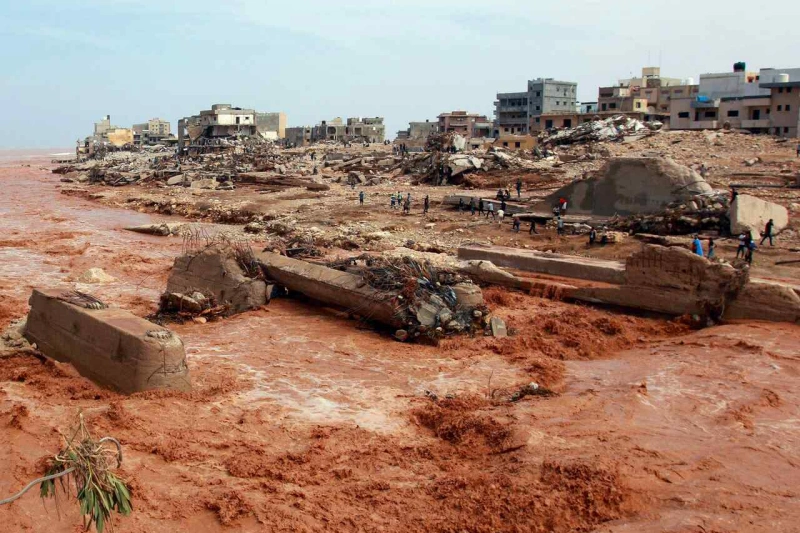

Libya flash floods left towns south of Tripoli without power, water and road access after torrents swept through valleys rarely touched by heavy rain.
A wall of mud swept through Mizdah in the dead of night, dragging cars, lamp posts and whatever else stood in its path. By Saturday morning, the scale of the Libya flash floods was becoming clear across north-western Libya.
The rain began late on Thursday and did not let up. By Friday, the Libya flash floods had turned wadis, the dry riverbeds that thread through this semi-desert stretch south of Tripoli, into raging channels of water and debris. Mizdah, a town of fewer than 30,000 people, bore the brunt.
One person died. A passerby was rushed to Mizdah General Hospital but could not be saved, the Libyan television channel Al-Masar reported. At least 79 others were injured, according to Xinhua, in a town where heavy rainfall is so rare that few buildings were built to withstand it.
Mizdah’s municipal spokesman, Omar Kachaka, told local television the floods caused “a widespread power outage after numerous electricity poles fell.” Landslides followed. The municipality declared a state of emergency and told residents to stay indoors and away from the valleys still filling with water.
About 170 kilometres south of Tripoli, in Bani Walid, the Libya flash floods forced rescue teams to spend the night pulling residents from vehicles swept away by mudflows. The security directorate there shut the road to Tarhuna after Wadi Washtata burst its banks, warning drivers not to attempt a crossing. Bani Walid General Hospital said it had treated several people who had nearly drowned in the Tininai area and put its staff on round-the-clock alert.
Further south, in Nasmah, the mayor, Ahmed al-Sid, declared his municipality a disaster zone. He cited extensive damage from the rain and from wadis that overflowed faster than anyone expected in a district accustomed to dust, not floodwater. High-voltage transmission towers came down in the wider region, and at least one bridge was destroyed.
This is the contradiction sitting at the heart of the Libya flash floods. These are not coastal towns built to flood. They are inland, semi-arid communities where a downpour like this should be a once-in-a-generation event. Instead, it arrived with almost no warning and overwhelmed roads, hospitals and power grids built for a drier climate.
Prime Minister Abdulhamid Dbeibah ordered authorities to mobilise resources immediately “to ensure a rapid response,” his office said. He directed teams to clear roads and restore electricity, drinking water and telecommunications. Local Government Minister Mohamed Ben Ghalboun went further, granting Mizdah’s mayor full emergency authority and releasing emergency budget funds to cover urgent needs.
The Government of National Unity also tasked its Air Ambulance Service with evacuating residents from Al-Shqaiqah, roughly 170 kilometres south of Tripoli, and flying urgent medical cases to specialist facilities. Tripoli’s electricity company activated its emergency operations room and put maintenance crews on standby for grid faults expected to spread as the water recedes.
Government agencies scrambled to respond as the Libya flash floods disrupted power, transport and communications across several municipalities. Emergency teams worked to reopen roads and reconnect isolated communities while officials assessed damage to public infrastructure.
None of this happens in a vacuum. Libya is still living with the memory of September 2023, when Storm Daniel breached two dams above Derna and killed more than 4,000 people, according to Libyan authorities at the time. That disaster exposed how little of the country’s infrastructure, split for years between rival governments, had been maintained. Two years on, the Libya flash floods in Mizdah, Bani Walid and Nasmah suggest the underlying vulnerability has not gone away, even if the scale this time is far smaller.
Authorities have not confirmed further deaths beyond the one recorded in Mizdah, and officials stress the situation remains fluid as rain continues to fall in parts of the west. Communications in some of the worst-hit valleys remain patchy, which means the true injury count could still climb once rescue teams reach areas currently cut off by washed-out roads.
For families in Mizdah, Bani Walid and Nasmah, the immediate concern is simpler than politics or infrastructure audits. It is whether the Libya flash floods recede before the night comes again.


