



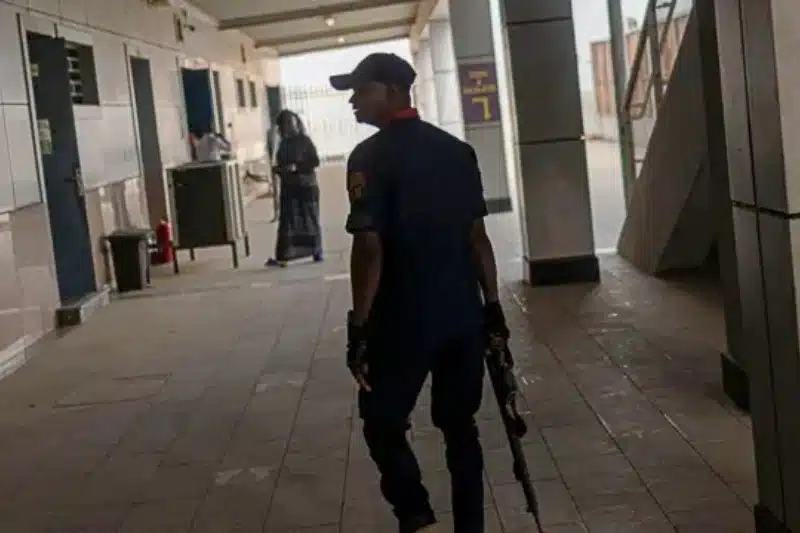

For hours, men trapped inside an overcrowded cell in Minna banged on a locked door, gasping for air that never came. By dawn on 17 September, dozens of them were dead in what is now trending as Nigeria’s Minna mining deaths, one of the country’s worst recent detention tragedies.
The Nigeria Security and Civil Defence Corps had arrested them two days earlier. Officers raided illegal mining sites near M.I. Wushishi and Lukoto, on the edge of Niger State’s capital, seizing suspected miners and mining equipment on 15 and 16 September.
What followed has become one of the most disturbing custody scandals in Nigeria in years. The Nigeria’s Minna mining deaths have already triggered a federal suspension, a state period of mourning, and a demand from Amnesty International for an independent inquiry.
Conflicting Accounts Emerge
NSCDC’s first explanation pointed to illness. State commandant Suberu Siyaka Aniviye said the detainees had died in the early hours of 17 September “following a suspected outbreak of disease,” without naming the illness involved.
A source at Minna General Hospital, where the bodies were taken, put the toll at 33 and pointed to diphtheria. Other officials, including the state governor, cited a higher figure of 37. Neither number has been formally confirmed pending post-mortem results.
An internal security assessment offered a different account. It found that around 65 detainees had been packed into a single holding cell, and that overcrowding and poor ventilation, not infection, were the more likely trigger behind the Nigeria’s Minna mining deaths.
One survivor, named only as Shehu, told the Associated Press that detainees “could not breathe” and scrambled for air as others banged on the cell door for help.
Public anger intensified as details of Nigeria’s Minna mining deaths spread across Niger State.
Shafatu Sulaiman, who lost two sons in the cell, appealed to the government for answers at the hospital where the bodies lay. Overnight, protesters in M.I. Wushishi and nearby Mekunkle damaged vehicles and property, according to a security briefing on the unrest.
Niger State Governor Mohammed Umaru Bago confirmed the toll and called it tragic. He declared three days of mourning, postponed a ruling party rally due in Minna, and pushed back the start of campaigning for elections scheduled for January.
Federal Probe Ordered
The Nigeria’s Minna mining deaths reached Abuja within a day. Police commissioner Adamu Elleman ordered the state criminal investigation department to open a probe.
Interior Minister Olubunmi Tunji-Ojo went further on 18 September, suspending the commandant with immediate effect and directing him, along with his heads of operations, mining, legal and intelligence units, to report to national headquarters for a panel of inquiry. A replacement commandant has already been sent to take charge in Niger State.
Illegal mining sits inside a wider security problem in Nigeria’s north-central belt. Analysts have long linked unregulated gold digging in Niger State to armed gangs, known locally as bandits, who profit from the trade and are said to use the proceeds to fund kidnappings for ransom.
The raid that led to the Nigeria’s Minna mining deaths was one round in a running battle between the state and these networks, a fight that has already cost security personnel their lives in earlier clashes.
Here lies the contradiction at the heart of the case. The NSCDC frames its operation as protecting national assets from criminal exploitation.
Yet the facility meant to hold suspects to account became the place where they died, an institutional failure now facing the same scrutiny as the men it detained.
Amnesty International has called for a fully independent investigation, arguing that an internal panel alone cannot satisfy public confidence. Families of the dead want the same thing: not another statement, but answers.
The gold beneath Minna promised opportunity. Instead, it delivered a cell too small for the men who dug it out and left a country asking how so many could die within reach of the very agency built to keep them safe.
As investigations begin, Nigeria’s Minna mining deaths have become a test of accountability for the agencies charged with enforcing the law.


