



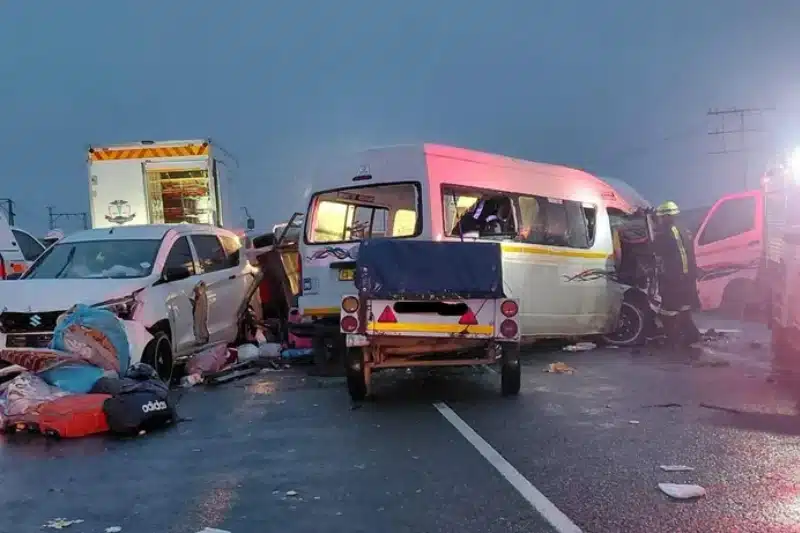

Twenty-one people set off on a Sunday night journey along South Africa’s N1 and never reached their destination. By Monday morning, the Western Cape crash near Prince Albert had become one of the deadliest road disasters the province has recorded this year.
The collision happened shortly before midnight, close to 11.30pm, on the stretch of highway between Prince Albert and Leeu-Gamka, roughly 380 kilometres east of Cape Town. Two Toyota minibus taxis met head-on. A Suzuki station wagon, unable to avoid the wreckage, ploughed into one of the taxis moments later.
Western Cape police spokesperson Warrant Officer Christopher Spies said eighteen people were declared dead at the scene. Three more died after being rushed to hospital, taking the toll to 21. At least four others were left with serious injuries.
The cause of the Western Cape crash has not yet been established. Police say an investigation is under way, and no arrests have been announced.
What makes this Western Cape crash harder to absorb is that it did not happen in isolation. Less than 24 hours earlier, eight people, including two children, died when a Toyota and a Volkswagen collided head-on on the N17 near Ermelo, in Mpumalanga. Two separate provinces, two devastating crashes, one brutal weekend. Together, they claimed 29 lives.
Government has responded with the language it reaches for after every such tragedy. Acting Government Spokesperson Nomonde Mnukwa extended condolences to the families of those who died and wished the injured a full recovery. Emergency services, law enforcement and provincial traffic authorities remain on site, working to clear the highway and support grieving families.
But condolences arrive against a backdrop that South Africans know too well. The timing is no accident of scheduling either. Both crashes fell just before the Heritage Day long weekend, a period when traffic volumes typically surge as families travel to celebrate. Officials had already been urging motorists to observe speed limits, avoid reckless overtaking, stay sober behind the wheel and buckle up before the Western Cape crash and its Mpumalanga counterpart renewed concerns about road safety.
The numbers behind the headline are stark. South Africa records a road death rate of around 24.5 per 100,000 people, well above the global average of roughly 15. Minibus taxis, the backbone of daily transport for millions of commuters who have no other affordable option, are disproportionately represented in the country’s worst crashes. In January, two separate minibus taxi collisions killed at least 25 people, 14 of them children.
There is a contradiction sitting at the heart of the Western Cape crash story. Earlier in the year, Transport Minister Barbara Creecy pointed to an 18 percent drop in Easter road fatalities, crediting intensified enforcement, hundreds of roadblocks and hundreds of thousands of vehicle checks.
Progress, on paper, was real. Yet a single weekend in September has undone much of that optimism, a reminder that enforcement campaigns tend to work only for as long as the roadblocks stay up.
Investigators will now try to establish what forced two loaded taxis into each other’s path on an open highway in the dead of night. Fatigue, speed, poor visibility and reckless overtaking are the usual suspects on South Africa’s long-distance routes. According to South African transport authorities, more than 80 percent of road crashes are linked to driver behaviour rather than road conditions.
For now, families affected by the Western Cape crash and the Mpumalanga collision are left with funerals to plan rather than answers. The N1 will reopen, the traffic will resume, and somewhere down the same stretch of tarmac, another taxi will pull away from a rank carrying passengers who trust it will get them home.
That trust, this weekend, was the real casualty.


