



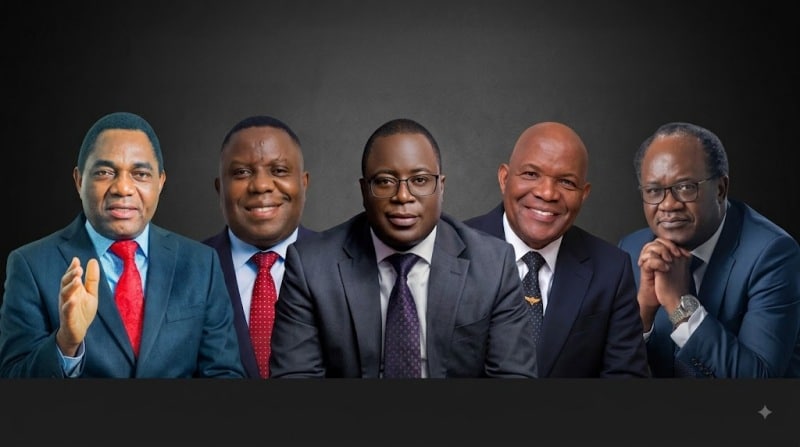

Zambians go to the polls on Thursday in a Zambia general election that will test President Hakainde Hichilema’s economic record. He faces a fragmented but energised opposition.
The Electoral Commission of Zambia cleared fourteen presidential candidates to contest the vote on 13 August 2026. It is the first Zambia general election held under the Constitutional Amendment Act No. 13 of 2025.
More than 8.7 million people are registered to vote, and the majority are women, the Electoral Commission of Zambia says. Roughly 4 million of them are aged between 18 and 35. Their frustration with unemployment and the cost of living has become the loudest theme of this Zambia general election.
Hichilema leads the United Party for National Development. He is seeking a second term on a platform built around debt restructuring, single-digit inflation targets and mass recruitment into the civil service and security services. His strongest challenger in the election is Brian Mundubile of the National Reconciliation Party for Unity and Prosperity. Mundubile has drawn support from a coalition of opposition figures under the Tonse-Pamodzi Alliance, including Given Lubinda and Harry Kalaba.
The contest matters well beyond Lusaka. Zambia is one of Africa’s most consistent democracies. It has managed three peaceful transfers of power since 1991. It also navigated two smooth successions after the deaths of sitting presidents in 2008 and 2014, according to the Africa Center for Strategic Studies. Whether that record holds through this Zambia general election, shadowed by unresolved grief and mining money, is the question observers are watching closely.
Hichilema inherited an economy in default back in 2021. The kwacha had lost half its value, and inflation was running above 20%, the Africa Center notes. His government has since restructured Zambia’s debt under the G20 Common Framework. The World Bank projects growth of roughly 6% for 2025 and 2026, driven by services, manufacturing and new mining investment.
Yet the recovery has not reached most households ahead of Thursday’s vote. Inflation was still running at 9.4% in January 2026, above the central bank’s single-digit target. More than 70% of Zambians live on less than three dollars a day, World Bank figures cited by AllAfrica show. Food prices, unreliable electricity and thin job opportunities remain the daily reality for most voters, regardless of the improved picture in Lusaka’s official statistics.
Unemployment, particularly among the young, sits at the centre of every manifesto in this Zambia general election. Official youth unemployment was measured at 9.89% in 2024. That figure understates the scale of underemployment in Zambia’s informal economy, where most young workers scrape a living without steady wages. The NRPUP manifesto leans heavily on this frustration and promises disciplined service delivery in place of empty promises. The UPND points instead to civil service and military recruitment drives as proof of its own record on jobs.
Electricity access has become a related grievance ahead of the national poll. Around 72% of citizens reported having no or irregular power supply in 2024, according to the Institute for Security Studies. The burden falls hardest on small businesses and the young entrepreneurs the government says it wants to support.
No issue has embarrassed the Zambian state quite like the unburied remains of former president Edgar Lungu. Lungu died in a South African hospital on 5 June 2025 following cardiac complications. His body has remained in a South African funeral home ever since, caught in a bitter legal fight between his family and the Zambian government.
Hichilema’s administration wanted a state funeral in Lusaka. It argued that a former head of state belongs among his predecessors at Zambia’s presidential burial site. Lungu’s family resisted. They said the former president did not want his old rival anywhere near his funeral. South Africa’s Supreme Court of Appeal sided with the family in June 2026, overturning an earlier High Court order that had favoured repatriation.
More than a year after his death, Lungu remains unburied, and the saga has bled directly into this Zambia general election. Mundubile has told campaign rallies that a dignified burial will only happen once his party forms the next government. His critics call the promise opportunistic.
Some former Lungu allies, including Resolute Party leader Martin Phiri, have cited the prolonged delay as a reason for abandoning the opposition and backing Hichilema instead. Most ordinary Zambians, however, have told local broadcasters that the funeral saga will not decide their vote, insisting the country’s focus has shifted to development and governance.
Copper remains Zambia’s economic backbone. It accounts for roughly 72% of export earnings and close to half of government revenue. That dependence has pulled mining companies directly into the politics of this Zambia general election. First Quantum Minerals, Barrick Gold, Vedanta Resources and KoBold Metals all operate major Copperbelt assets. Each has benefited from Hichilema’s investor-friendly reforms since 2021.
First Quantum Minerals has faced the sharpest scrutiny. An investigation by the campaign group Global Witness alleged the Canadian miner has bankrolled Hichilema’s party for two decades. It claimed the company pledged up to 50 million US dollars towards the UPND’s 2026 campaign.
A former ZCCM-IH official said a related royalty deal was pushed through at a rate close to what First Quantum itself had proposed. Both First Quantum and the Zambian government have rejected the allegations as unsubstantiated. Pro-government outlets have dismissed the report as foreign interference timed to influence the Zambia general election.
Vedanta Resources, which controls Konkola Copper Mines, has its own fraught history with the state, and that history has resurfaced in campaign debate around the presidential race. The government tried to place the company into liquidation in 2019. That dispute has since eased as Vedanta resumed investment. It remains a reminder of how quickly Lusaka’s relationship with foreign miners can sour when politics and copper revenue collide.
For opposition parties, the closeness between mining capital and the ruling party has become a ready-made line of attack. They have struggled, though, to offer a fully costed alternative. Whether that argument lands with voters is unclear. So is whether the incumbent’s economic stabilisation record will prevail. Both questions will only be settled once the Electoral Commission of Zambia begins releasing results after polls close on Thursday evening.
What is certain is that this Zambia general election is being decided less by ideology than by lived experience. It comes down to the price of mealie meal, the reliability of the grid, and the availability of jobs for the young. It also comes down to a grieving nation still waiting to bury a former president it cannot agree how to mourn.


