



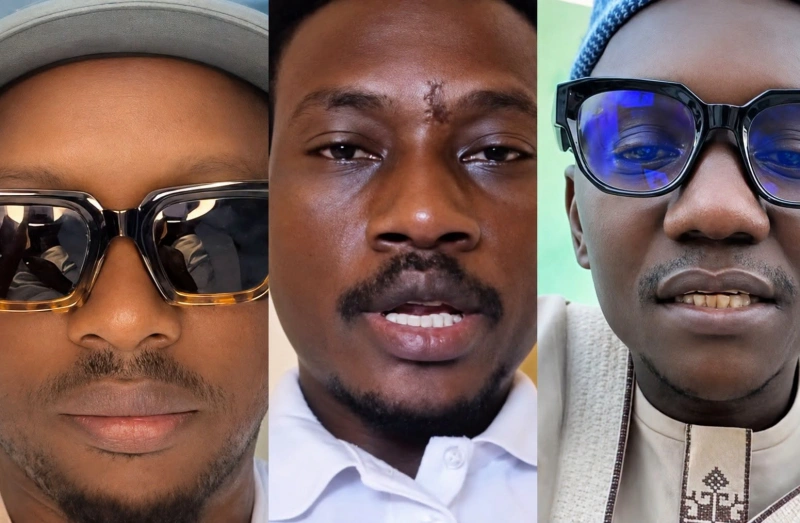

A Dakar court has jailed three pro-government commentators for insulting the president, in a ruling that exposes a widening split inside Senegal’s ruling party.
The Tribunal des Flagrants Délits in Dakar delivered its verdict on Wednesday, 5 August. Judges found three presenters from the online outlet Feeñal Digital guilty of insulting the president under Article 254 of the Penal Code, alongside a charge of statements contrary to public morals.
This is the latest case in Senegal to test how far the law on insulting the president can reach, even inside the ruling coalition itself.
Mandoumbé Diop, who broadcasts as Lamignou Darou, received three months in prison. His co-defendants, Maguèye Diaw and Moustapha Ndiaye, known on air as Oustaz Thiep and Ndiaye Touba, were each handed two months. All three were also fined 500,000 CFA francs, roughly $870, according to Senegalese outlet SeneNews.
The case stemmed from a TikTok video posted in late July. In it, the trio offered prayers calling for misfortune and death upon, in their words, “the one who betrayed the Pastef project.” No name was mentioned on screen. Prosecutors and investigators nonetheless concluded the target was President Bassirou Diomaye Faye, who rode Pastef’s momentum into office in March 2024.
Officers from the Division Spéciale de Cybersécurité, Senegal’s cybercrime police unit, arrested the three men inside the Feeñal Digital newsroom on 27 July, as reported by Senego. They were remanded in custody on 30 July before facing trial.
At the hearing, the defendants argued the recording was a private joke shared between friends, never meant for public consumption or aimed at any official. The prosecution rejected that defence, telling the court there was little doubt about who the remarks targeted, per coverage from SenTV.
Defence lawyer Aby Nar Ndiaye said he was disappointed with the outcome and maintained that nothing in the case file supported a finding of insulting the president against his clients. He confirmed plans to appeal, meaning Wednesday’s ruling is not final and could still be overturned on review.
Notably, the sentences handed down were lighter than what prosecutors had sought. The state had asked for a year, with six months to be served, against Lamignou Darou, and three months against his co-defendants, according to reporting carried by allAfrica via RFI. Lamignou Darou had also faced a previous conviction in October on related facts.
What makes this case unusual is that it is not opposition figures clashing with the state. All three men identify as militants within Pastef, the movement founded by former tax inspector Ousmane Sonko. Their anger, as prosecutors read it, was directed inward at the party’s own leadership, which makes a conviction for insulting the president unusual in this context.
That internal rift has been building for months. President Faye dismissed Sonko as prime minister on 22 May, citing a need to avoid excessive personalisation within the party.
Four days later, on 26 May, Pastef lawmakers elected Sonko speaker of the National Assembly. That effectively created a rival centre of power within the same movement. Sonko was subsequently re-elected party leader in June.
Article 254 of Senegal’s Penal Code is the provision behind the charge of insulting the president. It carries a maximum penalty of two years in prison plus a fine.
Rights groups in the country have long pushed for its repeal. They argue it is a relic from an earlier, more repressive era of governance, one that predates the current administration’s promises of political rupture.
By recent standards, Wednesday’s sentences were unusually harsh. In comparable prosecutions cited by RFI, a trader and an activist each received one month in custody out of six-month sentences that were largely suspended. This time, the court imposed straight custodial terms with no suspension.
Senegal’s press freedom record has been uneven. Reporters Without Borders ranked the country 49th globally in 2021, before it slid to 94th in 2024 amid internet shutdowns and broadcaster suspensions.
It climbed back to 74th in 2025, then eased slightly to 78th out of 180 nations in the 2026 index. That suggests recovery has stalled rather than reversed outright.
For now, the appeal is the next milestone to watch. This case has already drawn attention well beyond Senegal, given that the insulting the president charges were brought against government loyalists rather than opposition critics.
It will show whether Senegal’s higher courts treat the offence of insulting the president as a tool still fit for use, or as an inherited relic increasingly out of step with a government that came to power promising a cleaner break from the past.


