



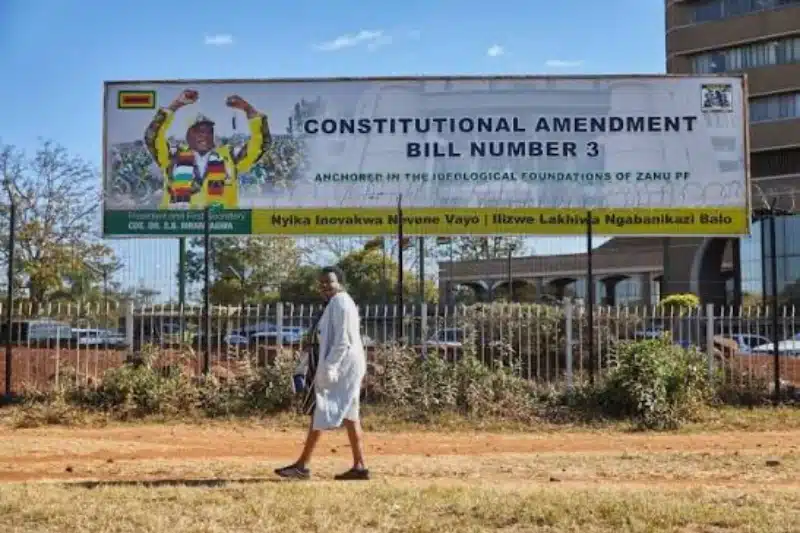

Zimbabwe constitutional amendments have plunged the country into fresh political and legal turmoil, days after President Emmerson Mnangagwa signed the changes into law. The Constitution of Zimbabwe Amendment Act No. 3, gazetted as Act No. 6 of 2026, overhauls how the president is chosen and how long elected officials serve.
Mnangagwa assented to the bill on 7 July, according to a special government gazette confirmed by presidential spokesperson Nick Mangwana. The National Assembly had approved the changes by 226 votes to 41 on 30 June, after the Senate passed the bill 75 votes to four on 24 June. Zanu PF and its allies dominate both chambers.
At the centre of the Zimbabwe constitutional amendments is a shift from five year to seven year terms for the president and parliament. Mnangagwa’s second and final term, previously due to end in 2028, now runs until 2030. Elections that voters had expected in 2028 have effectively been pushed back by two years.
A more far reaching change scraps direct presidential elections, a system Zimbabwe adopted in 1987. Under the new section 92, MPs and senators sitting jointly will elect the president after each general election or whenever a vacancy occurs. A candidate needs more than half the votes cast by lawmakers to win, with a run off between the top two contenders if nobody secures a majority on the first ballot. The Zimbabwe Electoral Commission will still administer that vote, even though its powers have shrunk elsewhere.
The amendments also strip ZEC of long standing functions. A new section 43A moves responsibility for voter registration and the voters roll to the Registrar General. A separate provision creates a Delimitation Commission, appointed by the president, to take over the redrawing of electoral boundaries from ZEC. The Senate expands from 80 to 90 members, with ten new seats filled through presidential appointment.
Justice minister Ziyambi Ziyambi defended the Zimbabwe constitutional amendments in parliament, arguing that five year cycles had proved too short for national development work and that longer terms would reduce political instability. Government officials say the changes will support policy continuity and give investors more certainty.
Opposition parties and civil society groups reject that defence. The Movement for Democratic Change, led by Douglas Mwonzora, filed an urgent application at the Constitutional Court on 9 July seeking to have the Zimbabwe constitutional amendments declared unconstitutional. The party argues Mnangagwa was obliged to hold a national referendum before signing the bill, since the changes touch the Bill of Rights and directly benefit the sitting president. As an alternative, the MDC wants the court to order a referendum within three months.
A broader coalition, now calling itself the Constitutional Restoration Movement, has also instructed lawyers to challenge the Zimbabwe constitutional amendments before the Constitutional Court. Convened by Reverend Kupukwashe Mtata, the coalition brings together churches, labour unions, students, war veterans and opposition figures including Tendai Biti and Jameson Timba. Beyond litigation, it has begun consultations ahead of nationwide peaceful mass action, alongside public meetings, petitions and prayer gatherings.
Human rights lawyer Doug Coltart has warned that the new provisions could let lawmakers keep renewing a president’s mandate without ever returning to the electorate. Biti has described the changes as shifting power to a small elite, while former opposition legislator Fadzayi Mahere called the enactment a dark moment for Zimbabwean democracy.
The coalition has appealed to the Southern African Development Community and the African Union to support its campaign for what it terms constitutional restoration. No formal SADC statement on the Zimbabwe constitutional amendments has yet been issued. South Africa currently holds the interim SADC chairmanship, a role Mnangagwa handed over in stages after Zimbabwe’s own tenure ended in 2025.
Human Rights Watch has also weighed in, noting that international human rights law does not fix the length of presidential terms but does require genuine periodic elections that reflect voters’ will. The organisation linked the Zimbabwe constitutional amendments to wider concerns about repression during the legislative process.
Six war veterans had earlier tried to block the Zimbabwe constitutional amendments at the Constitutional Court before the bill was enacted, but that challenge was dismissed in June, clearing the way for the final parliamentary votes.
With the Zimbabwe constitutional amendments now law, attention shifts to the Constitutional Court, where the MDC and the Constitutional Restoration Movement both hope judges will force a referendum or nullify the changes outright. Civic mobilisation is also expected to intensify in the coming weeks, though organisers have not yet set a date for nationwide action.


