




Somaliland’s decades-long push for statehood has taken its boldest turn yet, following Israel’s recognition of Somaliland and the decision to establish an embassy in Jerusalem. The breakaway region, which split from Somalia in 1991, is preparing to open its first embassy anywhere in the world. The location is Jerusalem.
The move follows Israel’s recognition of Somaliland as an independent and sovereign state. Israeli Prime Minister Benjamin Netanyahu announced the decision on 26 December 2025, making Israel the first United Nations member state to take such a step, according to UN Security Council records published by the UN’s press office.
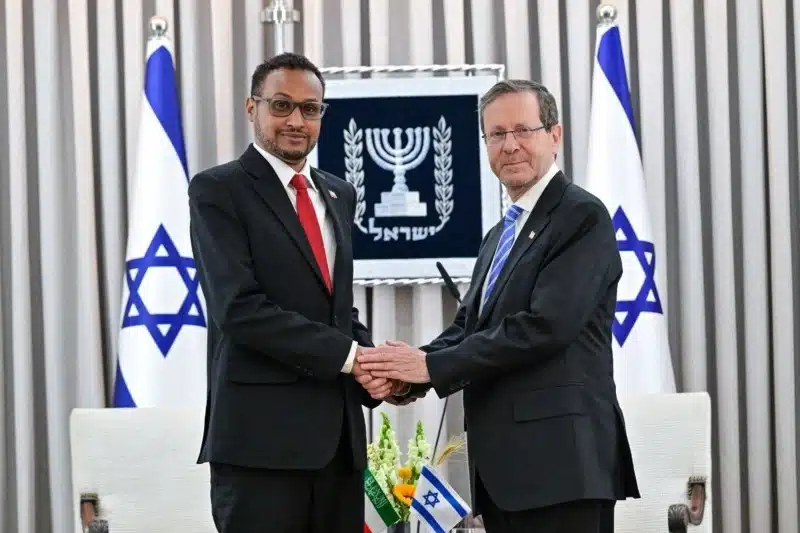
President Abdirahman Mohamed Abdullahi arrived in Israel on Sunday for his first official state visit since taking power. He was accompanied by First Lady Fardowsa Mohamed Roble and a senior delegation, the Jerusalem Post reported. He met President Isaac Herzog in Jerusalem on 14 June, with the embassy opening expected to follow on Monday, according to Middle East Monitor.
The diplomatic relationship has moved quickly. Israeli Foreign Minister Gideon Saar visited Hargeisa on 6 January, where he met Abdullahi at the presidential palace. The two leaders had already crossed paths in Davos earlier that month, the Jerusalem Post noted.
In February, Somaliland named Dr Mohamed Hagi as its first ambassador to Israel. Israel responded in April by appointing Michael Lotem as its non-resident ambassador to Somaliland. Herzog formally accepted Hagi’s credentials on 18 May, paving the way for the embassy announcement two days later.
Hagi confirmed the embassy’s Jerusalem location in a statement on X, describing it as a reflection of “growing friendship, mutual respect and strategic cooperation” between the two nations, according to Al Jazeera. Israel is expected to open its own mission in Hargeisa in return.
Somaliland will become the eighth country with an embassy in Jerusalem, joining the United States, Guatemala, Honduras, Kosovo, Papua New Guinea, Paraguay and Fiji, according to the Times of Israel. Kosovo remains the only other Muslim-majority state to take this step, Middle East Eye reported.
Geography explains much of the thinking behind Israel’s recognition of Somaliland and its growing engagement with Hargeisa. Somaliland sits across the Gulf of Aden from Yemen, where Iran-backed Houthi rebels have repeatedly targeted shipping and launched attacks on Israel since November 2023.
A ceasefire in Gaza in October 2025 brought a pause to those attacks, but the strategic value of a friendly foothold near the Red Sea corridor has not diminished, according to the Times of Israel.
Middle East Eye also reported that, in exchange for Israel’s recognition of Somaliland, the territory agreed to sign up to the Abraham Accords, the framework that previously brought Morocco, Bahrain and the United Arab Emirates into formal relations with Israel.
For Somaliland, the symbolism runs deep. The territory operates its own currency, passport, army and electoral system, yet has spent more than thirty years without formal recognition from any UN member state. Crowds gathered in Hargeisa to celebrate when Israel’s recognition of Somaliland was first announced, with billboards reportedly hinting at the news in the days beforehand.
The reaction elsewhere has been sharply different. Somalia’s federal government called the move a “deliberate attack” on its sovereignty, with Prime Minister Hamza Abdi Barre’s office warning it could “exacerbate political and security tensions” across the Horn of Africa, the Red Sea, the Gulf of Aden and the wider Middle East.
The African Union Commission, chaired by Mahmoud Ali Youssouf, rejected Israel’s recognition of Somaliland outright. The AU said the move ran counter to its founding principles and risked “setting a dangerous precedent with far-reaching implications for peace and stability across the continent.
That concern about precedent is shared widely. Analysts have noted that other separatist movements across Africa could point to Israel’s recognition of Somaliland as a template, regardless of the very different circumstances behind each case.
The UN Security Council held an emergency session on the matter on 29 December 2025. Member states, including Somalia’s regional allies, echoed the AU’s position and called for dialogue based on the 2023 Djibouti Communiqué between Mogadishu and Hargeisa.
More than twenty countries, alongside the Organisation of Islamic Cooperation, warned in December that the recognition could destabilise the region. Egypt’s foreign minister held calls with counterparts in Somalia, Turkey and Djibouti to coordinate a rejection of the move. Saudi Arabia and the European Union issued similar statements backing Somalia’s territorial integrity.
Al-Shabaab, the al-Qaeda-linked militant group active in Somalia, used the recognition to threaten further violence, vowing to “fight” any attempt by Israel to gain influence in Somaliland.
Whether Israel’s recognition of Somaliland becomes the breakthrough Hargeisa has waited decades for, or remains an isolated diplomatic experiment, may depend on what happens next. No other government has followed Israel’s lead so far.
For now, Somaliland has its embassy, its ambassador, and a seat at the table in Jerusalem. What it still lacks is broader international support for Israel’s recognition of Somaliland and the wider diplomatic acceptance that has eluded it since 1991.


