



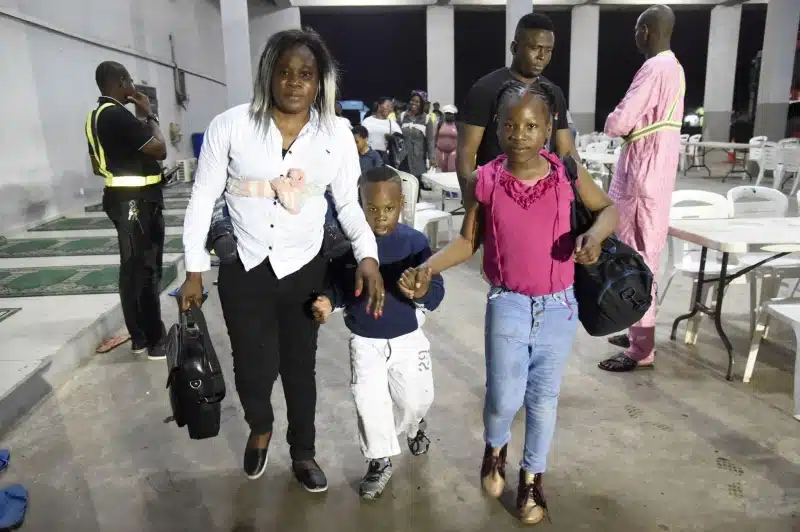

Nigeria has done a commendable thing. As South Africa descended once again into the all-too-familiar cycle of chants, ultimatums, harassment, looting, and the killing of fellow Africans – our government moved. Planes were dispatched, officials were deployed, and citizens were brought home. It was the right thing to do, and it deserves to be said plainly.
But as I watched the footage from the Nigerian High Commission in Pretoria – the lines of exhausted faces, the mothers clutching their daughters, the students who had built lives brick by careful brick in a country that suddenly turned on them – a familiar pang settled in my stomach. Not just sorrow for what they endured in South Africa. Something more uncomfortable. Something closer to home – the question of Igbophobia in Nigeria.
I am an Igbo man. I was born near the end of the Nigerian Civil War, close enough that the smoke had barely cleared from memory by the time I arrived in the world. I grew up on the stories – mothers who buried food under fermenting cassava to hide it from soldiers, children who learned hunger as their first language, communities that had to rebuild themselves from rubble. These were not tales from history books. They were handed to me warm, at dining tables, in whispers, the way you pass something fragile between careful hands.
So when I watch videos of Nigerians in South Africa describing what happened to them, I listen with two sets of ears. One is tuned to South Africa. The other is tuned to what I can only describe as Igbophobia in Nigeria.
What We Saw in South Africa
One of those voices that stayed with me belonged to a young man named Fola, 21 years old, standing outside the High Commission with the bewildered calm of someone still processing a betrayal. He told the interviewer that he had come to South Africa at age four. He said – and I have thought about this line since – “I speak better Zulu than many South Africans.” And still, riding in an Uber one day, he overheard the driver speaking freely about why foreigners must go, the driver perhaps assuming from Fola’s accent, his ease with the language, that he was one of them.
That is the particular cruelty of belonging-that-isn’t. You learn the language. You build. You contribute. You raise children. And then the mob reminds you that none of it was ever enough, because the thing they are reacting to was never about crime or economics – it was always about identity, about who is considered to truly belong. It is a logic that is not unfamiliar to anyone who has studied Igbophobia in Nigeria.
A mother I saw interviewed spoke of being stopped on roads by ordinary citizens. Harassed. Sometimes beaten. Her daughter, born in South Africa, a South African by every moral and legal right, sitting beside her as she described it. Then she said something that stopped me: her husband had been killed. She said it with the flat steadiness of a woman who has already used up her tears and was now simply reporting a fact to the world. Her daughter sat there, now fatherless on foreign soil that was also, by every right, her soil.
There is no statute of limitation on belonging in the eyes of a nativist. Being born somewhere does not protect you if your name, your face, or your accent marks you as other. A man can be killed for what he is, not for what he has done.
That last sentence I have heard before. Not from across a border. My mother told it to me.
She told us about a deadline, a date by which they were expected to be gone. Their own June 30, if I may call it that. They could not depart before the deadline expired.
When the day came, the women and children were sent to a quarters occupied by Europeans, seeking refuge in the shadow of colonial architecture because there was nowhere else that felt safe. And the men, our fathers, did something that still shakes me when I think of it: they got themselves drunk and lay down in front of their own homes. They lay down and waited to be killed. They made themselves easy to find. They slept on their own doorsteps as a kind of surrender, or perhaps a kind of defiance, as though to say: if you are coming, here we are. We will not make you search for us.
By grace, the day passed without incident. But a man who has lain down in front of his own home and waited for morning does not forget it. And neither do his children.
The Echo at Home: Igbophobia in Nigeria
Igbophobia in Nigeria is not a new phenomenon. It is, in fact, the term that academia has reached for to name what many Ndi Igbo have experienced in various forms since before independence – a range of hostile attitudes, discrimination, and episodic violence directed at the Igbo people when they live and work outside the South East. Scholars have documented it. Journalists have written about it. Most Igbo people living in Lagos have felt it, even if they have learned the peculiar art of swallowing it quietly and returning to work.
But in recent years, the whispers have gotten louder. What is increasingly described as Igbophobia in Nigeria has begun to surface more openly in political and civic spaces.
In 2015, a prominent traditional ruler in Lagos reportedly threatened that if the Igbo did not vote for his preferred candidate, he would see to it that they were driven into the Lagos lagoon. He said it. The lagoon remark was reported widely. And the world largely moved on, because such things, apparently, are not serious enough to disrupt the traffic of Nigerian politics.
During the 2023 elections, the pattern sharpened. Igbo voters in Lagos were warned that there would be “dire consequences” if they voted their conscience. On election day, a party operative was captured on video making threats inside a polling station, in front of law enforcement, with the kind of brazenness that only comes when one is confident there will be no consequences. A key figure in the APC presidential campaign declared openly: “Let 2023 be the last time of Igbo interference in Lagos politics.” He was later elevated to a position in the presidential advisory structure.
Then came 2024, and the hashtag that said what the whispers had always meant: #IgboMustGo. A social media account issued a formal ultimatum – all South-East indigenes were given thirty days to vacate Lagos and the entire South-West or face “massive protests.” The post went viral. Tension rippled through Igbo communities across Lagos. Governor Sanwo-Olu to his credit condemned it swiftly, calling it “reckless, divisive, and dangerous rhetoric,” and both the Lagos State government and the Nigerian Presidency moved to distance themselves.
President Tinubu warned that the law would catch up with the promoters. The condemnations were welcome and necessary. But we should note what they were also: familiar. The South African government has condemned xenophobic violence repeatedly over the years, in 2008, in 2015, in 2019, and again now. Official statements were issued. Investigations were promised. And then the conditions that produced the violence were left largely undisturbed, until the next eruption. Condemnations without structural reckoning are not remedies. They are pauses.
But a condemnation is not the same as a confrontation. A hashtag does not arise from nowhere.
The Property Question
There is another dimension to this story that receives less attention than it deserves, precisely because it is dressed in the respectable language of planning laws and regulatory compliance.
In February 2025, trading plazas belonging to Igbo businessmen at Ebute Ero Market in Lagos were demolished by agents of the Lagos State government. The Association of Igbo Town Unions – ASITU – condemned what they described as a “systematic demolition of lawfully acquired properties.” Their statement noted something important: the buildings being destroyed were not illegally built. They were constructed with approvals from the very government now masterminding their demolition. The same government had, in many cases, collected taxes on these properties for years – sometimes for two decades.
ASITU was so aggrieved by the failure of domestic institutions to respond that they petitioned the United Nations Human Rights Council and the African Commission on Human and Peoples’ Rights. When citizens of a country must appeal to international bodies to protect them from the actions of a state government within their own nation, something has broken that political speeches cannot fix.
The Igbo National Union-Worldwide echoed this alarm, warning that the Lagos State government appeared to be pursuing a deliberate script to ruin Igbo businesses and send their owners home “empty-handed.”
Now sit with that phrase for a moment: send them home empty-handed.
Where have we heard that logic before?
The Mirror
In South Africa, the justification for xenophobic violence is always the same: they take our jobs, they commit crime, they do not belong here. The ills of foreigners are exaggerated, curated, and amplified, until the exaggeration becomes the justification for whatever evil is chosen. Young Fola, who speaks better Zulu than his attackers, is still a foreigner. The child born on South African soil to a Nigerian mother is still a foreigner. Because the category was never really about documentation. It was always about belonging, which is to say, it was always about power.
Igbophobia in Nigeria follows its own local grammar, but the underlying logic is the same. They are accused of taking the land. Not metaphorically, but literally, of buying property, of establishing markets, of settling in numbers large enough to make some people nervous. The Yoruba lay claim to Lagos as ancestral homeland, a narrative that casts every non-Yoruba resident, and the Igbo in particular, as a settler who is merely tolerated. The economic footprint of the Igbo, their visibility in commerce, their tendency to build where they arrive, is reframed not as contribution but as encroachment. Success itself becomes the offence.
The logic that operates in South Africa – identity as threat, presence as provocation, prosperity as theft – is not foreign to Nigerian soil. Igbophobia in Nigeria operates by the same grammar, applied from within. When you exaggerate the crimes of a group to justify their expulsion. When you demolish their property under planning laws that are mysteriously applied selectively. When you threaten to drown them in a lagoon for voting.
When you warn them that the last election was the “last time” they would dare to interfere. When you issue them a thirty-day notice to leave the city their taxes help build, you are doing the same thing. The accent is different. The lagoon is not the Limpopo. But the architecture of the hostility is identical. This is where Igbophobia in Nigeria mirrors xenophobia abroad most clearly.
The Whisper in the Corner
This is not, as I said, a popular conversation. Few subjects make Nigerians as uncomfortable as a frank discussion of Igbophobia in Nigeria. It is the kind of thing spoken in corners – at dinner tables in Igbo homes, huddled inside a shop at Alaba, Aspamda, or Ladipo.
It is spoken carefully, because to say it loudly is to be accused of divisiveness, of tribalism, of not being a good Nigerian. The accusation lands hardest on those who have invested the most in the idea of Nigeria – who have built in Lagos, married across ethnic lines, sent children to federal schools, and kept believing that the republic belongs to all of its citizens equally.
It is an uncomfortable irony: the people most vulnerable to accusations of separatism are often the ones who have made the deepest peace with the idea of a united Nigeria.
The Question I Cannot Stop Asking
As I watch the repatriation flights arrive, I think about the Igbo men and women among the returnees. Those who may now need to decide where to settle. Those who, like Nigerians in South Africa, had built lives somewhere outside their region of origin, only to find that belonging is always provisional.
I am tempted – and I will be honest about this temptation, even though I know it will sound harsh – to tell every Igbo returnee: do not be in a hurry to settle outside your region. Not because Lagos does not belong to you. It does. Every square kilometre of this republic belongs to every Nigerian equally under the law. Not because you should be afraid. But because the pattern of what has happened in the last decade deserves to be taken seriously by the people most at risk from it.
I do not say this to encourage retreat. I say it because the lesson of the South African tragedy – and indeed the lesson of our own history – is that hostility rarely announces its final destination. It travels incrementally. It normalises itself between incidents. People are stunned each time, as though the previous incident was not a rehearsal.
And another election is around the corner.
So the questions I find myself sitting with are these: will people be allowed to vote according to their consciences, irrespective of where they live and where they do business? Will ballots be smashed and burnt again if the mob decides that the majority voted for a candidate they do not approve of? Will homes and businesses be targeted once more if the result does not go their way? Will a person be chased from a polling station, or worse, simply for looking like the wrong tribe in the wrong city?
These are not hypothetical questions. They are questions with recent answers, and those answers are not reassuring.
Our elders told us stories. Some of those stories have rhymes that echo today.
What Nigeria Must Reckon With
Nigeria cannot credibly condemn what happened to its citizens in South Africa while refusing to confront Igbophobia in Nigeria at home. The state cannot deplore the #IgboMustGo ultimatum in one breath and in the next allow the machinery of a state government to selectively demolish the properties of people of a specific ethnic group using laws that are not applied uniformly.
The Igbo are not asking for special treatment. They are asking for the ordinary treatment that the Constitution guarantees. The right to live anywhere in Nigeria. The right to vote. The right to own property and have it protected. The right not to be profiled, threatened, or expelled for the audacity of prospering in a city they helped build.
These are not radical demands. They are the minimum requirements for a republic that actually functions as one.
South Africa looked in the mirror and found something it did not like. Nigeria must confront Igbophobia in Nigeria internally if it is to speak credibly about xenophobia abroad. Until that confrontation happens, Igbophobia in Nigeria will remain an unresolved fault line beneath every national conversation about belonging.
That is where the uncomfortable truth lives. Not across the Limpopo. Here. At home.
The author is an Igbo Nigerian writer and commentator.


Very apt and expository! Kudos.