



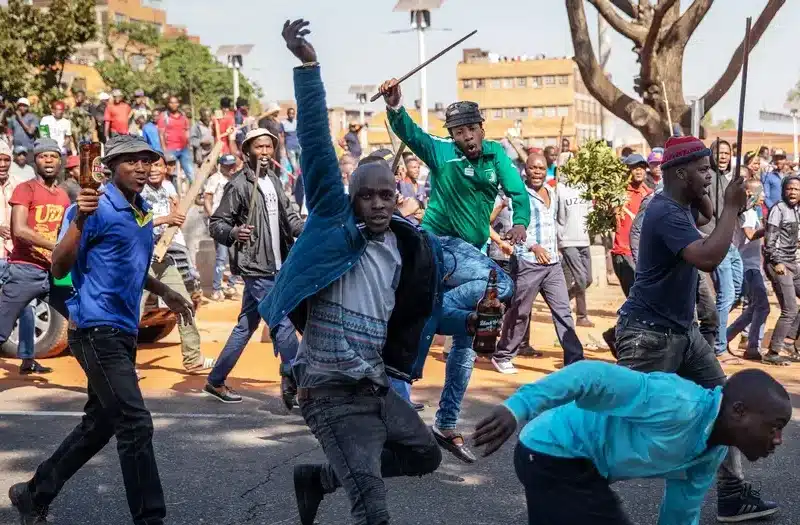

Organised groups are mobilising across Gauteng from 27 to 29 April, demanding the mass removal of migrants. Nigerian associations have issued urgent safety directives as police go on high alert.
AfricanQuarters South Africa | 27 April 2026
SAFETY DIRECTIVE: THE NIGERIAN CITIZENS ASSOCIATION SOUTH AFRICA (NICASA) AND THE NIGERIANS IN DIASPORA COMMISSION (NIDCOM) ARE ADVISING NIGERIAN NATIONALS IN GAUTENG TO STAY INDOORS, CLOSE THEIR BUSINESSES AND AVOID CENTRAL BUSINESS DISTRICTS UNTIL AT LEAST 29 APRIL 2026.
Across Gauteng, as South Africa anti-foreigner protests intensify, foreign nationals are shutting their shops, staying behind locked doors and tracking every update they can find. The instruction from their community leaders is blunt: do not go out unless you absolutely must.
The warning comes as coordinated South Africa anti-foreigner protests are set to sweep through the country’s economic heartland between 27 and 29 April 2026, with credible intelligence pointing to a high probability of violence.
Who is behind the protests
The demonstrations are not spontaneous. Two organised groups, “Concerned Citizens and Voters of SA” and “March and March”, have been driving the mobilisation. Their central demand is the mass repatriation of all foreign nationals in South Africa, whether documented or undocumented.
Their messaging has hardened in recent weeks. Organisers have framed migrants as a drain on healthcare and education, a driver of unemployment and, in language that analysts say crosses a dangerous threshold, even a cause of what they describe as a looming “civil war”.
That last phrase signals a shift from grievance to existential framing, which historically correlates with a higher risk of violence.
When protest movements begin reaching for that kind of language, the risk of actual violence against targeted communities tends to rise sharply.
What to expect as South Africa anti-foreigner protests unfold
Security analysts tracking the South Africa anti-foreigner protests expect marches to concentrate in central business districts, transport hubs and densely populated migrant areas. The tactics anticipated include forced business closures, intimidation of traders and opportunistic looting.
The shops most likely to be hit are the ones that cannot hide what they are: foreign-owned stalls and small groceries that have become fixtures in township streets and inner-city blocks. It happened that way in 2008. It happened again in 2015 and 2019. The businesses that get looted first are the ones migrants built from nothing, and rebuilding after each cycle gets harder.
Community leaders have flagged the CBDs, the busy commuter corridors and the high-density neighbourhoods where migrants tend to cluster as the areas to avoid entirely for the next three days.
Durban had already seen looting before the week was out. East London reported localised clashes. Cape Town recorded protest activity. By the time the Gauteng mobilisation got under way, it was already clear this was not one city’s problem.
The South Africa anti-foreigner protests this week are running across provinces simultaneously, which is what separates this moment from the more familiar local flare-ups that communities have learned to ride out.
Not just Gauteng: a nationwide pattern
What is unfolding in Gauteng sits within a broader national escalation. In the week before these protests were scheduled, Durban reported looting and clashes, East London saw localised unrest and protest activity was recorded in Cape Town.
The spread across provinces points to a synchronised rise in anti-foreigner sentiment rather than isolated, local grievances. Community leaders warn that the Gauteng protests may be a test run for something larger.
Calls are already circulating for a nationwide shutdown on 4 May 2026, a development that suggests the current wave of South Africa anti-foreigner protests could escalate well beyond what is planned for this week.
Elections, politics and dangerous rhetoric
With local government elections approaching later in 2026, migration has become a reliable political flashpoint. Parties and movements including ActionSA, Operation Dudula and the Patriotic Alliance have amplified anti-immigration rhetoric, putting sustained pressure on the government while, critics argue, indirectly emboldening the kind of vigilante-style mobilisation now being planned on the streets.
The concern among human rights observers is that political messaging of this kind creates a bridge between campaign rhetoric and street-level enforcement by civilian groups.
Official response and diplomatic engagement
The South African Police Service has been placed on high alert ahead of the protests. At the diplomatic level, Bianca Odumegwu-Ojukwu of NiDCOM is reported to be in active discussions with South African authorities over the security of Nigerian nationals in the country.
Despite that engagement, community leaders are advising foreign nationals not to rely solely on the security response. The guidance reflects a low level of confidence in rapid containment, based on how previous outbreaks of South Africa anti-foreigner protests were handled.
A cycle with deep roots
South Africa’s recurring xenophobic violence is not simply a product of bad actors. It sits on top of structural fault lines that successive governments have failed to address: chronic unemployment, deep inequality in urban centres, an overstretched public services system and the persistent political habit of scapegoating migrants when those pressures boil over.
These pressures mirror broader global migration dynamics, as outlined in frameworks on international mobility and displacement.
Gauteng, as the country’s economic and commercial hub, sits at the centre of that cycle. Economic stress rises, anti-foreigner rhetoric fills the vacuum, organised protests emerge and the violence that follows tends to land hardest on the informal migrant economies that form the backbone of many township communities.
For the hundreds of thousands of foreign nationals living and working across Gauteng, that cycle is not an abstraction. It is the rhythm of their lives in South Africa, and this week, it is spinning again.
What NICASA and NiDCOM are advising right now
- Stay indoors unless movement is absolutely necessary
- Close businesses through 29 April if possible
- Avoid CBDs and all known protest routes
- Do not engage or confront protesters under any circumstances
- Monitor verified news channels and trusted community networks


