



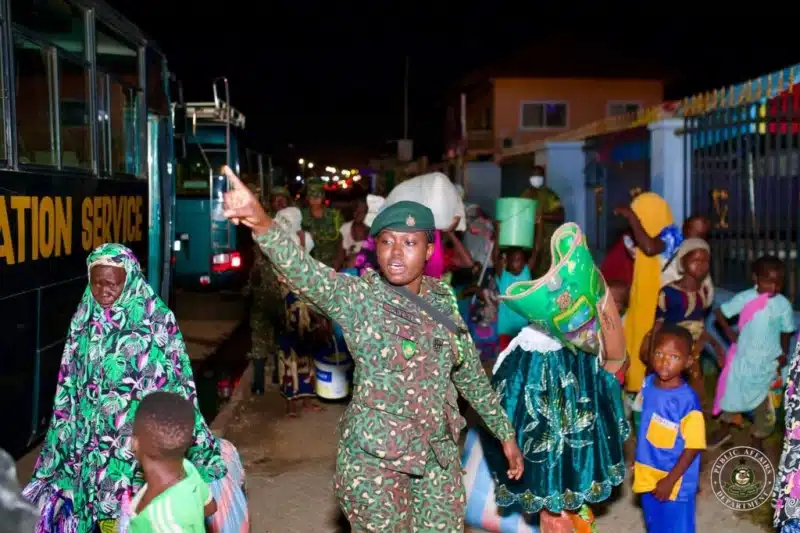

More than a third of those freed from Ghana human trafficking are children. Officials say the operation has lifted the lid on a structured criminal economy and pointed to the failures that allow it to thrive.
AfricanQuarters | ACCRA | 16 APRIL 2026
On the morning of 15 April 2026, immigration officers fanned out across four of Accra’s most congested districts and began pulling children from the roadside. By the time the operation concluded, the Ghana Immigration Service had freed 305 people, including 113 children, from what authorities describe as one of the most visible and yet least disrupted forms of modern slavery operating in the sub-region today.
The second phase of what the Ghana Immigration Service described as an intelligence-led crackdown swept through Nima, Madina, Kaneshie and Abossey Okai. These are not obscure corners of the capital. They are among its busiest trading zones, home to thousands of daily commuters and informal vendors. That visibility, authorities say, is precisely why traffickers chose them.
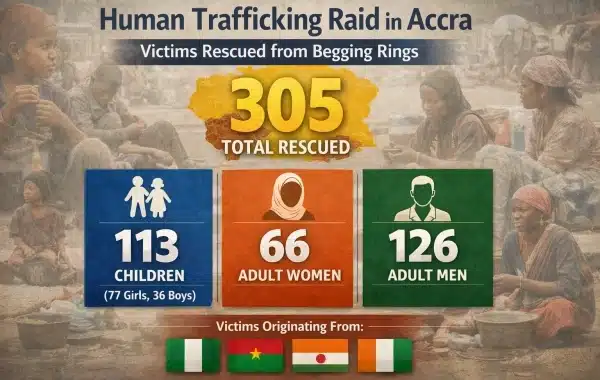
The scale of Ghana human trafficking uncovered in this single operation has alarmed officials. Of the 113 minors recovered, 77 were girls and 36 were boys. Many are believed to be foreign nationals. Investigators have pointed to likely origins in Nigeria, Burkina Faso, Niger and Côte d’Ivoire, though profiling of victims was still ongoing at the time of writing.
A Criminal Franchise, Not Informal Poverty
What the Ghana Immigration Service described after the raids challenges a widespread assumption: that begging in West African cities is an unorganised expression of poverty.
Investigators say the networks they dismantled operate with a clearly defined chain of command. Recruiters identify vulnerable families in rural and cross-border communities. Transporters move victims into Ghana. Urban handlers control daily movements and enforce income targets. Financial coordinators collect the proceeds and channel them upward.
Children are placed at the centre of this model deliberately. According to the Ghana Immigration Service, they are targeted because they attract greater public sympathy and therefore generate higher returns.
“Children are particularly targeted because they generate more sympathy and therefore more income, making them central to the business model.
— Ghana Immigration Service, April 2026
The economics that sustain the system are, from a criminal perspective, straightforward and attractive. Forced begging requires minimal start-up investment, generates daily cash, leaves almost no digital trace and conceals itself within the informal economic activity that characterises Accra’s major junctions. For organised crime networks seeking low-risk, high-volume revenue, it functions like a street-level franchise.
How Victims Are Moved and Controlled
Victims arrive in Ghana through what officials describe as the Sahel and northern corridors that feed southward into the capital. Most are recruited on false promises: work, schooling, better living conditions.
Once in Accra, many have their identity documents confiscated and are held in debt bondage. They are forced to work long hours in traffic and public spaces, given limited food and shelter and denied access to education. Psychological pressure to meet daily income quotas is enforced continuously, often through threats against family members who remain at home.
The Law Exists. Convictions Do Not Follow.
Ghana’s Human Trafficking Act, which Parliament first passed in 2005 and amended in 2009, provides for severe penalties. Yet conviction rates for those who organise these networks at the top remain persistently low.
The gap between legislation and enforcement reflects well-documented structural failures: insufficient shelter capacity for rescued victims, resource constraints within enforcement agencies and slow prosecution of high-level organisers who stay insulated from street-level operations.
Why The Borders Stay Open To Traffickers
The Economic Community of West African States free movement protocol was designed to promote regional economic integration. It has succeeded in doing so. But the Ghana Immigration Service and regional analysts have noted that the same protocol has inadvertently reduced scrutiny at border crossings, giving traffickers a relatively permeable set of borders through which to move victims.
Traditional cultural practices compound the problem. Informal fosterage arrangements, in which families send children to live with relatives or wealthier community members in the expectation of better opportunities, are increasingly exploited by recruiters as cover for trafficking operations.
Ghana sits at the intersection of several trafficking routes, functioning as both a destination and a transit country. The patterns identified in Ghana human trafficking are not unique to it. Similar networks built around forced begging and child exploitation have been documented across the sub-region, suggesting a model that is adaptive and expanding rather than localised.
What Happens To Those Rescued
Following the raids, those freed were transferred to an immigration processing centre. The Ghana Immigration Service is profiling them in coordination with the Ministry of Gender, Children and Social Protection and international partners. That process will determine nationality, age, vulnerability status and, eventually, reintegration pathways.
Reintegration is where previous operations in the Ghana human trafficking space have repeatedly faltered. Victims returned to the same poverty that made them vulnerable in the first place tend to cycle back into the system, sometimes through the same networks that first exploited them.
Without sustained follow-through, each rescue risks being less a solution than a temporary interruption.
A Fraction Of The True Scale
Authorities acknowledged that the 305 people freed this week likely represent only a fraction of those currently held within these networks in the capital alone.
Addressing the structural drivers of Ghana human trafficking, among them extreme poverty, migration pressure, weak cross-border intelligence sharing and inconsistent prosecution, remains the condition under which enforcement gains can be made permanent.
The Accra operation is, by any measure, a significant intervention. Whether it marks the beginning of a sustained regional response or remains a periodic disruption to a resilient criminal economy will depend on what follows it.


