




Nigeria – In the heart of Nigeria’s Southeast, Enugu State has undergone a remarkable transformation since Governor Peter Mbah took office on May 29, 2023. What began as ambitious campaign promises in 2023 has been rapidly materialising into concrete developments that would forever change the face of the Coal City State.
With a bold vision to elevate Enugu’s economy from $4.4 billion to $30 billion, Mbah’s administration has launched ambitious projects in transportation, aviation, tourism, and sports infrastructure, leveraging innovation and sustainability to redefine the Coal City State.
Drawing on verified initiatives, this story chronicles Enugu’s journey over the past two years, showcasing its achievements, ongoing efforts, and the promise of a brighter future.
The most visible symbol of Enugu’s ambition was perhaps Enugu Air, the state’s boldly conceived airline that positioned it among only three Nigerian states with their own carriers. By mid-May 2025, two aircraft already sat proudly at Akanu Ibiam International Airport, with a third scheduled to arrive before month’s end.
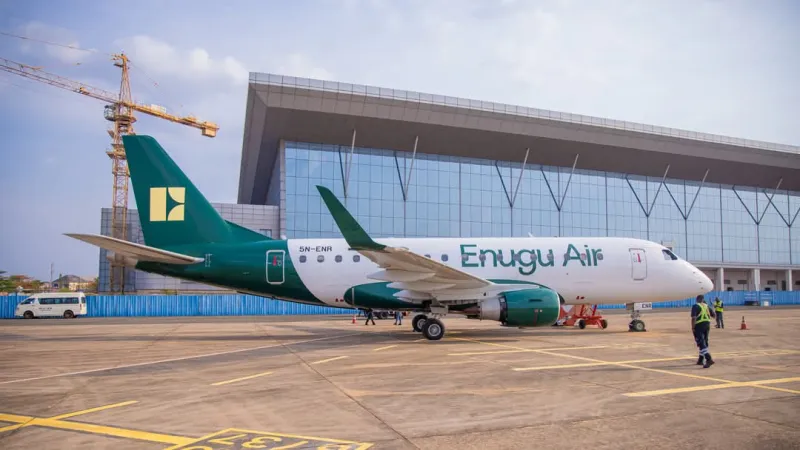
“Our vision is to connect Enugu not just to Nigeria, but to the world,” explained Dr. Obi Ozor, Commissioner for Transportation, during a press briefing. “When Enugu Air launches before our administration’s second anniversary, it will transform business travel throughout the Southeast.”
The N41.13 billion investment had raised eyebrows when first announced in 2023, but seeing the aircraft on Enugu soil silenced many critics. Still, challenges remained – runway issues at Akanu Ibiam International Airport needed resolution before the airline’s full potential could be realised.
On the ground, an equally ambitious transformation was underway. At Okpara Square, a fleet of 50 sleek Compressed Natural Gas (CNG) buses stood in formation, awaiting their commercial debut. Another 50 were en route, part of the administration’s clean energy mass transit program.
“These buses represent not just transportation, but a commitment to environmental sustainability,” Dr. Ozor noted as he inspected the vehicles. “By May 29th, Enugu residents will experience modern, affordable, and eco-friendly public transportation.”
The program hadn’t been without controversy. Traditional commercial drivers had staged protests in March, concerned about being edged out of business. The administration responded by promising integration of willing private operators into the new system.
Supporting the new bus fleet were four ultramodern transport terminals under construction across the state. The twin terminals at Holy Ghost were nearing completion, their modern architecture standing in stark contrast to the old colonial-era structures nearby. Additional terminals at Gariki, Abakpa, and Nsukka were progressing rapidly.
“These aren’t just bus stops,” emphasized a senior government official during a site visit. “They’re economic hubs that will create over 1,000 jobs and transform the commercial landscape of these areas.”
Perhaps the most ambitious aspect of Enugu’s transformation lay in its tourism master plan. The state, blessed with natural wonders but historically underexploited for tourism, had mapped out a comprehensive development strategy.
“Imagine walking on a 600-meter canopy over the ancient Nsude Pyramids, or zipping through the majestic pines of Ngwo Forest,” enthused Dame Ugochi Madueke, Commissioner for Culture and Tourism. “We’re not just preserving these treasures; we’re making them accessible and exciting for global visitors.”
The plan included the development of Awhum Waterfall with boardwalks and canopy walks, a 300-meter zipline at Ngwo Pine Forest, and the imposing Cross of Hope at Okpatu – a 15-floor structure rising 580 meters above sea level with panoramic views of the state.
Other projects included the Akwuke/Atakkwu Waterpark and the prestigious Ovu Lake Golf and Resort. Each site was designed to be self-sufficient with experience centers, food courts, and renewable energy sources.
With the 2026 National Sports Festival (dubbed the Coal City Games) on the horizon, Enugu was also investing heavily in sporting infrastructure. A N10 billion renovation of the iconic Nnamdi Azikiwe Stadium was scheduled to begin in June 2025, along with a N3 billion development of the Awgu Games Village.
“We’re not just hosting games; we’re building a sporting legacy,” declared Barr. Lloyd Ekweremadu, Commissioner for Youth and Sports. “These facilities will nurture the next generation of Nigerian athletes long after the festival concludes.”
The administration’s focus extended beyond physical infrastructure to human capital development. An Animation Lab stood ready for commissioning, representing the state’s entry into the lucrative digital content creation industry.
Most significantly, 2,100 youths who had received specialized training in December 2024 were scheduled for an empowerment program set to launch on International Youth Day, August 12, 2025.
Despite the impressive pace of development, challenges remained. The timeline for completing the sports facilities before the 2026 National Sports Festival was tight. The tourism projects, while well-conceived, were still largely in the planning phase. And the introduction of the CNG buses faced resistance from traditional transport operators.
Yet the momentum was undeniable. In just two years, Enugu State had embarked on transformative projects across transportation, infrastructure, tourism, and youth development – projects that promised to redefine the state’s place in Nigerian affairs.
As Governor Mbah’s administration approached its second anniversary, the question was no longer whether Enugu would change, but how rapidly its metamorphosis into a modern Nigerian hub would continue.

