



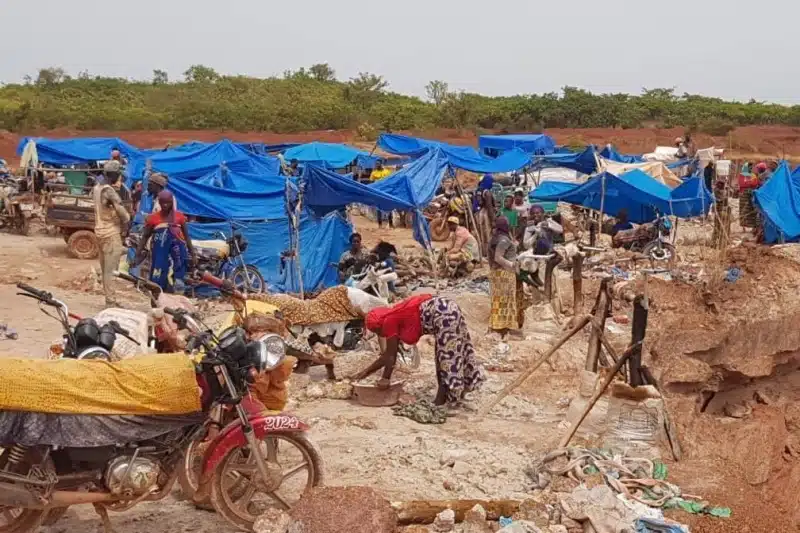

Nine people turned back from Guinea’s gold fields have died in Mali. The latest official count gives no cause of death.
Mali’s crisis coordination centre announced three more deaths on Tuesday 10 November, lifting its toll to nine among expelled gold miners and others sent across the border. It gave no cause, no names and no nationalities.
The expelled gold miners are part of a much bigger crowd. On 7 November, Mali said it had received about 160,000 people since Guinea’s operation began. Around 100,000 were in the Bamako district and 60,000 at the border town of Kouremalé. Bamako called it a “humanitarian emergency”.
It began with a ban. On 2 November, five Guinean ministers signed a joint communiqué ordering a total stop to uncontrolled gold mining in the Siguiri region. They blamed poisoned rivers and ruined farmland. Foreigners without papers would face “procedures provided by law”, the text said. It does not use the word expulsion.
Workers had already started leaving. Security forces moved onto the sites, and by 7 November Guinea’s defence and security ministries reported 1,263 arrests. The detainees were Guinean, Burkinabe, Malian, Togolese, Nigerien, Ivorian and Ghanaian. All were taken to Conakry.
The first convictions have also emerged, although they involve a separate case. Nine defendants appeared before the Dixinn Court of First Instance, where eight foreign nationals received two-year prison sentences and five-year bans from Guinea. The ninth defendant was sentenced to one year for irregular residence after being cleared of the principal mining charges.
Separately, proceedings involving 1,263 people arrested in Siguiri began on 10 November, with 202 defendants appearing before the CRIEF in the first hearing. Another group of minors is expected to face proceedings before a children’s court.
Now put the two sets of numbers side by side. Guinea counts arrests in the thousands. Mali counts arrivals in the hundreds of thousands. The gap between them is where the real story sits. Nobody has shown how many expelled gold miners were forced out and how many simply fled.
Conakry does not frame it that way. In the statements reported so far, it does not describe the people now in Mali as expelled gold miners. It speaks of arrests and legal procedure.
Burkina Faso says force was used against its expelled gold miners. Security minister Mahamadou Sana told reporters in Bamako on 4 November that some of his citizens were hurt, “sometimes by gunfire”. He called the treatment “cruel, inhuman and degrading”. Neither Burkina Faso nor Mali, he said, had been warned. A provisional count puts the Burkinabe affected at more than 8,000.
Guinea’s foreign minister, Morissanda Kouyaté, defended the ban to diplomats on 5 November. “Environmental protection cannot be sacrificed in the name of African brotherhood,” he said, according to AFP. The 2 November communiqué had promised operations in “strict respect for human rights”. No direct reply to the gunfire claim had been reported by 7 November.
Some voices inside the trade add a wrinkle. Dieudonné Francis Thienobego leads the Burkinabe community in Upper Guinea. He told a Guinean news site on 6 November that the measure did not single out one nationality. “Even the nationals are not spared,” he said.
The toll for expelled gold miners is itself disputed. APA reported on 6 November that the community health centre at Kouremalé had recorded four deaths. A Burkina Faso embassy counsellor in Bamako, Ramdé Antoine, put the figure at nine around the same time, though that was never confirmed. Mali’s own count was six on 7 November, then nine on 10 November.
Those figures may not measure the same thing. Sana has tied deaths to the treatment in Guinea, but no government has published a cause for any of them.
None of this came from nowhere. In June, Guinea suspended the Siguiri prefect, the sub-prefects and about 100 environmental officials for failing to enforce limits on destructive machinery. Later that month, President Mamadi Doumbouya banned raw gold exports. Conakry now cites cyanide pollution and the silting of the Niger and Tinkisso rivers.
A state tightening its grip on its gold is one thing. Doing it without warning the neighbours who share the border, and who now host the expelled gold miners, is another.
There is a legal gap too. Mali and Burkina Faso left ECOWAS on 29 January 2025. The bloc asked at the time that visa-free movement for their citizens continue “until further notice”. Reporters have found no text changing that. Whether it reaches the expelled gold miners now riding Malian trucks is unclear.
The trucks keep moving. On Tuesday, Ouagadougou sent 40 buses to carry about 2,400 people home.
Conakry has its arrests, Bamako its arrivals. The expelled gold miners who died have only a number, and for now no cause attached to it.


