



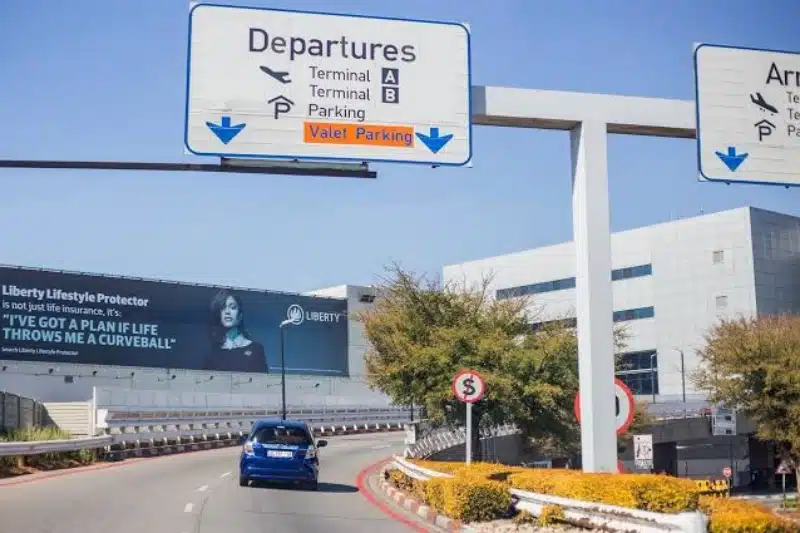

For a year, South Africa has been trying to bring its own citizens home from the war in Ukraine. On Sunday night, it stopped nine foreign nationals from leaving the country, reportedly to travel to Russia
The OR Tambo arrests took place at the airport and at a hotel in Bruma, east of Johannesburg. Hawks spokesperson Colonel Katlego Mogale said the suspects, aged between 20 and 26, were “allegedly preparing to board flights out of the country” when officers moved in.
Police describe the OR Tambo arrests as the result of an intelligence-led operation, with Interpol, SAPS Crime Intelligence and other agencies working alongside the Hawks.
Much is still unknown. Police have not named the suspects or given their nationalities. The BBC reported that none of them lived in South Africa. Police have not said which side the nine meant to fight for, even though the Associated Press reported that they were preparing to board flights to Russia.
The Hawks have also not said whether the nine were recruited, or whether the case links to earlier ones. Until they do, the OR Tambo arrests show who was stopped, but not who was behind it.
The OR Tambo arrests do show the authorities invoking a law designed to prevent South Africans and foreign nationals from participating in prohibited foreign military activity. The nine are expected to face charges under the Regulation of Foreign Military Assistance Act of 1998. According to the AP, the law bans mercenary activity and also reaches foreign nationals acting inside South Africa. A conviction carries a fine, imprisonment or both.
The nine are due at the Kempton Park Magistrates’ Court, although police gave the AP no date for it.
This time, the suspects are not South Africans. The earlier cases were. In November 2025, Duduzile Zuma-Sambudla resigned from Parliament after allegations that she helped lure 17 South African men to fight for Russia with promises of security training. She denied wrongdoing, and the AP reported that she was never formally charged. Pretoria arranged for the men to come home in February.
The AP also reported that radio presenter Nonkululeko Mantula was charged in late 2025 with recruiting four South African men for Russia’s army.
Those cases centred on South Africans allegedly tricked into going. Police have not said whether the nine were tricked, paid or simply willing.
The arrests suggest that OR Tambo may be more than an exit point for South Africans drawn into the war. It may also be a transit point for foreign nationals heading towards it.
Elsewhere on the continent, the pattern is clearer. Kenya’s government said in February that more than 1,000 citizens had been recruited. Zimbabwe said in March that 15 of its citizens had died and that it was seeking the return of 66 others. Information Minister Zhemu Soda said recruits were promised well-paid jobs, then had their travel documents taken and were forced into combat.
A Ukrainian intelligence assessment cited by the BBC puts the number of Africans recruited to fight for Russia at more than 1,700, from 36 countries. The BBC also noted that Ukraine has recruited foreigners too, so the question of which side still matters.
A Code for Africa investigation, cited by the Institute for Security Studies, found 289 websites, domains and social media profiles luring recruits with false promises.
Ghana and Kenya said after the Russia-Africa summit in Moscow in October that they had secured Russian commitments to stop enlisting their citizens. The OR Tambo arrests came ten days later. Promises were made in Moscow. The arrests were made in Johannesburg.
The National Prosecuting Authority has warned before, through spokesperson Bulelwa Makeke, that cases under the Act take time and hinge on the cooperation of other countries. That caution applies here. The OR Tambo arrests are a beginning, not a verdict.
Nine people were stopped before they could leave the country. Who pointed them towards that airport is the question the Hawks have yet to answer.


