



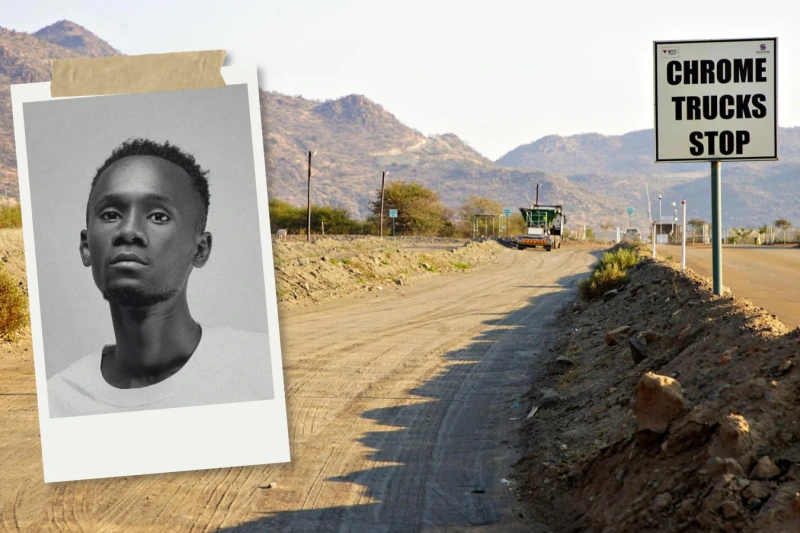

Mano Shottas was still filming when the shooting started.
As Mano Shottas went down, his phone kept streaming. The Committee to Protect Journalists recorded his last words as “Help. I got shot and they keep shooting… I am dying.”
It was 12 December 2024 in Ressano Garcia, a Mozambican town on the border with South Africa. He was 30, a father, and a blogger with tens of thousands of followers.
Almost two years on, a new investigation by Forbidden Stories says the footage Mano Shottas recorded points to the police. No official inquiry has been announced.
Ressano Garcia sits on a trade route that never really sleeps. More than 1,000 trucks a day carry chromium and other minerals from South Africa to the Port of Maputo, less than 100 kilometres away, according to figures a South African expert gave Forbidden Stories.
Residents say the ore pollutes the Komati River. On the day Mano Shottas died, protesters had blocked the road after hearing that the ore trucks were passing through again. André Mulungo of the rights group CDD told CPJ the haulage had been halted two months earlier after locals complained about contaminated water.
The country was already in turmoil. The October 2024 election was disputed, and CPJ’s records put the toll from the crackdown on protests at about 300 deaths by January 2025.
Mano Shottas had spent 18 months covering it all from his phone: protests, local news, even water pollution. A source close to him told Forbidden Stories he was arrested in January 2024 and held in a secret place.
His family, the source said, had to pay 50,000 meticais, about €700, to secure his release.
Forbidden Stories recovered a clip lasting two minutes and 24 seconds and analysed the full live recording. It placed the police between 62 and 90 metres from the blogger.
An acoustics expert, Rob Maher, studied the seven shots heard on the stream. He concluded they were fired towards the microphone from roughly 87 metres away, which matches where the officers stood.
The officers visible in the video do not appear to react to the gunfire that hit Mano Shottas. The investigators interpret this as an indication that the shots may have come from their own ranks.
That is an analysis, not a court finding, and we have not independently verified the acoustic work. Amnesty International, reporting in April 2025 after reviewing videos of the incident, concluded that Mano Shottas posed no imminent threat. It could not establish the intent of the officer who fired.
Accounts differ on how many times Mano Shottas was hit. CPJ, citing his widow, Vânia Tembe, and a protester standing about two metres away, says twice, the second time as he lay on the ground. The protester told CPJ an officer had ordered the blogger to stop filming.
He kept going.
A second video, filmed from another angle after the stream ended, shows him on the ground with officers several dozen metres away. No officer appears to approach him.
A woman who spoke to him by phone, identified only as Isabel, told Forbidden Stories that police would not let anyone reach him. Mano Shottas died hours later.
CPJ reported that police opened fire at the funeral of Mano Shottas on 14 December, killing two mourners and wounding a reporter.
Neither the justice ministry nor the interior ministry answered Forbidden Stories’ questions. The rights group CDD filed a complaint on 30 December 2024 seeking to hold the state civilly liable, and Forbidden Stories says the authorities have stayed silent since.
Forbidden Stories travelled to Komatipoort, on the South African side, to check whether the contamination Mano Shottas protested against was still there. Black and grey patches of coal and chromite ore line the road. The chromite glitters, and the wind carries it towards the Komati River.
The spills follow a pattern. Trucks heading back empty must lift their tarps for inspection at the border, then stop on the roadside to refit them and save fuel. Young men wait there to do the job for 10 rand, about 50 euro cents. Containers often tip over in the process, spilling powder.
AfriForum’s environmental head, Lambert de Klerk, says a February 2024 letter to two government departments in Pretoria demanding urgent action brought back little more than an acknowledgement.
South Africa’s environment department told Forbidden Stories it had issued directives to four trucking companies suspected of illegal dumping along the N4. The case stalled, it said, for lack of evidence, and the dumping happens at night or in the early morning to avoid detection. The mineral resources department did not respond.
Speaking up has a price. A Komatipoort resident who gave officials water and soil analyses says an anonymous caller told her to keep quiet and that they knew who her children were.
A local farmer, who asked not to be named, said men in the haulage trade told him they knew people who could sort out troublemakers.
Then there is the money.
In January 2024, getting Mano Shottas out of detention cost his family about €700. Between January 2025 and May 2026, more than €800 million worth of South African chromite and ferrochrome left the Port of Maputo, according to customs data shared with Forbidden Stories by The Counter, a research service. That is about 2.6 million tonnes.
A purchase document seen by the investigators links chrome from the Sefateng Chrome Mine in Limpopo to that port. The mine did not respond to questions, and the haulage company said it has controls to prevent unauthorised off-loading. The document shows a route. It does not show who dumped what.
Chromium can harm people, animals and crops, depending on its form, and farmers in Komatipoort say they fear for their water and soil. The report does not publish test results showing harmful levels, so that remains a community concern rather than a measured finding.
The death sits inside a wider record. The Mozambique Exposed project, which Forbidden Stories published in June, found no charges had been made public in the cases of four journalists killed, poisoned or missing since 2020, Mano Shottas among them.
“He just wanted a better Mozambique,” Isabel told Forbidden Stories.
The footage exists. The analysis exists. What is still missing is an official willing to answer for the death of Mano Shottas.


