



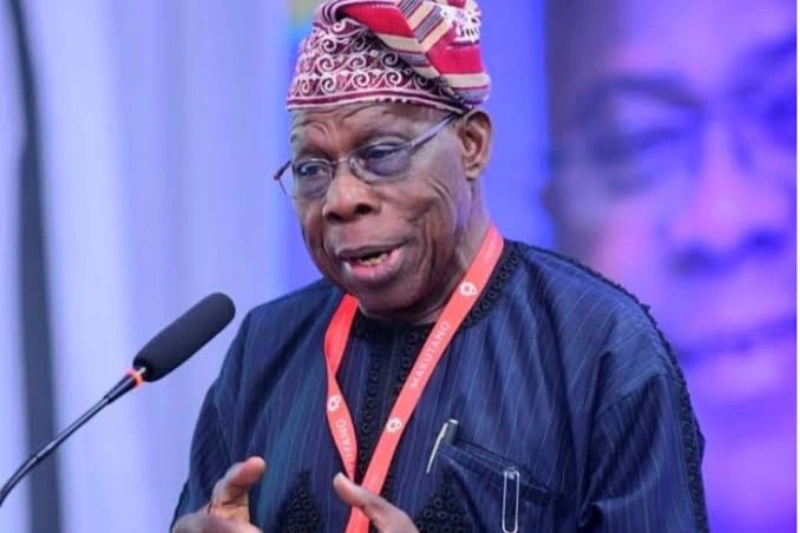

The Obasanjo debt warning came with a comparison few in Abuja will forget. Leprosy, he said, destroys only one person. Debt destroys generations.
Former President Olusegun Obasanjo made the remark on Friday in Abeokuta, Ogun State. The setting was the Ajibosin Platform, a public forum themed on artificial intelligence and grassroots development. His sharpest words, as Vanguard reported from Abeokuta, were about money.
His target was President Bola Tinubu. In April, at the State House in Abuja, Tinubu told Plateau leaders led by Governor Caleb Mutfwang that Nigeria would borrow whenever it had to. “Borrowing is not leprosy,” he said, adding that the task was working hard enough to repay it.
Obasanjo called that position “absolute nonsense”.
The timing gives the Obasanjo debt warning extra weight. On Tuesday, Senate President Godswill Akpabio read a letter from Tinubu asking lawmakers to approve a supplementary external borrowing plan for 2026 and 2027. The request covers $20.52 billion and €1.045 billion.
The letter lists infrastructure, agriculture, health, education, water supply, security and job creation among the beneficiaries. It lands months before the 2027 general election.
Opposition figures had already sounded alarms before the Obasanjo debt warning. Atiku Abubakar, the former vice president and ADC presidential candidate, said in remarks carried by ThisDay that the request vindicated his 12 October warning about a loan plan of up to $20 billion.
The debt that new money would join is already large. Nigeria’s total public debt stood at ₦166.79 trillion on 30 June 2026, according to the Debt Management Office. That is $120.93 billion, up from ₦152.4 trillion a year earlier. In June 2023, a month after Tinubu took office, the same office recorded ₦87.38 trillion.
Those figures give Obasanjo debt warning its edge. Size is not the only issue, though. The International Monetary Fund projects that interest payments by the Federal Government will absorb 53.7 per cent of its revenue in 2026. The figure refers specifically to Federal Government interest payments as a share of Federal Government revenue, not total public revenue.
The IMF’s Nigeria representative, Christian Ebeke, says the country’s debt remains sustainable and the risk of distress moderate. His concern is how little room those payments leave for health, education and security.
Obasanjo speaks with a record behind him. In October 2005, the Paris Club agreed to cancel about $18 billion of Nigeria’s debt, roughly 60 per cent of the $30 billion owed, according to the creditors’ own press release. Nigeria agreed to pay $12.4 billion to clear the rest. Obasanjo was president, and Ngozi Okonjo-Iweala led the delegation as finance minister.
That history shapes how the Obasanjo debt warning will be read. Here is a former president who negotiated Nigeria out of the Paris Club, speaking about a debt pile that has grown again.
The Presidency has defended the administration’s borrowing strategy. In June 2025, Special Adviser to the President on Information and Strategy, Bayo Onanuga, said borrowing was “not a sin”, arguing that the issue was how borrowed funds were used. He also claimed that Nigeria’s debt servicing had fallen from 97 per cent of government revenue to under 60 per cent, “freeing up fiscal space for investment in social services”.
Those figures were the Presidency’s own account of the administration’s fiscal performance. At the time of writing, we had found no public response from the Presidency to the latest Obasanjo debt warning.
Obasanjo also took aim at the naira. When he started his farm 47 years ago, he recalled, one naira bought $1.85. “What have we done?” he asked, putting today’s rate at 1,500 naira to the dollar. The DMO’s June figures imply a rate nearer ₦1,380, but his point about direction stands.
The Senate now holds the next move. Tinubu says the work is in the repaying. Obasanjo says the repaying may fall to children who never signed for the loan. Whatever lawmakers decide, the Obasanjo debt warning has set a plain test for the $20.52 billion: what will it have built when the bill falls due?
Someone will still be paying it long after the speeches are forgotten.


