



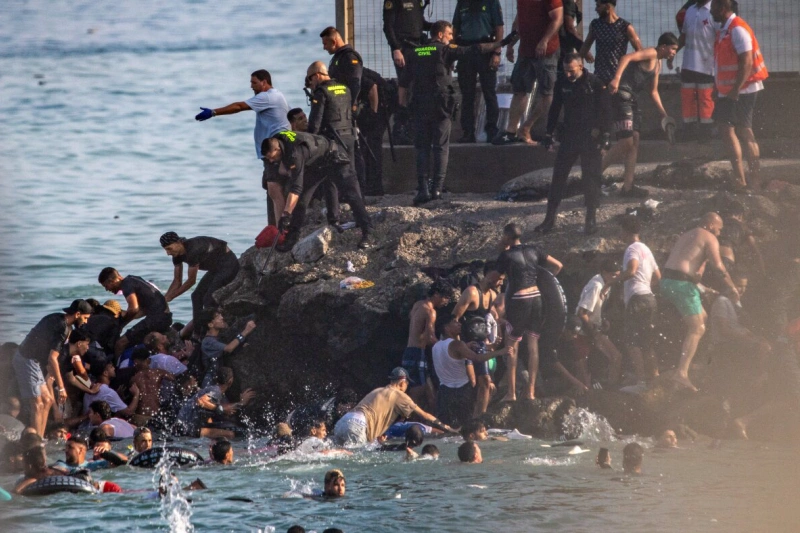

Spain has sent army reinforcements to Ceuta after tens of thousands of people surged across the border from Morocco in a single day, triggering the worst Ceuta migrant crisis the enclave has seen in years.
At least 19 bodies have been pulled from the water, Al Jazeera reported, citing authorities in the North African territory. Many of the dead drowned attempting the swim from the Moroccan coast, while others were killed in a stampede at a breakwater fence near Tarajal beach, according to Rachid Sbihi, who leads a local Civil Guard workers’ association.-
More than 40,000 people may have crossed into the enclave in roughly 24 hours, news agencies reported, citing unnamed police sources. Ceuta’s own population sits at only around 85,000, and the CNN news network described the scale of the rush as having little precedent.
Prime Minister Pedro Sánchez was due to visit Ceuta on Friday morning alongside Interior Minister Fernando Grande-Marlaska. Sánchez said on social media that his government was mobilising all available resources and coordinating closely with Moroccan authorities to restore order.
Sbihi described conditions in the enclave as a serious humanitarian crisis. The Ceuta migrant crisis has left local authorities struggling to provide shelter, food and medical care for thousands of new arrivals, with many wandering the streets without shelter, he told reporters.
Across the frontier in the Moroccan town of Fnideq, security forces deployed water cannon trucks and repeatedly pushed back crowds attempting to approach the crossing gates, Reuters witnesses said. The charred remains of a bus and seven vehicles were left behind after clashes broke out as authorities tried to disperse the crowds.
Spanish state broadcaster TVE reported that between 2,000 and 3,000 people crossed into Ceuta on Thursday alone, with most of those who succeeded doing so before midday. Officials warned that the Ceuta migrant crisis could worsen if nothing urgent is done to stop the surge. Groups continued moving along the coast into Friday morning, seeking routes around the fence, while some prepared to swim despite the reinforced presence.
Ceuta authorities have linked the surge to a recent Spanish Supreme Court ruling that bars officials from summarily returning migrants who arrive by sea without due process. That ruling does not apply to land crossings, such as scaling the border fence. However, activists in Morocco have questioned whether the ruling actually drove the rush, arguing most migrants would have had no knowledge of the court decision.
Spain’s government has also pointed to a separate factor. A regularisation programme launched by Madrid to grant legal status to around 500,000 undocumented migrants drew twice that number in applications, intensifying the up surge in Ceuta migrant crisis, according to Reuters.
The Ceuta migrant crisis has already rattled European capitals. France said it was tightening checks along its border with Spain, while Italian Prime Minister Giorgia Meloni threatened to suspend cooperation with Spain under the EU’s Schengen open-border scheme.
Ceuta and Melilla, Spain’s other North African enclave, remain the European Union’s only land borders with Africa, and both cities regularly experience crossing attempts by migrants seeking passage into Europe. Spain’s Territorial Policy Minister, Angel Víctor Torres, said the government reacted immediately once the surge began and would move to return migrants who entered unlawfully while respecting both court rulings and migrants’ rights.
By Friday, Spanish and Moroccan forces had reinforced the border fence and appeared to have largely halted further mass crossings. However, authorities cautioned that the Ceuta migrant crisis remains fluid and casualty figures could still rise.
This is a developing story and figures may change as authorities complete their assessment of the Ceuta migrant crisis.


