



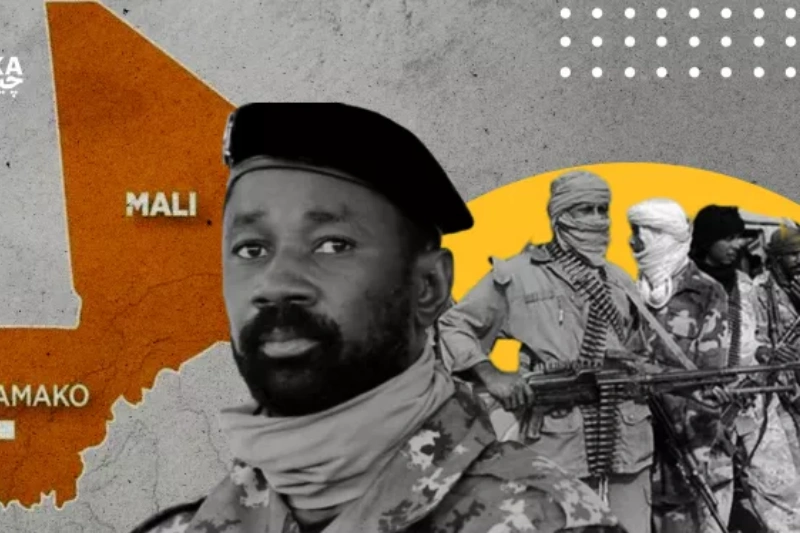

Mali’s government has not responded to reports that Washington is preparing possible US military action in Mali against the al-Qaeda linked group JNIM, despite the story dominating headlines across the Sahel this week.
The Washington Post reported on 22 July that the Trump administration is actively weighing US military action in Mali to target Jama’at Nusrat al-Islam wal-Muslimin, widely known as JNIM. The newspaper cited current and former American officials familiar with internal discussions.
Senior figures within the administration are reportedly split on the proposal. Sebastian Gorka, the National Security Council’s senior director for counterterrorism, is said to be among those pushing hardest for strikes to go ahead.
If approved, this would mark the eighth country where President Donald Trump has ordered strikes since returning to office in January 2025, following Yemen, Somalia, Syria, Iran, Iraq, Nigeria and Venezuela.
The Pentagon declined to comment when approached by the Washington Post. A White House official, asked directly about the prospect of US military action in Mali, neither confirmed nor denied that strikes were being planned. The official instead said Washington was pressing governments across North and West Africa to purchase American equipment and services to support their fight against terrorism, describing the situation as a “multinational problem.”
The State Department gave a similarly guarded response. It said the US “unequivocally condemns the terrorist activity in Mali” and remains committed to promoting regional ownership of the fight against extremist groups.
One administration official went further, placing much of the blame for Mali’s deteriorating security on Russia rather than on the Malian government itself. Moscow, the official argued, has proven an ineffective security partner for Bamako since taking over from French forces.
What has been notably absent throughout the talks over US military action in Mali is any word from Mali. The Washington Post said it reached out to a spokesperson for the Malian government for comment but received no response. Malian outlets including Malijet and Maliweb, which have closely followed the story, report the same silence from official channels in Bamako.
That silence is significant. Mali’s military government, in power since coups in 2020 and 2021, has generally been quick to reject reports it disputes. It suspended two French television channels in November over what it called false coverage of a JNIM fuel blockade, and it rejected a United Nations report on alleged killings in Moura in 2023. No comparable rebuttal has followed this week’s reporting on possible US military action in Mali.
JNIM was designated a foreign terrorist organisation by the United States in 2018. The group, primarily based in Mali, has expanded into Niger and Nigeria and is now estimated to have more than 6,000 fighters. It has carried out a string of high profile attacks this year, including coordinated assaults in late April that struck Bamako’s airport and killed Mali’s defence minister, and an ambush near Gao in early July that killed or captured at least 50 soldiers, some of them Russian personnel from Africa Corps.
Any US military action in Mali would carry serious risk, according to regional analysts. Russian forces have operated alongside the Malian army since Wagner’s successor, Africa Corps, took over security cooperation with Bamako. Analysts have warned that American strikes could raise the possibility of contact between US and Russian forces on Malian soil, requiring the kind of deconfliction arrangements seen in Syria.
Corinne Dufka, an independent expert on the region, told the Washington Post that any US intervention risks a backlash, warning that Washington could be squandering a chance to de-radicalise and demobilise fighters and could instead see JNIM turn its focus toward American targets.
For now, the question of whether the Trump administration will formally authorise US military action in Mali remains unresolved. Officials on both sides of the debate have yet to reach a final decision, and Bamako’s continued silence leaves open how the Malian government intends to respond once one is made.


