



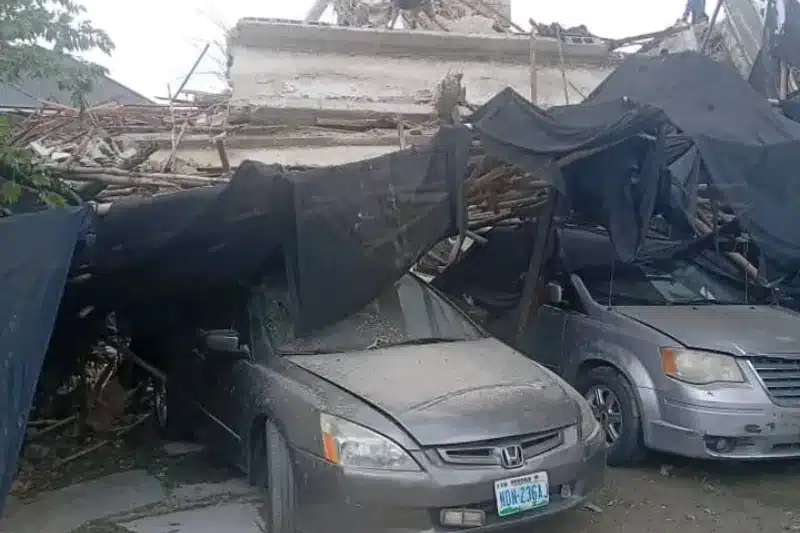

A three-storey building under construction came down on Monday night on Slaughter Street in Rumuolumeni, Obio/Akpor Local Government Area of Rivers State, leaving people trapped in the debris and setting off fresh alarm over construction safety in the region.
The building collapse in Rivers State drew an immediate response from the state government.
The Commissioner for Physical Planning and Urban Development, Amairigha Edward-Hart, sealed the site after leading officials of the ministry to inspect the extent of the damage and assess the possible cause of the collapse.
Speaking after the inspection, Edward-Hart said preliminary findings suggest that the incident may have resulted from the engagement of unqualified engineers, the use of substandard building materials, or a failure by the developers to adhere to the approved building plan.
He stressed the ministry would “intensify monitoring of approved building projects across the state to ensure developers strictly comply with approved building specifications.
Owner Unknown, Approval Unclear
It is yet to be confirmed whether the building had official approval, as the owner of the property has not been identified.
Edward-Hart warned that “anyone found erecting buildings without proper approval will face sanctions in line with the law.” The ministry said it will keep the site under close watch to ensure the developer does not return to resume construction.
The building collapse in Rivers State incident has raised questions on what could have been done either through stricter enforcement of planning regulations or routine inspections to prevent it.
No casualties were recorded, and no worker was on site at the time officials visited.
Engineers Pledge Investigation
The building collapse in Rivers State also drew comment from the professional body overseeing engineers in the country.
The Chairman of the Nigerian Society of Engineers, Belema Ekine, described the incident as unfortunate and said the association will carry out a thorough investigation to determine the cause of the collapse, noting that anyone found culpable will be sanctioned accordingly.
A Familiar Pattern
This building collapse in Rivers State is not an isolated event. The state has recorded multiple such incidents in recent years, with investigations repeatedly pointing to the same problems.
The State Commissioner for Physical Planning and Urban Development has previously said preliminary investigations at past scenes of collapse showed that buildings may have caved in due to the use of substandard materials by developers, with the use of 12mm rods for decking cited as a clear violation of construction standards.
In a separate incident earlier in the year, a three-storey building came down in Iriebe community in Obio-Akpor, with preliminary findings indicating that the structure was being erected in a waterlogged area while substandard materials were used in the construction. An eyewitness named Victor told Daily Trust the sound of that collapse was like a bomb blast, causing widespread panic in the area.
A National Problem
Every building collapse in Rivers State sits within a much wider crisis across Nigeria.
A 2025 report by the Building Collapse Prevention Guild found that over 1,639 persons have been killed in up to 679 building collapse incidents across Nigeria since 1971.
Research published in the Journal of Civil, Construction and Environmental Engineering found that the use of substandard construction materials accounts for 35.38 per cent of building collapse cases in Nigeria, with geotechnical investigation failures the second leading cause at 21.54 per cent.
Experts have linked many of these collapses to developers bypassing the basic professional procedures of getting building plan approval, engaging unqualified builders, and using defective or substandard materials.
The building collapse in Rivers State adds to a growing list that authorities have long promised to bring under control, yet construction sites across the country continue to tell a different story.
Experts point out that building codes and standards exist on paper in Nigeria, but developers routinely bypass approvals, alter designs mid-construction, or swap in inferior materials, largely because monitoring systems are too weak to catch them.
Latest building collapse in Rivers State has renewed public concern about construction oversight and public safety in rapidly expanding communities across Obio/Akpor and neighbouring areas.
Investigations into the Rumuolumeni collapse are ongoing.


