



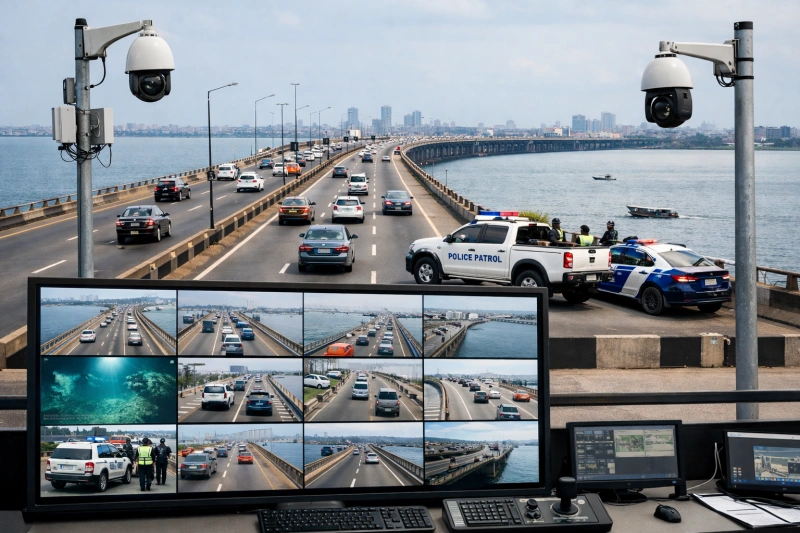

On a humid evening in Lagos, the traffic barely moves. Above the gridlock, fixed to poles and traffic lights, small black domes watch silently. Most passersby hardly notice them anymore. But behind those lenses, something far more complex is unfolding.
What looks like routine city surveillance is, according to a March 2026 report by the Institute of Development Studies and the African Digital Rights Network, part of a much broader system taking shape across African cities.
The study puts spending on AI surveillance in Africa at over $2 billion across 11 countries, prompting closer examination of how this technology is governed. Who is being watched, who is doing the watching, and who, if anyone, is holding them accountable.
A System Imported, Not Invented
The architecture behind AI surveillance in Africa does not originate on the continent. It arrives packaged.
At the centre are Chinese firms such as Huawei, ZTE, and Hikvision, offering what is marketed as the Safe City solution.
Governments are not simply buying cameras. They are entering bundled agreements, often financed through low interest loans tied to Chinese state banks. A single deal can cover hardware, artificial intelligence software, command centres, and long term technical support.
The promise is straightforward. Cities become safer. Traffic flows better. Crime becomes easier to track.
But embedded within that promise is a deeper shift. AI surveillance in Africa is not just observing crime. It is observing people.
And in environments where oversight is limited, that distinction matters.
Cities Under Watch
In Nigeria, the scale of AI surveillance in Africa is difficult to ignore. More than 10,000 cameras, backed by roughly $470 million in investment, now feed into expanding surveillance networks. From Lagos to Abuja, the infrastructure is becoming part of everyday urban life.
Elsewhere, the pattern repeats.
Cairo’s dense districts are mapped through thousands of AI enabled cameras. In Kampala, surveillance systems are integrated directly into policing operations. Nairobi has seen similar systems activated during periods of public unrest.

Across Algeria, Mozambique, Rwanda, and Senegal, AI surveillance in Africa continues to expand quietly and steadily, often without sustained public debate.
Individually, each installation is framed as modernisation. Taken together, they form a continent wide buildout of real time population monitoring systems.
But the speed of AI surveillance in Africa has, in many cases, outpaced the systems meant to regulate it.
When Surveillance Turns Inward
The report’s most unsettling finding is not just where the cameras are, but how AI surveillance in Africa is being used.
There is little evidence that these systems have significantly reduced crime. What they have done instead is expand the ability of states to track movement, identify individuals, and revisit events long after they occur.
In Kenya, surveillance tools were reportedly used to identify protesters during recent youth led demonstrations. In Uganda, similar systems have been linked to monitoring opposition figures. In Mozambique, camera placement has at times mirrored political geography, appearing more concentrated in areas associated with dissent.
None of this is always visible in the moment. The effect is gradual.
A protest ends. Days later, arrests follow.
A journalist moves through the city. Their movements are no longer anonymous.
Over time, awareness of constant observation begins to shape behaviour. People speak less freely. Movements become more cautious.
In such contexts, AI surveillance in Africa does not simply monitor society. It begins to redefine the limits of expression within it.
The Next Wave Is Already Forming
The spread of AI surveillance in Africa is far from over.
Across West Africa, governments are studying early adopters, particularly Nigeria, as a template. For smaller states, the appeal is practical. Surveillance offers the appearance of control in cities expanding faster than institutions can adapt.
The result is a growing queue of countries entering negotiations, exploring pilot programmes, or quietly installing early systems.
China remains the dominant supplier, but it is no longer alone. Other actors are beginning to position themselves in what is becoming an increasingly competitive market.
Yet one pattern is already clear. AI surveillance in Africa is expanding fastest where regulatory frameworks are weakest.
Surveillance and the Question of Governance
What the report ultimately exposes is not just a technological shift, but a governance test tied directly to the expansion of AI surveillance in Africa.
Surveillance itself is not inherently problematic. Around the world, governments deploy similar systems. But in those contexts, their use is typically bounded by law, subject to oversight, and open to challenge.
Across much of this rollout, those guardrails are thin or absent.
That imbalance changes how AI surveillance in Africa functions in practice.
Because surveillance reflects the nature of the state that wields it.
Where institutions are accountable and public trust is strong, surveillance is usually limited in scope and subject to scrutiny. People can question how it is used, challenge it in court, and push for clear limits.
In contrast, where governance is less transparent, AI surveillance in Africa is more likely to expand without clear rules or oversight.
The issue is not just that governments are watching. Many citizens do not know how these systems operate, have little influence over how they are used, and lack clear options when things go wrong.
The Quiet Transformation
Nothing about the rise of AI surveillance in Africa is loud.
It does not happen all at once. There is no clear announcement, no single point when a city can be said to be fully monitored. Instead, it happens incrementally. A camera appears. A control centre is built. Systems are linked and expanded.
Until one day, AI surveillance in Africa is no longer new. It is normal.
And that normalisation may be the most consequential shift of all.
Because beneath the language of smart cities and safer streets, a deeper reality is taking shape.
In the end, what matters is how these systems are used, why they are put in place, and whether those running them answer to the public.


